
题目列表(包括答案和解析)
| Saturday Kids’ Club Kids’ Club starts at 10:30 a.m., with creative activities, followed by the films at 11:30 a.m. For 3 ~ 16 years old. There will be no Kids’ Club on March 5 and March 26.  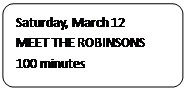
NOTE TO PARENTS: Parents can leave children over eight alone in the cinema. If you leave your children in the cinema, please be there on time to collect them at the end of the film. |
Can you remember a world before the Internet? If you answer is “no,” then you are probably a millennial. Millennials are the new generation of young Americans. They were born between 1982 and 1992. There are 33 million of them, and they are just starting to enter the workforce(劳动力). Many experts believe that millennials are different from young Americans of past generations. They also believe that millenials will change the workforce in important ways.
How are millennials different? They are the first generation born in the computer age. The internet has always been a part of their lives. They spend about 16 hours a week on the Internet, and this doesn’t include e-mail. And they spend 72 hours a week using other electronic media(媒体), including mobile phones and video games. They are “nation speakers” of the language of the computer age. People who were born earlier will never be native speakers of that language. Why not? They did not grow up “speaking” it.
How will millennials change the workforce? To answer that question, it is important to understand how millennials use the Internet. They use the Internet to communicate. They visit website such as FaceBook and MySpace every day. They share(分享)ideas, music, information, games, and friendships with people all over the world. When they start working, they will want to share their work and ideas with others.
It is also important to understand the way millennials grew up. Thair parents and teachers gave them a lot of attention. They taught them that their opinions were valuable(有价值的). As a result, amny millennials are very cinfident. At work, they will expect their co-workers and bosses to listen to their opinions.
Millennials also grew up with a lot of structure in their lives. Many of them went to school from the age of two or three and played on sports teams. At work, they will expect the rules to be clear. They will also expect a strong but fair boss, like a coach on a sports team. They will follow the person in charge (主管) if he or she is fair. But they will not follow an unfair boss. They will also expect their work to be fun and creative, similar to their experience on a sports team.
These are a few of the changes that experts believe millennials will bring to the American workforce. But the world is changing very fast. There will probably be more changes that are difficult to imagine today.
1.According to the first paragraph of the passage, which of the following is NOT true?
A. Millennials belong to a new generation.
B. Millennials were born about ten years ago.
C. Millennials are entering the workforce.
D. Millennials know little about the world before the Internet.
2.Which is the main reason that make the experts believe millennials are different from young Americans of past generations?
A. Millennials can speak a better native language.
B. Millennials grow up with computers and Internet.
C. Millennials use mobile phones and e-mails often. D. Millennials spend long hours playing video games.
3.Why do the millennials experct to share their work and ideas with others?
A. Because they know how to use the Internet to make new friends.
B. Because they understand how to communicate with new friends.
C. Because they grow up sharing ideas, music, information, games, and friendships with others by the Internet.
D. Because the Internet can provide all the information they need.
4.According to the passage, which of the following is NOT true?
A. Millennials grow up with more attention from their parents and teachers.
B. Many millennials are showing more confident than others at work.
C. Many millennials give more valuable opinions to their co-workers and bosses.
D. Many of the millennials have had fun and creative experiences when they are on sports teams.
5. From the passage we know that ______.
A. the number of the millennials had come to 33 million by the end of 1982
B. most of the millennnials learn native computer language in schools.
C. millennials require their bosses to be healthier and the rules clearer at work
D. more changes will probably be brought to the American workforce by millennials
Feeding a crowd of hundreds doesn’t make Kenny Seals-Nutt nervous.
In fact, he thrives in the kitchen. He’s in his perfect place when dicing tomatoes, making salads and baking cakes.
By the time Kenny, 16, reached his third year of high school at Hickory Grove, North Carolina, US, he had become vice president of his school’s cooking club. He also opened his own food company, called Modern Fusion.
Kenny said he developed his love of cooking by watching his mother, and his grandmother, who owned a catering (饮食业) business herself. Kenny helped them both in order to remember their tips: how long to cook chicken so it stays wet, and the right amount of tomatoes to add to a spaghetti dish.
At the age of 5, he cooked his first dish of shrimp and broccoli. Taking it for his school lunch, he warmed it up in the school’s microwave, while the other kids ate their sandwiches.
“I love to eat, and it started to become more fun to cook than to use a microwave,” he said.
Cooking came easy to Kenny, and he enjoyed adding new ingredients into common dishes. “It started with a passion (热情) and I wanted to know more,” he said. He began to watch the Food Network and read chef blogs.
Last summer, Kenny put his skills to the test by working with his grandmother to cater his uncle’s wedding. While she cooked traditional dishes, Kenny wanted to add new to the expected flavors (风味).
Now Kenny spends his weekends catering his own events: weddings, birthday parties, baby showers. Kenny’s dishes are always a hit.
Chef Frederick Mookie Hicks, owner of a catering business, said Kenny’s success comes from his ability to multitask in the kitchen. Hicks said he has asked Kenny to cook with him on jobs three times now, and he presents Kenny as a positive example of a passionate chef to the students in his cooking classes.
“He’s so vigorous (精神饱满的) about cooking that he doesn’t let anything stop him,” Hicks said. “I knew in the first five minutes of working with the kid that he is something special.”
1.How is Kenny different from other students?
A.He opened a cooking club in his high school.
B.He is famous on the Food Network.
C.He owned a food company at 16.
D.He loves to multi-task.
2.What does the underlined word “thrives” probably mean?
A.works energetic B.grows fast
C.learns quickly D.makes progress
3.Which of the following best describes Kenny’s cooking?
A.Traditional. B.Creative.
C.Simple. D.Strange.
4.We can conclude from the article that ______.
A.Kenny proved himself by catering his uncle’s wedding alone
B.Kenny likes to follow his mother’s recipe when cooking
C.Kenny was able to cook his first dish in primary school
D.Kenny’s success in cooking has a lot to do with his family
Feeding a crowd of hundreds doesn’t make Kenny Seals-Nutt nervous.
In fact, he thrives in the kitchen. He’s in his perfect place when dicing tomatoes, making salads and baking cakes.
By the time Kenny, 16, reached his third year of high school at Hickory Grove, North Carolina, US, he had become vice president of his school’s cooking club. He also opened his own food company, called Modern Fusion.
Kenny said he developed his love of cooking by watching his mother, and his grandmother, who owned a catering (饮食业) business herself. Kenny helped them both in order to remember their tips: how long to cook chicken so it stays wet, and the right amount of tomatoes to add to a spaghetti dish.
At the age of 5, he cooked his first dish of shrimp and broccoli. Taking it for his school lunch, he warmed it up in the school’s microwave, while the other kids ate their sandwiches.
“I love to eat, and it started to become more fun to cook than to use a microwave,” he said.
Cooking came easy to Kenny, and he enjoyed adding new ingredients into common dishes. “It started with a passion (热情) and I wanted to know more,” he said. He began to watch the Food Network and read chef blogs.
Last summer, Kenny put his skills to the test by working with his grandmother to cater his uncle’s wedding. While she cooked traditional dishes, Kenny wanted to add new to the expected flavors (风味).
Now Kenny spends his weekends catering his own events: weddings, birthday parties, baby showers. Kenny’s dishes are always a hit.
Chef Frederick Mookie Hicks, owner of a catering business, said Kenny’s success comes from his ability to multitask in the kitchen. Hicks said he has asked Kenny to cook with him on jobs three times now, and he presents Kenny as a positive example of a passionate chef to the students in his cooking classes.
“He’s so vigorous (精神饱满的) about cooking that he doesn’t let anything stop him,” Hicks said. “I knew in the first five minutes of working with the kid that he is something special.”
【小题1】How is Kenny different from other students?
| A.He opened a cooking club in his high school. |
| B.He is famous on the Food Network. |
| C.He owned a food company at 16. |
| D.He loves to multi-task. |
| A.works energetic | B.grows fast |
| C.learns quickly | D.makes progress |
| A.Traditional. | B.Creative. |
| C.Simple. | D.Strange. |
| A.Kenny proved himself by catering his uncle’s wedding alone |
| B.Kenny likes to follow his mother’s recipe when cooking |
| C.Kenny was able to cook his first dish in primary school |
| D.Kenny’s success in cooking has a lot to do with his family |
One day, a boy found the cocoon(茧) of a butterfly and brought it home. A few days later, the boy saw a small ___16___in the cocoon. He sat and watched for several hours as a butterfly struggled to make ___17___body through that little hole. Suddenly it stopped.
So the boy ___18___to help the butterfly, thinking the butterfly might be ___19___. He took a pair of scissors(剪刀) and cut the hole ___20___. The butterfly came out of the cocoon, but it ___21___a little different. It had a weak body and small, thin ___22___. The butterfly didn’t start to fly. In fact, the butterfly spent the rest of its life crawling(爬行) around with a weak body and thin wings. It was never able to fly.
The boy acted with___23___but he didn’t understand why it could be like this. When a butterfly crawl out of the cocoon, it must struggle. The hard work of ___24___out of the cocoon makes the fluid(液体) from the butterfly’s body into its wings. It helps the butterfly be ___25___to fly. If the butterfly never has to squeeze(挤压) itself out of the cocoon, its wings will never get the fluid and it can never fly.
___26___struggles are what we need in our lives. If we lived our lives without any problems, we would never learn or grow. We would not be ___27___ we could have been and we would never fly.
In our lives, pain and suffering is the key to all windows, and sometimes even ___28___ growth, without it, there’s no way of life. We can’t avoid ___29___ or problems. So, next time you are ___30___ a problem or difficulty, remember the butterfly. Struggle a little–then fly!
1.A. hole B. worm C. tail D. snake
2.A. it B. it’s C. itself D. its
3.A. decided B. asked C. showed D. ordered
4.A. afraid B. interested C. surprised D. grateful
5.A. slimmer B. bigger C. shorter D. smaller
6.A. touched B. sounded C. looked D. smelt
7.A. wings B. feet C. eyes D. head
8.A. success B. excitement C. kindness D. humour
9.A. get B. getting C. to get D. got
10.A. ready B. quiet C. glad D. used
11.A. Somewhere B. Something C. Some time D. Sometimes
12.A. as helpful as B. as weak as C. as strong as D. as creative as
13.A. repeats B. recommends C. requires D. represents
14.A. happiness B. difficulties C. pleasure D. hope
15.A. served with B. growing into C. bringing in D. faced with
湖北省互联网违法和不良信息举报平台 | 网上有害信息举报专区 | 电信诈骗举报专区 | 涉历史虚无主义有害信息举报专区 | 涉企侵权举报专区
违法和不良信息举报电话:027-86699610 举报邮箱:58377363@163.com
