
题目列表(包括答案和解析)
| A.外婆家后园的花红柳绿、虫鸣燕舞给儿时的“我”留下深深的印象,为“我”成年后的养花之渴望做了铺垫。 |
| B.作者认为,自己在很长一个人生阶段只长年岁不长心眼,是因为自己连养花种草都做不好。 |
| C.第⑥段叙述黄岳渊先生辞官种花之事,多用四字句和文言词语,既使文章语言凝练典雅,也可借此暗示黄岳渊先生的高雅。 |
| D.文章先从自己种花草的经历谈起,再对照黄岳渊种花草的故事,顿悟出人的一生只能做一件事的道理,由事入理,说理既深刻又形象。 |
听力理解(本大题共30小题,每小题1分,共30分)
A.在下列每小题内,你将听到一个或两个句子并看到供选择的A、B、C三幅图画。找出与你所听句子内容相匹配的图画。
1.
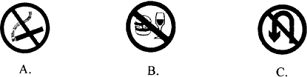
2.
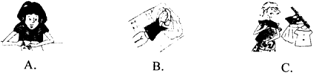
3.
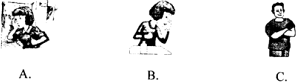
4.
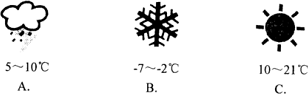
B.在下列每小题内,你将听到一个问句并看到供选择的A、B、C三个答语。找出能回答你所听到的那个问句的最佳选项。
5.A.I’m from Tianjin.
B.Tianjin is a beautiful city.
C.I’m a student.
6.A.It’s white.
B.It’s tall.
C.It’s young.
7.A.You’re welcome.
B.That’s a good idea.
C.Don’t mention it.
8.A.I like the school.
B.The school is far away.
C.I go by bus.
9.A.I was born in a small town.
B.I came here yesterday.
C.I had lunch at home.
10.A.I like holidays.
B.I went to Qingdao.
C.I stayed there for 2 weeks.
11.A.Since 1998.
B.Next year.
C.Last week.
12.A.I’m in Class One.
B.My name’s John.
C.I’m fifteen.
13.A.Her classes are interesting.
B.She is strict.
C.She is 26 years old.
14.A.Yes, go straight ahead.It’s opposite a school.
B.The hotel is very big.
C.People like going there.
C.下面你将听到十组对话,每组对话都有一个问题。根据对话内容,从每组所给的A、B、C三个选项中找出能回答所提问题的最佳选项。
15.What’s Harry’s favourite sport?
A.Football.
B.Table tennis.
C.Basketball.
16.When did the man come to China?
A.In August 1989.
B.In October 1999.
C.In October 2002.
17.Is Betty going to play the piano tomorrow morning?
A.No, she isn’t.
B.Yes, she is.
C.Yes.She likes playing the piano.
18.In Tom’s opinion, what’s the population of Shanghai?
A.10 million.
B.13 million.
C.15 million.
19.Where does the woman want to go?
A.Australia.
B.Africa.
C.Europe.
20.Who gave the man the advice?
A.The woman’s teacher.
B.The man’s pen friend.
C.The woman’s pen friend.
21.What haven’t they got at home?
A.Oranges.
B.Bananas.
C.Apples.
22.How many times has the woman been to the United States?
A.Three times.
B.Four times.
C.Five times.
23.What does Sam do on his birthday?
A.Have a party.
B.Make a cake.
C.Go dancing.
24.When is Charlie’s chemistry lesson?
A.At half past one.
B.At half past two.
C.At half past three.
D.听下面长对话或独白。每段长对话或独白后都有几个问题,从题中所给的A、B、C三个选项中选出最佳选项。
听下面一段材料,回答第25至第27题。
25.Where is Mary now?
A.At school.
B.At home.
C.On the Great Wall.
26.What are the students getting together for?
A.Having a school trip.
B.Having a swim.
C.Having a meeting.
27.Who is writing postcards?
A.Tony.
B.Wang Hui.
C.Lingling.
听下面一段材料,回答第28至第30题。
28.What does David like doing in the evening?
A.Staying at home.
B.Watching television.
C.Going out with his friends.
29.Where does David’s brother work?
A.In a school.
B.In a bank.
C.In a hospital.
30.What’s the difference between the two brothers?
A.The character.
B.The colour of eyes.
C.The colour of hair.
听力理解(本大题共30小题,每小题1分,共30分)
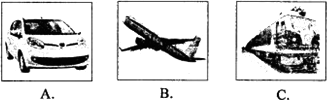
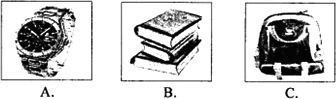
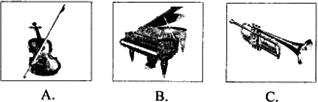
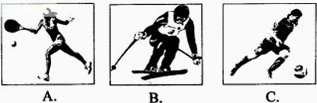
A)在下列每小题内,你将听到一个或两个句子并看到供选择的A、B、C三幅图画。找出与你所听句子内容相匹配的图画。
1.
2.
3.
4.
B)在下列每小题内,你将听到一个问句并看到供选择的A、B、C三个答语。找出能回答你所听到的那个问句的最佳选项。
5.A.It’s Sunday.
B.It’s September.
C.It’s red.
6.A.Yes, I will.
B.Yes, I can.
C.No, I’m not.
7.A.It’s beautiful.
B.It’s big.
C.No, it isn’t.
8.A.He’s better.
B.I’m here.
C.She’s twelve.
9.A.Yes, please.
B.I don’t like orange.
C.It’s cheap.
10.A.She’ s kind.
B.She’s cooking.
C.She’s a teacher.
11.A.To the park.
B.With my dog.
C.I was walking.
12.A.Yes, he is.
B.Once a week.
C.Last night.
13.A.Yes, it is.
B.No, it can’t.
C.It’s new.
14.A.She’s drinking now.
B.She likes dancing.
C.She’s tall with long hair.
C)下面你将听到十组对话,每组对话都有一个问题。根据对话内容,从每组所给的A、B、C三个选项中找出能回答所提问题的最佳选项。
15.What can Mike do?
A.He can ride a bike.
B.He can swim.
C.He can drive a car.
16.How mangy chairs are there in Betty’s classroom?
A.30.
B.45.
C.50.
17.What does the woman want to do?
A.To read some books.
B.To borrow some books.
C.To buy some newspapers.
18.Why didn’t Tom come to school yesterday?
A.His father was ill.
B.He was ill.
C.His mother was ill.
19.What’s the weather like now?
A.Cloudy.
B.Rainy.
C.Snowy.
20.What are they going to make for Jack?
A.A cake.
B.A toy.
C.A model ship.
21.Where is Jerry’s T-shirt?
A.On the bed.
B.On the table.
C.In the living room.
22.What’s the man going to do?
A.To see a film.
B.To hold a party.
C.To have a swim.
23.When will the speakers meet?
A.At 6∶30.
B.At 7∶00.
C.At 7∶30.
24.Where’s the woman from?
A.Australia.
B.Japan.
C.China.
D)听下面长对话或独白。每段长对话或独白后都有几个问题,从题中所给的A、B、C三个选项中选出最佳选项。
听下面一段材料,回答第25至第26题。
25.What’s Lingling doing?
A.Reading a storybook.
B.Listening to music.
C.Watching TV.
26.What’s Peter interested in?
A.Stamps.
B.Movies.
C.Animals.
26.Who will go with Peter?
A.Lingling.
B.Peter’s mother.
C.Peter’s sister.
听下面一段材料,回答第26至第30小题。
26.How were Mr Wang’s classes?
A.Boring.
B.Bad.
C.Interesting.
29.Which of the following is NOT talked about in the passage?
A.Mr Wang visited his students’ home.
B.Mr Wang bought useful books for his students.
C.Mr Wang asked his students to listen carefully in class.
30.What did Mr Wang promise to do in the last class?
A.To see his students soon.
B.To stay with his students.
C.To play with his students.
听力(25分)
(一).听句子(5分)
在每小题内,你将听到一个句子,并看到供你选择的3个单词或短语。每个句子读一遍。请在每小题A、B、C三个选项中选出你所听到的单词或短语。
1.A.lamb
B.name
C.time
2.A.luck
B.leg
C.neck
3.A.sounds
B.sons
C.salad
4.A.word
B.walk
C.work
5.A.how about
B.think about
C.ask about
(二)情景反应:根据你听到的句子选择适当答语。(5分)
6.A.I’m glad.
B.I have a stomachache.
C.I don’t know.
7.A.Once.
B.Once a week.
C.A week.
8.A.Yes, I do.
B.Yes, I can.
C.Yes, I have.
9.A.I’m tired.
B.No, you are tired.
C.Yes, very much.
10.She can’t sleep.
B.He can’t sleep.
C.I can’t sleep.
(三)听句子。
在每小题内,你将听到一个句子,请在每小题A、B、C三个选项中选出1个与你所听到的句子意义最接近的句子。(5分)
11.A.They often go to the movies every day.
B.they often go to the movies once a week.
C.They often go to the movies on Saturdays.
12.A.What’s wrong with you?
B.What’s your name?
C.What meat is in your Pizza?
13.A.Mary and Jim are in the same class.
B.Mary and Jim are not in different grades.
C.Mary and Jim are not in the same grade.
14.A.I am going to Paris.
B.Tom and I are going to Paris.
C.Tom is going to Paris.
15.A.We had a good time in the park last Sunday.
B.We loved the park very much.
C.Last Sunday we were in the park.
(四)对话理解。(5分)
根据你听到的对话内容选择正确答案。
16.A.He has a backache.
B.He has a stomachache.
C.He has an ache in his head.
17.A.Maybe she has a cold.
B.Maybe she has toothache.
C.Maybe she has a fever.
18.A.Coffee and milk.
B.Milk with honey.
C.Tea with honey.
19.A.Once a week.
B.Twice a week.
C.Three times a week.
20.A.Because she is stressed out.
B.Because she is very tired.
C.Because she isn’t feeling very well.
(五)短文理解。
听短文,回答下面问题。(5分)
21.What’s the young man doing by the road?
A.He is drinking something.
B.He is eating something.
C.He is reading something.
22.What does the young man do when he sees the policeman?
A.He says “Hello” to him.
B.He gets up and runs away.
C.He is waiting for him.
23.Why does the policeman run after the young man?
A.Because he thinks the young man is a thief.
B.Because he knows the young man.
C.Because he wants to know who runs faster.
24.Why does the young man run?
A.Because he is afraid of the policeman.
B.Because he likes running.
C.Because the doctor tells him to run after eating.
25.What does the young man look like?
A.He is a thief.
B.He is fat.
C.He is twenty.
湖北省互联网违法和不良信息举报平台 | 网上有害信息举报专区 | 电信诈骗举报专区 | 涉历史虚无主义有害信息举报专区 | 涉企侵权举报专区
违法和不良信息举报电话:027-86699610 举报邮箱:58377363@163.com