A. little B. much C. many 查看更多


题目列表(包括答案和解析)

A desert is a very dry land where there is hardly any rain. In the day, it can be so hot that you could fry an egg on the ground. But during the night it is sometimes so could that water would turn into ice.
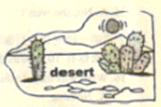
Many desserts are covered in sand. But some have mountains, rocks, or lakes that have dried up in the heat. The Great American Dessert has cliffs(悬崖) that have been made into amazing and beautiful shapes by the wind. The Sahara Desert in Africa is mostly sand. The Australian Desert has red sand.
Sometimes it does not rain for a whole year in the desert. But there is water deep under the ground and some plants have roots that go very deep to find it. Other plants have roots that spread out(延伸) a long way so they can suck up the rain as soon as it falls.
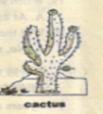
One desert plant is the cactus, which has long, spreading roots. The cactus stores water inside its hard skin. This skin protects it from heat and cold.
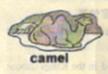
Camels are a bit like cactus plants! They store water too—inside their bodies. They have special fur which protects them from the sun during the day and keeps them warm at night.
Some other animals live in deserts, too. They have to be very good at seeing and hearing because most of them only come out at night. This is why many desert animals have extra big eyes or ears.
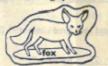
A desert fox has bigger ears than a normal for. A gerbil has huge eye, so that it can see at night. It stays cool in the day by staying underground, like most desert animals.
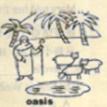
Some people live in the desert but they always make their homes near an oasis. An oasis is where water comes from an underground river. Near an oasis, people can grow lots of plants and keep animals.
Life is hard in the desert, for people, animals and plants. But desert people like to live there.
【小题1】A desert is very dry because__________.
A.it is sandyB.there is so little rain
C.the wind is strongD.there is no water deep under the ground
【小题2】What does the underlined phrase"suck up"in paragraph 3 mean_________?
A.围堵B.讨好C.释放D.吸收
【小题3】Some desert animals have extra big eyes or ears because__________.
A.the sunlight is too strong in the dayB.they need to see and hear well at night
C.it is very cold at nighD.they store water in them.
【小题4】Most desert animals stay cool in the day by_________.
A.storing water in side their bodiesB.drinking water as much as they can
C.staying undergroundD.growing lots of plants
【小题5】Which of the following is true?
A.Desert people like to live in the desert though life is hard.
B.People in the desert usually fry eggs on the ground.
C.Camels have special fur to store water.
D.All the deserts are covered in sand.

查看答案和解析>>


A young girl called Ida in Sweden decided to travel to a place she hadn't seen for 22 years. She had a happy life until some kids asked, "Why don't you look like your mom?" Ida was sent to her adopted(收养) family in Sweden right after she was born.She really didn't know anything about her birthplace, Korea, except for some information she recently heard about her birthparents.
During her schooldays, she was often questioned about her looks. Ida considered herself a normal Swedish person. She tried to be part of the group in her school, but she found it hard. She was still seen as an outsider.
As she grew older, she accepted(接受)who she  was. Still, she
wanted to find the missing piece of the puzzle (困惑). After finding out the place of her birthparents, Ida went to Korea in 2008. When she first arrived, she was surprised to see so many people who looked like her. However, apart from her looks, not much could be shared (分享) with others. She knew little about the culture, food, especially the language. Being in Korea wasn't always easy for her.
Perhaps Ida can never truly fit in either culture, but it's worth visiting her birthplace because she finally realized how special and different she is. She has two loving families, and most of all a better understanding of who she is. This helps her to have a positive view of her life.
【小题1】 Where was Ida born?
A.In Japan.B.In Sweden.C.In England.D.In Korea.
【小题2】Why was she seen as an outsider in Sweden?
A.Because of the culture.B.Because of her looks.
C.Because of the food.D.Because of the language.
【小题3】What does the phrase "apart from" in Paragraph 3 mean?
A.exceptB.as forC.as well asD.besides
【小题4】What can we learn from the passage?
A.Ida hadn't seen her birthparents for at least 22 years.
B.Ida found it easy for her to get used to living in Korea.
C.Ida still couldn't accept who she was after she went back to Sweden.
D.Ida realized she can't live a happy life either in Sweden or in Korea.

查看答案和解析>>


A thousand years ago Hong Kong was covered by a thick forest. As more and more people came to  1  in Hong Kong, these trees were cut down and burnt. Now there is  2  forest left, though there are still some small areas covered with trees. We call these woods.
Elephants, tigers and many  3  animals were living in the thick forest. When people came to live in Hong Kong, the  4  began to die out. Early farmers grew rice and  5  pigs and chickens in the valleys. They cut down the trees and burnt them. They needed  6  to keep themselves warm in winter, to cook their food and to keep away the dangerous animals. Elephants quickly disappeared because there was not enough food for them. So did  7  of the wolves and tigers. Monkeys and many other animals soon  8  in the same way.
You might think that there are no longer any animals in Hong Kong  9  in the zoos. But there are still about 36 different animals  10  there. One of the most interesting of Hong Kong's animals is the barking deer. These are beautiful little animals  11  a rich brown coat and a white patch (补丁) under the tail. They look like deer but they are much smaller. They are less than two feet(英尺)  12 . They make a noise rather like a dog  13 . In Hong Kong the barking deer has only a real enemy-- 14 . People hunt these little animals though it is illegal (违法的). There are now not many barking deer left. So it is important  15  people to protect wild animals.
【小题1】
A.workB.studyC.live    D.enjoy
【小题2】
A.many  B.a fewC.noD.not
【小题3】
A.other   B.others  C.the other D.another
【小题4】
A.people B.animals  C.plants   D.things
【小题5】
A.grew  B.madeC.gotD.kept
【小题6】
A.fire  B.hotness  C.heat   D.stoves(炉子)
【小题7】
A.much  B.a littleC.a lots   D.most
【小题8】
A.lived  B.died  C.came   D.left
【小题9】
A.besidesB.except  C.and  D.or
【小题10】
A.live  B.to live  C.lived D.living
【小题11】
A.haveB.without  C.with   D.get
【小题12】
A.high   B.higher  C.short  D.shorter
【小题13】
A.shouting B.crying  C.barking  D.talking
【小题14】
A.tigers B.men  C.wolvesD.elephants
【小题15】
A.to   B.for  C.like    D.of

查看答案和解析>>

A thousand years ago Hong Kong was covered by a thick forest. As more and more people came to  31  in Hong Kong, these trees were cut down and burnt. Now there is 32  forest left, though there are still some small areas covered with trees. We call these woods.
  Elephants, tigers and many 33  animals were living in the thick forest. When people came to live in Hong Kong, the 34  began to die out. Early farmers grew rice and 35  pigs and chickens in the valleys. They cut down the trees and burnt them. They needed 36  to keep themselves warm in winter, to cook their food and to keep away the dangerous animals. Elephants quickly disappeared because there was not enough food for them.  37  did most of the wolves and tigers. Monkeys and many other animals soon 38  in the same way.
  You might think that there are no longer any animals in Hong Kong 39  in the zoos. But there are still about 36 different animals 40  there. One of the most interesting of Hong Kong's animals is the barking deer. These are beautiful little animals 41  a rich brown coat and a white patch (补丁) under the tail. They look like deer but they are much smaller. They are less than two feet 42 . They make a noise rather like a dog 43 . In Hong Kong the barking deer has only a real enemy-- 44 . People hunt these little animals though it is illegal (违法的). There are now not many barking deer left. So it is important 45  people to protect wild animals.

【小题1】
A.work B.study C.live   D.enjoy
【小题2】
A.many B.a few C.no   D.not
【小题3】
A.otherB.others  C.the other D.another
【小题4】
A.peopleB.animals C.plants  D.things
【小题5】
A.grewB.made  C.got  D.kept
【小题6】
A.fireB.hotness C.heat  D.stoves(炉子)
【小题7】
A.so  B.Such  C.As  D.Nor
【小题8】
A.lived B.died(死)C.came  D.left
【小题9】
A.besidesB.except  C.andD.or
【小题10】
A.live B.to live C.livedD.living
【小题11】
A.have B.without C.with  D.get
【小题12】
A.highB.higher  C.shortD.shorter
【小题13】
A.ShoutingB.crying C.barking D.talking
【小题14】
A.tigersB.men C.wolvesD.elephants
【小题15】
A.to  B.for  C.like   D.of

查看答案和解析>>


A young girl called Ida in Sweden decided to travel to a place she hadn't seen for 22 years. She had a happy life until some kids asked, "Why don't you look like your mom?" Ida was sent to her adopted(收养) family in Sweden right after she was born.She really didn't know anything about her birthplace, Korea, except for some information she recently heard about her birthparents.
During her schooldays, she was often questioned about her looks. Ida considered herself a normal Swedish person. She tried to be part of the group in her school, but she found it hard. She was still seen as an outsider.
As she grew older, she accepted(接受)who she  was. Still, she
wanted to find the missing piece of the puzzle (困惑). After finding out the place of her birthparents, Ida went to Korea in 2008. When she first arrived, she was surprised to see so many people who looked like her. However, apart from her looks, not much could be shared (分享) with others. She knew little about the culture, food, especially the language. Being in Korea wasn't always easy for her.
Perhaps Ida can never truly fit in either culture, but it's worth visiting her birthplace because she finally realized how special and different she is. She has two loving families, and most of all a better understanding of who she is. This helps her to have a positive view of her life.
【小题1】 Where was Ida born?

A.In Japan.B.In Sweden.C.In England.D.In Korea.
【小题2】Why was she seen as an outsider in Sweden?
A.Because of the culture.B.Because of her looks.
C.Because of the food.D.Because of the language.
【小题3】What does the phrase "apart from" in Paragraph 3 mean?
A.exceptB.as forC.as well asD.besides
【小题4】What can we learn from the passage?
A.Ida hadn't seen her birthparents for at least 22 years.
B.Ida found it easy for her to get used to living in Korea.
C.Ida still couldn't accept who she was after she went back to Sweden.
D.Ida realized she can't live a happy life either in Sweden or in Korea.

查看答案和解析>>


同步练习册答案