
题目列表(包括答案和解析)
When trouble comes, what do we usually do? We pick up our mobile phones and call for help. That’s easy, right? People with mobile phones often think so. But in an emergency, many people are unable to call for help. Floods and earthquakes come suddenly. Wars can hurt or kill. Successful communication can sometimes mean the difference between life and death.
Meet French NGO Telecoms Sans Frontiers (Telecommunications Without Borders). Its goal is to use mobile communication technology to help people in need. TSF began in 1998. First, they opened their main base in France. Then in 2003, they started another base in Nicaragua. The next year they opened their Thailand base. Now if a disaster hits anywhere in the world, TSF is ready. They can send workers to a disaster area to set up communication systems within 24 hours.
Once TSF arrives at a disaster area, they set up telephone connections and Internet service. They share these services with other international helpers on the scene such as the UN or UNICEF. Mobile communication helps these other volunteers do their jobs better.
TSF also offers three-minute phone calls to local people who need to contact their loved ones. These communications can allow people to get together again after being separated(分开). Often the callers are moved to tears after speaking to a relative found to be still alive. Then the families can decide on a safe course of action for their family members.
Since 1998, TSF has helped thousands of people in many countries. Most of the TSF workers does not get paid with money, but the satisfaction(满足感) of helping others and changing lives is often a great reward.
1. Telecoms Sans Frontiers is ______________________.
A. a mobile phone company from France B. a charity group from France
C. a mobile phone company from Thailand D. a charity group from Thailand
2. What does TSF mainly do?
A. They teach people how to use Internet service.
B. They provide clean drinking water for people.
C. They offer communication services for people in need.
D. They help other volunteer groups do their jobs better.
3. How soon can TSF send workers to a disaster area?
A. In one day. B. In two days. C. In three days. D. In four days.
4. Which one shows the right order of the following events?
a. People are moved to cry.
b. TSF workers set up communication systems.
c. A disaster hits somewhere in the world.
d. TSF arrives at the disaster area in a short time.
e. People make free calls to other family members.
A. a-b-c-d-e B. c-b-d-a-e C. c-d-b-a-e D. c-d-b-e-a
5. Which of the following is TRUE?
A. Most TSF workers are volunteers.
B. TSF has a history of over 20 years.
C. TSF provides services for local people only.
D. TSF had opened 4 bases worldwide by 2004.
| 根据短文内容,完成表格中的内容配对。 | |||||||||||||||
| English idioms are interesting. An idiom is a phrase that we can't understand from the meaning of each word. For example, if an American boy asks his mom what's for dinner tomorrow, she may say "I'll play it by ear", that means she doesn't have plans for dinner and she will decide later. "Play it by ear" used to mean playing music without using the music (乐谱), but now people often use it when they're not talking about music! There are many idioms in English. If you learn to use them, your English will be much more vivid (生动的) and colorful. Have you ever heard the idiom "He bought the farm?" It means he died. Do you know how it became popular? It was first used in World War I. When a soldier died, the government gave his family enough money to buy a farm. In the early 1930s, people in the US often did not know when or where their next meal was. So as soon as they got something in their hand that could be eaten, it would go into their mouth. That was how people began to use the idiom "living hand to mouth" to mean "living a poor life". And don't be angry if your English friend says this to you, "Break a leg in your game!" He is wishing you good luck! Hundreds of years ago, people believed in sprites (小妖精). Sprites enjoyed causing trouble. If the sprites heard you ask for something, they would make the opposite happen. Tell someone to "break a leg" and the sprites would make something good happen. Aren't English idioms interesting? And break a leg in your next football match!
|
听力录音材料:
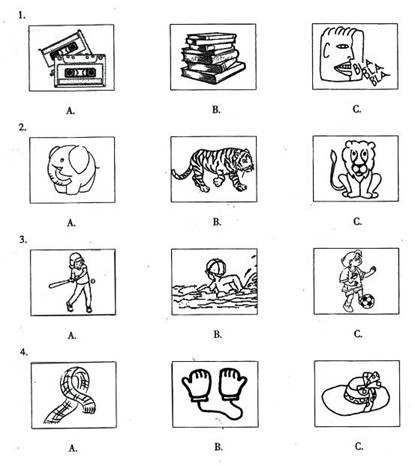
一、听对话,从下面各题所给的A、B、C三幅图片中选择与对话内容相符的图片。每段对话你将听两遍。
Number 1
M: Hey, Betty! How do you study for a test?
W: I study by listening to tapes.
Number 2
M: Sally, did you use to be afraid of tigers?
W: Yes, I did.
Number 3
M: I think we should be allowed to play soccer after class.
W: I agree.
Number 4
M: It’s Celia’s birthday tomorrow. I don’t know what I should get her.
W: If I were you, I would get her a scarf.
二、听对话或独白,根据对话或独白的内容,从下面各题所给的A、B、C三个选项中选择最佳选项。每段对话或独白你将听两遍。
请听一段对话,完成第5至第6小题。
M: Hi, Maria! Whose backpack is this?
W: I don’t know. Look, there is a hair band in it. So the owner can’t be a boy.
M: It could be Lily’s hair band. She has long hair.
W: You’re right. The backpack might belong to Lily.
请听一段对话,完成第7至第8小题。
W: Have you done your homework, John?
M: Not yet.
W: Then why are you watching TV now?
M: This is my favorite baseball game.
W: You can watch it after you finish your homework.
M: But the show will be over.
W: There will be another game next week.
M: Please?
W: You know the rules, John.
M: I hate the rules! I can’t wait till I grow up.
请听一段对话,完成第9至第10小题。
W: Hi, Lewis! I’m so glad the holiday is finally here.
M: Me too. Imagine! We’ve got three days in a row.
W: So, where’re you going?
M: I don’t have any plans yet. I’ll just play it by ear. How about you, Tina?
W: We’re going hiking and camping in the mountains.
M: That sounds exciting!
W: Would you like to join us?
M: Hmm, let me think about it. I’ll let you know later.
请听一段对话,完成第11至第13小题。
M: Gina, I was invited to a party. I don’t know what to wear and I need your help.
W: Well, what kind of party is it?
M: It is an important party for all junior students.
W: When is the party?
M: 8:00 pm, next Friday evening.
W: Oh, that is one week from today. You have enough time to get prepared. And if I were you, I
would wear a shirt and tie. But don’t wear a suit. That makes you look old.
M: I agree. But what if I don’t know anyone?
W: Well, if I were you, I would talk to someone first. It is not good to be too shy, right?
M: Yes, you are right.
W: Don’t worry. Everything will be fine. Have a good time at the party.
M: Thanks.
请听一段独白,完成第14至第16小题。
Hello, boys and girls. Welcome to our Summer Camp Day! It is a team competition taking place once every year both at the festival and on our website!
There are four teams: red, yellow, blue, and purple. You can join a team by joining the team’s Facebook group. Within each group, team members work together on how they can win the competition, and decide more fun things like team songs, team flags and so on.
Each year, one team will be named the Summer Camp Day Champion. The winning team will be decided at the end of the festival, and we will fly their flag that day. The winning team will also get a party.
As a team member, you have to wear your team color and encourage your teammates, or join in games. The games include spelling game, guessing game, water ball game and soccer game. If you win a game, you will get prizes like T-shirts or some other souvenirs. Most of the games will be during the day on Saturdays, and the winning team’s party will be on Sunday afternoon.
I hope you will enjoy yourself in our summer camp!
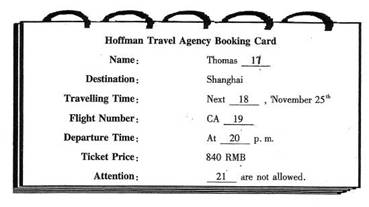
三、听对话,根据所听到的对话内容和提示词语,将所缺的关键信息填写在答题卡的相应位置上。对话你将听两遍。
W: Hello, Hoffman Travel Agency.
M: Hello. I’d like to book a flight from Beijing to Shanghai, please.
W: I see. May I have your name, please?
M: Thomas Green. T-H-O-M-A-S. Thomas. G-R-E-E-N, Green.
W: Got it. So when are you travelling?
M: I’d like to fly next Monday, November 25th.
W: Wait a moment, please. (Pause) We have one ticket left.
M: Perfect! How much is the ticket?
W: It is only 840 RMB.
M: Well, that’s a pretty fair price.
W: A ticket to Shanghai for next Monday, November 25th. OK, your ticket has been booked. The flight number is CA1589 from Beijing International Airport Terminal Three to Shanghai Hongqiao Airport. The departure time is 8:30 p.m.
M: Thank you so much! By the way, can I bring my pet with me?
W: I’m sorry. Pets are not allowed.
M: Oh, I see. Thanks.
W: You are welcome. Goodbye.
M: Bye.
一、听对话,从下面各题所给的A、B、C三幅图片选项与对话内容相符的图片。每段对话你将听两遍。(共4分,每小题1分)
二、听对话或独白,根据对话或独白的内容,从下面各题所给的A、B、C三个选项中选择最佳选项。每段对话或独白你将听两遍。(共12分,每小题1分)
5. What’s in the backpack?
A. A notebook. B. A pencil box. C. A hair hand
6. Whose backpack could it be?
A. Jack’s B. Lily’s C. Maria’s
请听一段对话,完成第7至8小题。
7. What is John doing now?
A. Watching TV. B. Doing homework. C. Playing baseball.
8. What does John hate?
A. The shows. B. The rules C. The games.
请听一段对话,完成第9至10小题。
9.How long will the holiday be?
A. Two days. B. Three days. C. Four days.
10. What is Tina going to do during the holiday?
A. Go hiking and camping. B. Go to the beach. C. Visit the museum.
请听一段对话,完成第11至13小题。
11. When is the party?
A. Next Sunday evening. B. Next Saturday evening. C. Next Friday evening.
12. What will the boy probably wear for the party?
A. A shirt and tie. B. A suit and shirt. C. A suit and tie.
13. What can we know about the boy?
A. He has no friends. B. He needs more time. C. He wants some advice.
请听一段对话,完成第14至16小题。
14. How can you join the team?
A. By joining a party on Saturdays.
B. By joining a group on Facebook.
C. By joining games on the Internet.
15. Which game is not talked about?
A. Guessing game. B. Spelling game. C. Dancing game.
16. What does the speaker want to do?
A. To tell us about a competition.
B. To introduce a competition team.
C. To encourage us to win the game.
三、听对话,根据所听到的对话内容和提示词语,将所缺的关键信息填写在答题卡的相应位置上。对话你将听两遍。(共10分,每小题2分)
知识运用
A habit is any action that we have performed so often that it becomes something we do almost without thinking. Some of them are thought to be bad habits. People spend countless hours and dollars each year trying to drop these bad habits but often fail. Why? Change is hard work and there is no shortcut to achieve it. However, there is still some advice for you to follow.
First, look at why you do it. In other words, what’s the result of doing this thing? If your bad habit is shouting at people when you are unhappy or under pressure, what do you get from it? It may make you feel a little better for the moment. Or maybe you have a bad habit of leaving your homework undone. The result could be that you get more time to spend on the Internet!
Next, take a look on the other hand. What are you losing because of your habit? Shouting at other people is a bad habit because it makes people around you feel bad and unhappy. Leaving your homework undone is a bad habit because you may be punished by your teacher. Having more Internet time means that you are losing the chance to learn the things that you need to learn. When you think that way, you’ll find that it’s not wise to keep your bad habit! Now it is time to make a decision. What will you choose? I’m sure you will choose to do what you think is more important.
1.From the first paragraph we know that .
A. people always fail to break bad habits
B. we must change all the habits we have
C. a habit is a terrible thing we can never change
D. it’s difficult, but we should do something about bad habits
2.The underlined sentence “there is no shortcut to achieve it” means that .[来源:学_科_网]
A. it is not easy to give up bad habits B. there is a long way and a short way
C. something dangerous may happen D. we must cut bad habits in a short time
3. According to the passage, if you want to drop your habits, you have to .
A. talk to others when you are in low spirits B. know why you do what you do
C. finish your homework first D. spend less time on the Internet
4.. The main purpose of this passage is to ask us .
A. not to shout at people when we are sad B. not to spend much time on the Internet
C. to give up our bad habits D. to decide what to choose
湖北省互联网违法和不良信息举报平台 | 网上有害信息举报专区 | 电信诈骗举报专区 | 涉历史虚无主义有害信息举报专区 | 涉企侵权举报专区
违法和不良信息举报电话:027-86699610 举报邮箱:58377363@163.com