
题目列表(包括答案和解析)
 | 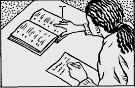 |  |  |
| 1.The weekend before she has to give it to the teacher, she sits on her own in the kitchen. First, she looks at the title and thinks a lot. | 2.Then she writes a few ideas onto a piece of paper, in no particular order. She looks up a couple of words in the dictionary and writes those down. | 3.Then she has a sandwich and goes to watch TV. | 4.The next day she looks at what she wrote. She adds some more ideas. Then she decides how to order her ideas. She starts to write. |
 |  |  |  |
| 5.There are some words she’s not sure about so she looks them up in her dictionary. | 6.When she has finished writing, she reads carefully through her composition. She crosses some things out and changes one or two sentences. | 7.Then she looks back at her notes from other written work. She makes sure she hasn’t made any of the same mistakes. | 8.Finally, she writes out her composition onto a clean piece of paper and puts it in her bag. |
| A.She looks at the title and thinks a lot. |
| B.She has a sandwich and goes to watch TV. |
| C.She writes a few ideas onto a piece of paper. |
| D.She looks up a couple of words in the dictionary. |
| A.she writes them down | B.she looks back at her notes |
| C.she crosses some things out | D.she looks them up in the dictionary |
| A.driver | B.doctor | C.student | D.parent |
If you take away many sentences from somebody's written work as your own without permission, it's called plagiarism,but if you take the knowledge from a piece of work by another and change the words, then it's not plagiarism. This is the difference between using the Internet and plagiarism. If you are given homework to work out math problems, then you should use your brain without a computer! If the teacher asks you to learn something about a famous literary person, you can use the computer. If you take down the main important information of the task, it’s OK. However, if you run to the computer to do your thinking for you all the time, you don’t exercise your brain and you will forget how to work out a problem. By using a computer, students may get a useful answer fast, to finish homework, but when they have to face an exam, they will not be ready for it.
Though teachers say finding or buying homework answers online is not many in schools, an interview with school students shows only 10% hopes to finish their holiday homework by themselves. They complain that the homework is too much for them to finish. Besides, many of students have to go to all kinds of training classes during the holiday. These take away much of their time for doing homework. So they want to find or even buy answers online or copy each other's homework. Students should learn that being a student is about getting skills, but not just getting quick, cheap "answers" for homework problems. I mean we should use the computer properly.
【小题1】If you want to look up some information about something or somebody, you____.
| A.should work it out by yourself |
| B.can turn to a computer for help |
| C.must discuss it with your teacher |
| D.will meet problems with plagiarism |
| A.Answering questions in our own words. |
| B.Buying homework answers on the Internet. |
| C.Copying others’ written work without permission. |
| D.Doing our homework with the help of a computer. |
| A.The answers are cheap and quick. |
| B.They can exercise their brains all the time. |
| C.They have to go to all kinds of training classes during the holiday. |
| D.They have too much homework to finish. |
| A.Using it for math problems. |
| B.Using it all the time for the homework. |
| C.Using it to get some information on the answers. |
| D.Using it when there's too much homework to finish. |
Read how Sofia writes a composition.
 |  |  |  |
| 1.The weekend before she has to give it to the teacher, she sits on her own in the kitchen. First, she looks at the title and thinks a lot. | 2.Then she writes a few ideas onto a piece of paper, in no particular order. She looks up a couple of words in the dictionary and writes those down. | 3.Then she has a sandwich and goes to watch TV. | 4.The next day she looks at what  she wrote. She adds some more ideas. Then she decides how to order her ideas. She starts to write. she wrote. She adds some more ideas. Then she decides how to order her ideas. She starts to write. |
 |  |  |  |
| 5.There are some words she’s not sure about so she looks them up in her dictionary. | 6.When she has finished writing, she reads  carefully through her composition. She crosses some things out and changes one or two sentences. carefully through her composition. She crosses some things out and changes one or two sentences. | 7.Then she looks back at her notes from other written work. She makes sure she hasn’t made any of the same mistakes. | 8.Finally, she writes out her composition onto a clean piece of paper and puts it in her bag. |
| A.She looks at the title and thinks a lot. |
| B.She has a sandwich and goes to watch TV. |
| C.She writes a few ideas onto a piece of paper. |
| D.She looks up a couple of words in the dictionary. |
| A.she writes them down | B.she looks back at her notes |
| C.she crosses some things out | D.she looks them up in the dictionary |
A.drive r r | B.doctor | C.student | D.parent |
1The boy doesn't speak his sister, but his written work is very good.
A. as well as B. so good as
C. much better than D. much worse than
| A.as well as | B.so good as |
| C.much better than | D.much worse than |
湖北省互联网违法和不良信息举报平台 | 网上有害信息举报专区 | 电信诈骗举报专区 | 涉历史虚无主义有害信息举报专区 | 涉企侵权举报专区
违法和不良信息举报电话:027-86699610 举报邮箱:58377363@163.com