
题目列表(包括答案和解析)
听力选择(共15小题,计15分;每小题约有8秒钟的答题时间)
(一)录音中有五个句子,每个句子听一遍,然后从每小题A、B、C中选出能对每个句子做出适当反应的答语。(5分)
1.A.Yes, please.
B.Good idea.
C.Of course, it is.
2.A.Thank you.
B.Me, too.
C.The same to you.
3.A.Oh, they are over there.
B.I'm glad you've found it.
C.Go straight and turn left.
4.A.OK, I will.
B.Yes, I think so.
C.Good for you.
5.A.Never mind.
B.You are welcome.
C.I'm sorry.
(二)录音中有五组对话,听对话两遍后,从每小题A、B、C三个选项中,选出能回答所给问题的正确答案。(5分)
6.How long has Mr.Brown been in China?
A.In 2002
B.Ten years ago
C.For ten years
7.Who would like to drink some orange juice?
A.Lucy
B.Lily
C.Mary
8.Why does Yao Hua come here?
A.For holiday
B.On business
C.To study English
9.Allan is from ________.
A.England
B.Canada
C.Australia
10.Where is the boy now?
A.In a restaurant
B.In a hospital
C.In a shop
(三)录音中有一段对话,听对话两遍后,从每小题A、B、C中选出能回答所给问题的正确答案。(5分)
11.Where are they talking?
A.On the phone.
B.At Brian's home.
C.At Jenny's home.
12.What's the date today?
A.December 20th.
B.December 22nd.
C.December 25th.
13.How did Brian go to New York?
A.By plane.
B.By sea.
C.By train
14.Who did Brian go to New York with?
A.Nobody.
B.His father.
C.His mother.
15.What did Jenny ask Brian to do?
A.Call him.
B.Take photos.
C.Come back soon.
听力填表(共5小题,计5分)
录音中有一篇短文,听短文两遍后,根据所听内容填写下面表格.(每空不多于三个词).
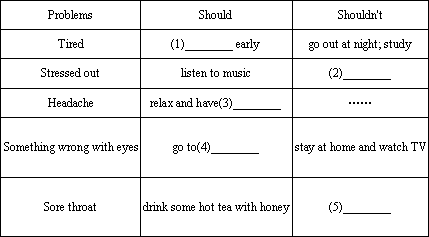
听力选择(共25小题,计25分)
(一)录音中有5个句子,每个句子听一遍,然后在每小题A、B、C三个选项中,选择符合题意的图画回答问题。
1.What animal is endangered?
A.
B.
C.
2.Why is he anxious?
A.
B.
C.
3.What am I looking for?
A.
B.
C.
4.What is Grace’s favorite?
A.
B.
C.
5.What housework does Linda always help her mother do at home?
A.
B.
C.
(二)录音中有5个句子,每个句子听两遍,然后在每小题A、B、C三个选项中,选出能回答每个句子的正确答案。
6.A.I’d like to.
B.Good idea.
C.Sorry, I can’t.
7.A.I ride to work.
B.I like walking.
C.I don’t have a car.
8.A.I love it a lot.
B.No, thanks.
C.With pleasure.
9.A.10 minutes later.
B.About 10 minutes.
C.10 minutes ago.
10.A.Sorry, I can’t.
B.Yes, he has
C.No, he doesn’t.
(三)录音中有五段对话,听对话两遍后,从每小题A、B、C三个选项中,选出能正确回答下面每个问题的答案。
11.When is the train leaving?
A.Three ten.
B.Three twenty.
C.Three thirty.
12.How will the woman go to Qingdao?
A.By train.
B.By ship.
C.By plane.
13.How fast does the man often drive his car?
A.60 kilometers per hour.
B.80 kilometers per hour.
C.100 kilometers per hour.
14.How does the man go to Shanghai?
A.by bus.
B.by train
C.by plane
15.How does the girl often go to school?
A By bike.
B.By bus.
C.On foot.
(四)录音中有一段对话,听对话两遍后,从每小题A、B、C三个选项中,选出能正确回答下面每个问题的答案。
16.Where are they talking?
A.On the phone.
B.At Brian’s home.
C.At Jenny’s home.
17.What’s the date today?
A.December 20th.
B.December 22nd.
C.December 25th.
18.How did Brian go to New York?
A.By plane.
B.By sea.
C.By train
19.Who did Brian go to New York with?
A.Nobody.
B.His father.
C.His mother.
20.What did Jenny ask Brian to do?
A.Call him.
B.Take photos.
C.Come back soon.
(五)录音中有一篇短文,听短文两遍后,从每小题A、B、C三个选项中,选出能正确的答案。
21.My family lived in _________ before I was 12 years old.
A.the city
B.town
C.the mountains
22.I spent _________ walking to school every morning.
A.half an hour
B.one hour
C.one and a half hours
23.I could meet _________ on the way to school.
A.my friends
B.my parents
C.nobody
24.There were _________ students in my class.
A.12
B.20
C.40
25.I could see _________ there.
A.the sea
B.many high buildings
C.many kinds of flowers
Brian is my good friend. He has a five-year-old daughter, Lydia. Lydia likes animals very much and always 1 to have a dog. This Sunday is Lydia's birthday. Brian wants to buy 2 a dog. So he goes to the 3 near his home. He says hello to Paul, the owner(主人)of the store. Paul says hello to him, too. Brian says, "This is a clean and 4 pet store." Then he walks around the store. 5 he doesn't see any pets. "Excuse me. 6 are the pets?" he asks. "The pets are right here," says Paul. Then Paul 7 him a catalog(目录簿). Brian sees 8 pictures of pets in it, like dogs, cats and birds. "You only need to 9 me the pet you like," says Paul. "We can mail(邮寄)it to you." "What if I don't like it?" asks Brian. " 10 mail it back," says Paul. "Oh, sounds interesting," says Brian.
| 【小题1】 |
|
| 【小题2】 |
|
| 【小题3】 |
|
| 【小题4】 |
|
| 【小题5】 |
|
| 【小题6】 |
|
| 【小题7】 |
|
| 【小题8】 |
|
| 【小题9】 |
|
| 【小题10】 |
|
A new study suggests that the more teenagers watch television, the more likely they are to develop depression (抑郁症) as young adults.
The researchers used a national long-term survey of healthy young teenagers of about 13—16 to find out the relationship between media(媒体) use and depression. They based their findings on more than 4000 young teenagers who were not depressed when the survey began in 1995.
As part of the survey, the young people were asked how many hours of television or videos they watched daily. They were also asked how often they played computer games and listened to the radio. Here was the result. The young people spent five and a half hours a day using media and more than 2 hours of that was spent watching TV.
Seven years later, in 2001, more than 7% of the young people had signs of depression. The average age at that time was 21. Brian Primack at the University of Pittsburgh medical school was the lead author of the new study. He says every extra hour of television meant an 8% increase in the chances of developing signs of depression.
The researchers say they did not find any such relationship with the use of other media such as movies, video games or radio. But the study did find that young men were more likely than young women to develop depression given the same amount of media use.
Doctor Primack says the study did not find out if watching TV causes depression directly. But one possibility, he says, is that it may take time away from activities that could help prevent depression, like sports and social activities. It might also prevent a person from sleeping well, he says, and that could have an influence.
The study was just published in the Archives of General Psychiatry.
In December, the journal Social Indicators Research published a study of activities that help lead to happy lives. Researchers from the University of Maryland found that people who describe themselves as happy spend less time watching television than unhappy people. The study found that happy people are more likely to be socially active, to read, attend social services and to vote.
|
Process of the study |
Details |
|
The purpose of the research |
To find out 1. between media use and depression |
|
At the beginning of the research |
2. was made among over 4000 young people who were not depressed. |
|
The result of the survey |
These young people spent five and a half hours a day in using media and they spent over 2 hours or that 3. |
|
Seven years later |
Researchers found 7% of the young people had a sign of depression. Every extra hour of watching TV meant an 8% increase in the chances of developing signs of depression. |
|
Results of the study |
1. Watching TV might have 4. and it may take time away from activities and sports. 2. Young men get more chance than young women to develop depression. 3. The reason some people get depression is that 5. |
湖北省互联网违法和不良信息举报平台 | 网上有害信息举报专区 | 电信诈骗举报专区 | 涉历史虚无主义有害信息举报专区 | 涉企侵权举报专区
违法和不良信息举报电话:027-86699610 举报邮箱:58377363@163.com