
题目列表(包括答案和解析)
阅读理解
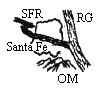
Santa Fe, the capital of New Mexico, U. S. A., is in the central part of the state, on the Santa Fe River, which flows into the Rio Grande 35 kilometers west of the city. More than two thousand meters above sea level, it lies in the Sangre de Cristo Mountains with the Ortiz Mountains to the southeast.
Santa Fe was founded in 1609 by the Spanish on an old Indian village. In 1680 the Indians seized the place but only held it for twelve years before the Spanish retook it. The city remained under Spanish rule until Mexico won its independence in 1821. From then on it was a Mexican city until 1846 when it was taken over by American troops.
With a population of 48 953, Santa Fe is now the second largest city in the state. Because of its sunny weather, rich history and surrounding mountains, it is a good place for holiday makers. Besides hunting and skating in the mountains people enjoy shopping in the Indian and Spanish shops, which brings a large income to the city every year. In summer there is an international opera season when operas are shown in a partly-roofed, open-air theatre daily for people from all over the world.
1.Which of the drawings below gives an idea of what Santa Fe is like?
RG=the Rio Grande SFR=the Santa Fe River OM=the Ortiz Mountains
[ ]


2.Santa Fe was under the rule of the Mexicans in ________.
[ ]
3.The people who held Santa Fe for the longest period in history were the ________.
[ ]
4.What is of special interest to people who visit Santa Fe in summer?
[ ]
5.Santa Fe is best described as a ________.
[ ]
6.One of the reasons for visitors to come to Santa Fe is that it ________.
[ ]
A.has fine weather
B.is the state capital
C.has historical monuments
D.is on the Santa Fe River
For as long as I can remember, Grandma’s plentiful tomato garden has been a sign of summer’s end. Each September, just as the decreased heat of the sun suggests cooler days, Grandma requests (ask for something) my help in her tomato garden. I’m sure that she cannot pick tomatoes without my youthful eyes and quick mind. She says we need to examine each tomato and agree on its readiness for picking. While Grandma’s request for my help in the tomato garden is always the same, her desire for my help seems to increase each year.
Grandma has eyes for finding even the tomatoes hidden by undergrowth and other tomatoes. I, however, just turn circles looking for the ones I think Grandma will like. I spot what looks like a ripe(成熟的)tomato, head in its direction, and then get sidetracked by another that appears to be equally ripe. I usually end up watching Grandma and trying to stay out of her way, which seems the only way my eyes and mind are useful.
There we are, lost in the tomato vines(藤). Grandma’s eyes are always knowing, and they are no different in the vegetable garden. From afar she spots (notice) what looks like a ripe tomato. As she walks toward the garden, she evaluates the tomato for a second time, but from a different angle. I already know it will end up in the basket with the pile of others Grandma has carefully chosen. However, Grandma acts as if she needs a final look to be sure. She calls me to her side, kneels beside the vine while enjoying the warmth of the fading sunlight on her face, and grasps the tomato in her hand. She turns each round, red ball toward the sunlight before disconnecting it from the vine with a half-hearted smile.
She then looks at me. I nod my head and smile. Grandma assumes I smile in agreement with her tomato selection. I know I smile, instead, at her.
1.Why does Grandma ask the author to go to the tomato garden with her?
A.He can help pick more tomatoes.
B.He can learn the hardship of labor.
C.She enjoys staying with him while working.
D.She tries to share tomato harvest with him.
2.The second paragraph shows that the writer _________.
A.isn’t good at picking tomatoes
B.doesn’t like to stay with Grandma
C.thinks his eyes and mind are useful
D.is trying to be out of Grandma’s sight
3.What’s the best title of the story?
A.Gardening—good for my Grandma.
B.Growing Grandma.
C.Gardening—good for my growth.
D.Picking tomatoes.
Have you ever complained (抱怨) why life is so tiring? Does the sky sometimes 36 dark to you? Are your lessons sometimes not successful? Well, friends, cheer up and 37 all the time. If you see the world with your warm heart, you will find the whole world smiling to you.
On a sunny morning, you plan to have a walk to relax yourself. Just before you go out, it 38 starts to rain. Maybe you would feel very sad and start to complain about the weather. But dear friends, why 39 sit down and listen to the free concert that the nature brings you? And with the timely rain, crops(庄稼) in the fields will grow better and farmers will have a good harvest (收成).
40 everyone wants to succeed in what he tries to do, life isn’t a bed of roses. It’s very common to meet difficulties on the way to success. 41 difficulty isn't terrible. The real terrible thing is that we are afraid of it. Difficulty is 42 a spring (弹簧). If you are 43 , it will be strong. So when you meet difficulties, don't give up. Instead, you should face them with a smile.
Attitude 44 everything. With an optimistic (乐观的) attitude, life is easy and 45 . If you want to be happy, try to remember these five easy rules. Free your heart from hate; Free your mind from worries; Live an easy life; Give more; Expect less. The quickest way to receive happiness is to smile, the fastest way to lose it is to complain.
36. A. seem B. seems C. seemed
37. A. cry B. smile C. complain
38. A. suddenly B. finally C. hardly
39. A. don't B. not C. didn’t
40. A. But B. For C. Although
4l. A. In fact B. From early on C. For example
42. A. unlike B. likes C. like
43. A. powerful B. weak C. confident
44. A. decides B. deciding C. to decide
45 A. please B. pleased C. pleasant
 |
Tom and Fred were talking about the year 2050.
“What will 1 be like in the year 2050?” asked Tom.
“I don’t know,” said Fred. “What do you think?”
“Well, no one knows. But it is __2__ to guess,” said Tom. “In the year 2050 everybody will carry a pocket (袖珍) __3___. The computer will give people the __4__ to all their problems. We shall all have telephones in our pockets,__5___ . And we’ll be able to talk to our friends all over the world. Perhaps(也许) we’ll be able to ___6__ them at the same time. Machines will do ___7___of the work, and people will have more__8__. Perhaps they will work only two or three days a week. They will be able to fly to the moon by spaceship and spend their holidays there.”
“I’m very _9__to hear that. I hope to fly to the moon. And I hope I’ll be able to live _10___,” said Fred. “Won’t that be interesting? Just like a fish.”
|
1. |
|
|
2. |
|
|
3. |
|
|
4. |
|
|
5. |
|
|
6. |
|
|
7. |
|
|
8. |
|
|
9. |
|
|
10. |
|
湖北省互联网违法和不良信息举报平台 | 网上有害信息举报专区 | 电信诈骗举报专区 | 涉历史虚无主义有害信息举报专区 | 涉企侵权举报专区
违法和不良信息举报电话:027-86699610 举报邮箱:58377363@163.com