
题目列表(包括答案和解析)
阅读与回答问题
One evening last July, my old car broke down on a highway.It was an hour before sunset, and.I was 25 miles from home.I couldn't reach anyone to pick me up, so I decided to take a bus.
After a while, a bus pulled up and I asked the driver how far she was going.“Four more lights,”she said.She dropped me off at the end of her routes and told me which bus to look for.After waiting 30 minutes, I began to think about a very expensive taxi ride home.Then a bus pulled up and the door opened.
“I just can't leave you here,”she said.“I'll give you a ride home.”
“You'll drive me home in the bus?”I asked, confused.
“No, I'll take you in my car,”she said.
“It's a long way,”I answered.
“Come on, sir,”she said.“I have nothing else to do.”
On the way, she told me a story.A few days earlier, her brother had run out of gas.A good Chinese man had picked him up, taken him to a gas station and then back to his car.“I'm just passing the favor along,”she said.
When I offered her money as a thank-you, she wouldn't accept(接受)it.“That wouldn't make it a favor,”she said.“Just do something nice for somebody.”Pass it along.
1.What does“pick…up”best mean in the first paragraph?
______________________________________________
2.How did the writer get home?
______________________________________________
3.What did the driver tell the man?
______________________________________________
4.What is the main idea of this passage?
______________________________________________
5.Please write down the best title for this story.
______________________________________________
听力
(一)录音中有五个句子。从下面每小题所给的A、B、C三个选项中,选出能应答每个句子的最佳答案。(每个句子仅读一遍)
1.A.No, you aren't.
B.Yes, it is.
C.Sure.Here you are.
2.A.She works at a restaurant.
B.She works very hard.
C.She works for eight hours a day.
3.A.Yes, we really do.
B.Yes, we'll buy a car.
C.Not until the wind stops.
4.A.Me, too.
B.Never mind.
C.I'm sorry to hear that.
5.A.Hold on, please.
B.It's very kind of you.
C.No, I don't think so.
(二)录音中有五组对话,听对话两遍后,从每小题A、B、C三个选项中,选出能回答下面每个问题的正确答案。
6.What does the girl want to be when she grows up?
A.

B.

C.

7.What was the weather like last Saturday?
A.

B.

C.

8.How did the man come to school today?
A.By bike
B.On foot
C.By bus
9.Where did Cathy go last Saturday?
A.To the lake.
B.To the beach.
C.To the park.
10.What does the boy want to do in this conversation?
A.Buy a pen.
B.Change a pen.
C.Take a pen.
(三)录音中有一段对话,听对话两遍后,从每小题A、B、C三个选项中,选出能回答下面每个问题的正确答案。
11.What are the speakers mainly talking about?
A.Life.
B.Camping.
C.Plans.
12.What will the woman do in the city?
A.Work at a store.
B.Attend a school.
C.Have a picnic.
13.Who will the woman stay with?
A.The man.
B.Her family.
C.The man's brother.
14.What do they do in the morning when they camp?
A.Go swimming.
B.Play basketball.
C.Tell stories.
( )15.What can we learn from the conversation?
A.The woman has worked for four summers.
B.John is the man's brother.
C.Summer vacation is coming.
(四)听力填表(共5小题,计5分)
录音中是一家宾馆对
Peter电话的回复。听两遍后,根据所听内容完成下面的表格。(每空一词)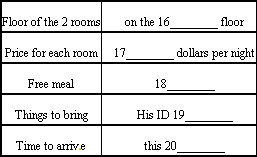
Reading comprehension(阅读理解)
Alan Chang was a handsome young man with good manners(举止).
One morning he was walking along a street on his way to an appointment(约会). He did not want to be early or late. He had forgotten to bring his watch so he went up to a man who was waiting for a taxi.
“Excuse me, sir,” he said, very politely, “but could you tell me the time?” The man, who was very well-dressed and looked quite rich, said nothing. He did not even look at Alan. Alan spoke to him again. “Excuse me, sir,” he said, “but could you please tell me what time it is?”
This time the man looked at him, but he did not speak and looked quickly away. Alan thought to himself: Well, he's not deaf. He must be just rude(无礼). “Why won't you tell me the time, sir?” he said again.
The man turned towards him and said, “Try to understand me. I am standing here waiting for a taxi. You come up to me and ask me for the time. If I tell it to you, you will thank me. I will say, ‘That's all right.’ You may then say, ‘It's a beautiful day.’ To which I may say, ‘Yes, I like these sunny winter days.’ Before we know what is happening we have a friendly talk. You are a polite young man and so when my taxi comes, I offer you a ride. You accept.
“We talk. I like you. You like me. I ask you to my house. You meet my daughter. She is a very nice girl. You are a good-looking man. You like each other. Soon you fall in love. You want to marry(结婚). And I do not want my daughter to marry a man who is too poor to buy a watch. Now do you understand my problem?”
True or False(判断下列句子是否符合短文内容,符合的用T表示,不符合的用F表示)
1.Alan asked the man the time because he was too poor to buy a watch.
( )
2.Alan thought the man was rude when he would not tell him the time.
( )
3.The man didn't tell Alan the time because he didn't want to speak to Alan.
( )
4.The man worried that Alan might like him and invite him to his house.
( )
5.Alan was a handsome young man with very good manners.
( )
6.Alan loved the man's daughter so much that he wanted to marry her.
( )
A: Hello, Daming! 1
B: I’m looking for a book called Robinson Crusoe.
A: What’s it about?
B: 2 The hero in the book is a castaway(乘船失事的人).
A: 3 Tell me more about it.
B: He lives on the island for twenty-eight years. In the end he is saved and comes back home.
A: 4
B: It first came out in 1719. It’s really a great book.
A: It’s a pity that I haven’t read it.
B: Oh, here is it. If you like, after I finish it, I can lend it to you.
A: 5 Thanks a lot.
B: You’re welcome.
|
A. It’s a great book by an English writer. B. When did it come out? C. What’s up? D. It’s written by my favourite writer, Lu Xun. E. Why are you so busy? F. Go on, please. G. Sounds like a good idea. |
阅读理解
Han Meimei has read something with the colour words in them. She doesn't understand what they mean. So she went to her teacher, Mrs Green, for help. Here is what they are talking about:
Meimei: Good morning, Mr Green. Have, you got a moment?
Green: Yes. What can I do for you, Meimei?
Meimei: I've come to some sentences that I don't understand. Can you help me?
Green: What are they?
Meimei: They are words of colour in these sentences on this list :
(1) Jack is blue today.
(2) She's yellow.
(3) He's told a white lie (谎言).
(4) Tom has a green thumb (大拇指).
Green: In everyday English the word blue means sad. Yellow means afraid sometimes. A person with a green thumb usually grows plants well. When you tell a white lie, you mean not to trouble someone too much. A white lie is not a bad one.
Meimei: Would you please give me an example of “a white lie”?
Green: Certainly. If I give you a cake and you don't like it, you won't say that you don't like it. Instead you'll say that you are not hungry. That's a white lie.
Meimei: I see. Thank you very much.
1.In everyday English, words of colour sometimes do not mean ________.
[ ]
2.The sentence “Jim has a green thumb” means ________.
[ ]
3.Someone is blue when he has ________.
[ ]
A.got some good news
B.heard that his best friend has been killed in an accident
C.been given a nice and blue suit
D.nothing to eat but rather hungry
4.Which of the following can be a white lie?
[ ]
A.Miss Forgetful has broken a beautiful glass but she doesn't say so.
B.Ron likes the fried chicken and says that he hopes to eat some of it.
C.Jill forgot to do the lessons but she said that she was ill last night.
D.The old doctor's daughter told him that all the people in the town were well because she did not want to hurt him.
湖北省互联网违法和不良信息举报平台 | 网上有害信息举报专区 | 电信诈骗举报专区 | 涉历史虚无主义有害信息举报专区 | 涉企侵权举报专区
违法和不良信息举报电话:027-86699610 举报邮箱:58377363@163.com