
题目列表(包括答案和解析)
A young officer was at a railway station. On his way home, he wanted to tele phone his mother to tell her the time of his train, so that she could meet him at the station in her car. He looked in all his pockets, but
  found that he did not have the right money for the call, so he went outside and looked around for someone to help him.
At last an old soldier came by, and the young officer stopped him and said, "Have you got change for ten pence?" "Wait a moment,” the old soldier answered, beginning to put his hand in his pocket, "I'll see whether I can help you.” "Don't you know how to speak to an officer?" the young man said angrily. "Now let's start again. Have you got change for ten pence?"
"No, sir,” the old s oldier answered quickly.
根据短文内容, 选择正确答案;
( ) 26.The young officer wanted to telephone his mother to tell her _________.
A. that he was going to visit her
B. when his train would leave
C. when his train would arrive
D. that he was now at the railway station
( ) 27. He looked around for help because he _________.
A. didn't have coins for the phone call
B. had no money to make the phone call
C. didn't have the local money
D. wanted to change money
( ) 28.The old soldier _________.
A. was glad to help him
B. didn't know if he had coins
C. didn't want to help him
D. was angry
( ) 29.The young officer was angry because he thought the old soldier _________.
A. didn't know how to speak to him
B. didn't want to help him
C. didn't answer him correctly
D. was not friendly to him
( ) 30.The old soldier in the story was_________.
A. clever B. stupid C. polite D. friendly
| |||||||||||||||||||||||||||||||||||||||||||||||||||||||||||||||||||||||||
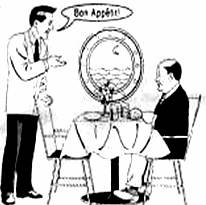
Many years ago my grandfather Benjamin Brown, traveled on a ship. The first evening at dinner a Frenchman sat down next to my grandfather. Before he sat down, the Frenchman looked at my grandfather and said, “Bon appetit.” My grandfather stood up and said, “Ben Brown.”
The same thing happened the next evening and the one after that. An Englishman on the ship could speak French. My grandfather said to him, “I don’t understand the man who has dinner with me. Every evening he comes to dinner and introduces himself.” The Englishman asked my grandfather’s mistake. He explained to my grandfather that “Bon appetit,” was not the man’s name, but was French for “Enjoy your meal.”
The next evening my grandfather came to dinner after the Frenchman. My grandfather smiled and said in French, “Bon appetit.” The Frenchman stood up and replied, “Ben Brown.”
根据短文内容,选择正确答案。
1.How did my grandfather travel many years ago?
A.By train B.By plane C.On a bus D.On a ship
2.What did my grandfather say when the Frenchman said “Bon appetit”?
A.Good evening B.Bon Appetit C.Ben Brown D.Enjoy yourself
3.Who helped Ben Brown understand the Frenchman’s words?
A.The waiter B.An Englishman C.Ben Brown himself D.Nobody
4.What does “Bon appetite.” Mean in English?
A.Enjoy your meal B.What’s your name? C.Good evening D.How are you?
5.How many people were there in the story?
A.Two B.There C.Five D.Six
阅读下面短文,从短文后所给各题的四个选项(A、B、C和D)中,选出可以填入空白处的最佳选项。
Monday morning is an important time at our school. All of the students go to the playground. We listen to music, and we 21 the national flag go up.
Usually, one student gives a talk on Monday mornings. One Monday last year, a boy gave the talk. He was 22 and excited! When I saw him, I wanted to have a try, too.
Can I really do it?
Last week, our teacher said our class should give the talk. My teacher 23 me, “I know you want to have a try. Next Monday morning, I want you to give the talk. Go and write something down. 24 for it, I’m sure you’ll do well.”
“Thank you.” I answered. It was such a great 25 for me! When I got home, I was excited. I wrote two pages for the talk. I read them again and again. When I read, I asked my parents 26 . I wanted to make my teacher happy.
Finally Monday morning came. I began to feel 27 .
When did I last give a talk to 28 many people? Never! This was my first time. Could I really 29 it? Maybe I couldn’t finish the talk.
When I got to school, we all went out to the playground. I 30 in front of everyone. I opened my mouth, but I couldn’t say anything.
“Take it easy,” I said to 31 . “Don’t be nervous. You can do it.”
Just then, I looked down at everyone. I saw about 1,000 eyes. They were all looking at me ! I couldn’t 32 stand up.
I took a look at their eyes more carefully. Their eyes seemed to say, “You can do it! Come on! 33 afraid, just talk!”
I took a big breath. Then I began to talk. It wasn’t hard. It was easy.
I don’t know 34 I finished my talk, but I tried my best to do it. I felt so good that day. I showed myself 35 everyone what I can do.
21. A. watch B. see C. notice D. look at
22. A. surprised B. proud C. bored D. careful
23. A. spoke B. asked for C. said to D. showed
24. A. Look out B. Come on C. Take care D. Get ready
25. A. chance B. news C. time D. message
26. A. to do B. to listen C. to see D. to play
27. A. excited B. happy C. nervous D. surprised
28. A. after B. such C. before D. so
29. A. do B. speak C. talk D. take
30. A. sat B. stood C. jumped D. ran
31. A. me B. myself C. my class D. my parents
32. A. be able to B. hardly C. never D. even
33. A. Not be B. Don’t C. Don’t be D. Not
34. A. where B. how C. why D. whether
35. A. with B. at C. to D. for
| |||||||||||||||||||||||||||||||||||||||||||||||||||||||||||||||||||||||||||||||||||||||||||||||||||||||||||||||||||||||||||||||||||||||||||||||||||||||||||||||||||||||||||||||||||||||||||||||||||||||||||||||||||||
湖北省互联网违法和不良信息举报平台 | 网上有害信息举报专区 | 电信诈骗举报专区 | 涉历史虚无主义有害信息举报专区 | 涉企侵权举报专区
违法和不良信息举报电话:027-86699610 举报邮箱:58377363@163.com