
题目列表(包括答案和解析)
John is twelve years old. He had a bad cold and coughed day and night. He went to see a doctor. The doctor gave him some cough medicine. Look at the instruction on the bottle of the medicine and then choose the right answers:
Cough Medicine
Shake(摇动)it well before use.
Take it three times each day before meals.
Dose (药量):
Age:over 14 2 teaspoonfuls(勺)
8—13 1 teaspoonful
4—7 1/2 teaspoonful
Not right for children below the age of three. Put it in a cold place.
Use it before December 1st 2012.
1.John should take ____ a day.
A.2 teaspoonfuls
B.3 teaspoonfuls
C.4 teaspoonfuls
D.1 teaspoonful
2.The medicine should be kept in _______.
A.a fridge(冰箱) B.hot water
C.any place D.the sun
3. John should ____ before he takes it.
A.shake the medicine well
B.eat nothing
C.do some exercise
D.drink a cup of tea
4. When people are ____ years old, they cannot take this medicine.
A.eighty B.thirty C.two D.twelve
5.John will ____ the medicine when it is left after Dec.1st, 2012.
A.throw(扔) away
B.stop to take
C.take once
D.take six times more
John is twelve years old. He had a bad cold and coughed day and night. He went to see a doctor. The doctor gave him some cough medicine. Look at the instruction on the bottle of the medicine and then choose the right answers:
Cough Medicine
Shake(摇动)it well before use.
Take it three times each day before meals.
Dose (药量):
Age:over 14 2 teaspoonfuls(勺)
8—13 1 teaspoonful
4—7 1/2 teaspoonful
Not right for children below the age of three. Put it in a cold place.
Use it before December 1st 2012.
【小题1】John should take ____ a day.
| A.2 teaspoonfuls |
| B.3 teaspoonfuls |
| C.4 teaspoonfuls |
| D.1 teaspoonful |
| A.a fridge(冰箱) | B.hot water |
| C.any place | D.the sun |
| A.shake the medicine well |
| B.eat nothing |
| C.do some exercise |
| D.drink a cup of tea |
| A.eighty | B.thirty | C.two | D.twelve |
| A.throw(扔) away |
| B.stop to take |
| C.take once |
| D.take six times more |
A Brown University sleep researcher has some advice for people who run high schools: Don’t start classes so early in the morning. It may not be that the students who nod off at their desks are lazy. And it may not be that their parents have failed to enforce(确保) bedtime. Instead, it may be that biologically(生物学上)these sleepyhead(贪睡者)students aren’t used to the early hour.
“Maybe these kids are being asked to rise at the wrong time for their bodies,” says Mary Carskadon, a professor looking at problem of adolescent (青春期的)sleep at Brown’s School of Medicine.
Carskadon is trying to understand more about the effects of early school time in adolescents. And, at a more basic level, she and her team are trying to learn more about how the biological changes of adolescence affect sleep needs and patterns(方式).
Carskadon says her work suggests that adolescents may need more sleep than they did at childhood, no less, as commonly thought.
Sleep patterns change during adolescence, as any parent of an adolescent can prove. Most adolescents prefer to stay up later at night and sleep later in the morning. But it’s not just a matter of choice---their bodies are going through a change of sleep patterns.
All of this makes the transfer(迁移)from middle school to high school---which may start one hour earlier in the morning----all the more difficult, Carskadon says. With their increased need for sleep and their biological clocks set on the “sleep late, rise late” pattern, adolescents are up against difficulties when they try to be up by 5 or 6 a.m. for a 7:30 a.m. first bell. A short sleep on a desktop may be their body’s way of saying. “I need a timeout.”
【小题1】Carskadon suggests that high schools should not start classes so early in the morning because _______.
| A.it is really tough for parents to enforce bedtime |
| B.it is biologically difficult for students to rise early |
| C.students work so late at night that they can’t get up early |
| D.students are so lazy that they don’t like to go to school early |
| A.turn around | B.agree with others | C.fall asleep | D.refuse to work |
| A.Adolescents depend more on their parents. |
| B.Adolescents have to choose their sleep patterns. |
| C.Adolescents sleep better than they did at childhood. |
| D.Adolescents need more sleep than they used to. |
| A.Adolescent health care. |
| B.Problems in adolescent learning. |
| C.Adolescent sleep difficulties. |
| D.Changes in adolescent sleep needs and patterns. |
Grace is nine years old. She has a bad cold and coughs all the time. One day, she went to see a doctor. The doctor gave her some cough medicine.
There are some words on the bottle of the medicine.
|
Shake the bottle well before taking the medicine. |
||
|
Take the medicine 3 times a day after meals. |
||
|
Dose(剂量) for each time: |
||
|
Age |
Over 15 |
2 teaspoons(茶匙) |
|
8-14 |
1 teaspoon |
|
|
4-7 |
1/2 teaspoon |
|
|
*It doesn't work for the children below the age of 3. *Be sure the cap on the bottle is nice and tight(紧的)after taking the medicine. *Keep it away from sunlight. *Use before Dec.2009. |
1.How much medicine should Grace take a day?
A.Half a teaspoon. B.At teaspoon.
C.Two teaspoons. D.Three teaspoons.
2.What should Grace do at first when she wants to the medicine?
A.Wash the bottle. B.Shake the bottle.
C.Keep the bottle cool. D.Keep the bottle hot.
3.After Grace takes the medicine, she should ____.
A.throw the cap away
B.put the bottle in a place with sunlight
C.put a nice cap on the bottle
D.put the cap back on the bottle and tighten it
4.Can a two-year-old child take the medicine?
A.No, he can't.
B.Yes, but only 1/3 teaspoon each time.
C.Yes, but he has to ask the doctor
D.Yes, but only 1/2 teaspoon each time.
5.Which of the following is TRUE?
A.If someone has a stomachache, he can also take the medicine.
B.If Grace's father has a cold, he should take the medicine 2 teaspoons a day.
C.After getting up, Grace should take the medicine at once.
D.Grace can't use the medicine after DEC.2009.
What do you do if you're stranded(处于困境的)on a lonely island? Surely you need to find a way to get in touch with the outside world. Your best chance of doing this is to draw the attention of a passing plane.
Body signals(信号)
Pilots from different countries understand body signals if they have the correct training. When you wave your arms up and down in a straight line, it means "yes". When you point downwards and swing your arm from side to side, it means "no". If you want the pilot to know that it's safe to land, push your hands out in front of you and bend(弯曲)your knees. If you want to say that it's not safe to land, put your arms in the air and move them to one side.
Smoke signals
The smoke from a fire can be seen from far away, so it's a good way to draw attention. If the weather is dry, it isn't hard to start a fire. Remember, however, that fires can be very dangerous if they get out of control. Never light a fire unless you're sure that it can't spread. If the ground is dark, light smoke can be seen more easily. Green grass and leaves produce light smoke.
Ground-to-air signals
It's a good idea to build some signals, too. Use large pieces of wood to make the symbols(标记). If you can't find any wood, use earth. Some useful symbols are:
F "I need food and water."
II "I need medicine."
I "I am badly hurt."
X" I am unable to move from here."
Pilots' replies
If the pilot lowers the plane's wings from side to side, this means "message received and understood". (At night, the pilot flashes the plane's green lights.) If the pilots flies the plane in a clockwise circle, this means "message received but not understood".(At night, the pilot flashes the plane's red lights.)
However, there is no signal which means "message not received". Why not?
【小题1】 Which picture means "it's not safe land"?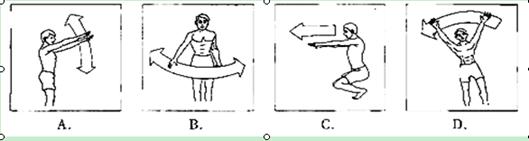
【小题2】 What can we learn from the passage?
| A.Swinging your arm from side to side means "yes". |
| B.If the ground is dark, light smoke can't be seen. |
| C.If you need some medicine, make a symbol "II". |
| D.The pilots make replies with a blue light at night. |
| A.The explanation of building signals on an island. |
| B.The importance of making signals on an island. |
| C.Ways of sending out signals on a lonely island. |
| D.Ways of receiving signals from a lonely island |
湖北省互联网违法和不良信息举报平台 | 网上有害信息举报专区 | 电信诈骗举报专区 | 涉历史虚无主义有害信息举报专区 | 涉企侵权举报专区
违法和不良信息举报电话:027-86699610 举报邮箱:58377363@163.com