
题目列表(包括答案和解析)
阅读理解.
Mrs Harris wanted to hold a big party. She was beginning to write the invitations when her husband saw that she was writing, "Party:6:30 to 8:30 p. m. "
"That isn't very nice, is it?"he said."You are telling our guests that they must go home at 8:30. "So Mrs Harris just wrote,"Party:6:30 p. m. "
A lot of guests came, and they all had a good time, so they didn' t go home at8:30. In fact, they were still there at midnight when the door bell rang and a policeman arrived.He said," You must stop making noise, because someone has complained."
Mr Harris said he didn't want to quarrel(吵架) with the policeman, so everybody went home. They were sorry to have to go.
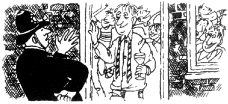
When Mr and Mrs Harris were alone again, she said to him, "That was a surprise, wasn't it? Who complained about the noise?"
"I did," Mr Harris answered in a tired voice.
根据短文内容回答下列问题.
(1)What did Mr Harris not want Mrs Harris to do?
[ ]
A.To write the invitations.
B.To write "6:30" on the invitations.
C.To write "8:30" on the invitations.
D.To write "6:30 to 8:30" on the invitations.
(2)Mrs Harris didn't change the invitations, did she?
[ ]
|
A.Yes, she didn't. |
B.No, she did. |
|
C.Yes, she did. |
D.No, she didn't. |
(3)Did they go home at 8:30?
[ ]
|
A.Yes, all did. |
B.Yes, a few did. |
|
C.No, not all of them did |
D.No, none did. |
(4)Why did they go home?
[ ]
A.Because a policeman came to stop them.
B.Because Mr Harris quarreled with a policeman.
C.Because somebody came to complain.
D.Because Mr Harris asked them to go home.
(5)Who had complained to the police?
A.A policeman had.
B.Someone had.
C.Nobody had.
D.Mr Harris had.
阅读理解.
Mrs Harris wanted to hold a big party. She was beginning to write the invitations when her husband saw that she was writing, "Party:6:30 to 8:30 p. m. "
"That isn't very nice, is it?"he said."You are telling our guests that they must go home at 8:30. "So Mrs Harris just wrote,"Party:6:30 p. m. "
A lot of guests came, and they all had a good time, so they didn' t go home at8:30. In fact, they were still there at midnight when the door bell rang and a policeman arrived.He said," You must stop making noise, because someone has complained."
Mr Harris said he didn't want to quarrel(吵架) with the policeman, so everybody went home. They were sorry to have to go.
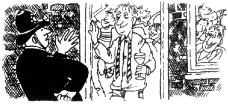
When Mr and Mrs Harris were alone again, she said to him, "That was a surprise, wasn't it? Who complained about the noise?"
"I did," Mr Harris answered in a tired voice.
根据短文内容回答下列问题.
(1)What did Mr Harris not want Mrs Harris to do?
[ ]
A.To write the invitations.
B.To write "6:30" on the invitations.
C.To write "8:30" on the invitations.
D.To write "6:30 to 8:30" on the invitations.
(2)Mrs Harris didn't change the invitations, did she?
[ ]
|
A.Yes, she didn't. |
B.No, she did. |
|
C.Yes, she did. |
D.No, she didn't. |
(3)Did they go home at 8:30?
[ ]
|
A.Yes, all did. |
B.Yes, a few did. |
|
C.No, not all of them did |
D.No, none did. |
(4)Why did they go home?
[ ]
A.Because a policeman came to stop them.
B.Because Mr Harris quarreled with a policeman.
C.Because somebody came to complain.
D.Because Mr Harris asked them to go home.
(5)Who had complained to the police?
A.A policeman had.
B.Someone had.
C.Nobody had.
D.Mr Harris had.
阅读理解
It isn't strictly true that one half of the world is rich and the other half is poor. It is one-third that is very rich and two-thirds that are very poor.
People in the rich countries don't understand the great difference between them and those in the poorer countries. A very simple example is that a dog or a cat in north America eats better than a child in the poorer countries. A fisherman in South America may be catching fish which is processed into pet food, and his own children are not getting enough to eat for their bodies to grow properly.
Although a lot of the world's natural resources like oil come from these poorer countries, people in the richer countries are using about sixty times as much of these resources as people in Asia or Africa. And it's the richer countries that decide what kind of prices they are ready to pay for these resources. And the prices the richer countries get for their own exports, however, are always rising. So they are getting richer and richer and the poorer countries are getting poorer.
1.________ of the world is very rich and ________ very poor.
[ ]
A.One half, the other half is
B.One-third, two-thirds are
C.One-four, three-fourths are
D.One-third, one-third is
2.In the passage, the writer says that the fish a fisher-man in South America catches may be made into -.
[ ]
A.his own pet food
B.pet food for poor countries
C.pet food for richer countries
D.the food for children's bodies to grow properly
3.A lot of the world's natural resources come from ________.
[ ]
A.richer countries in Africa
B.poorer countries in the world
C.poorer countries in South America
D.countries in Asia
4.Usually it is ________ that decide the prices of the resources.
[ ]
A.the richer countries
B.the poorer countries
C.the bank of the world
D.the owner of the resources
5.________ decide the prices for the exports of the richer countries.
[ ]
A.The poor people in richer countries
B.The rich people in poorer countries
C.The poorer countries themselves
D.The richer countries themselves
| |||||||||||||||
阅读理解
An English traveler found himself in Norway with only enough money in his pocket to buy the ticket for his trip back home. As he knew that it would take him two days to get to England, he decided he could easily do without food. So he bought a ticket and got on the ship.
He closed his ears to the sound of the lunch bell. When dinner time came, he refused (拒绝) to go to the dinning hall. He told others he didn't feel well. The next morning, he didn't go to breakfast and at lunch time he again stayed in the room. At dinner time he was very hungry, he said, “I'm going to eat. ”
At the dinner table he ate everything the waiter put in front of him.
“Bring me the bill,” he said.
“The bill, sir?” said the waiter.
“Yes,” answered the traveler.
“There isn't any bill,” he said, “On the ship meals are included (包括) in the money for the ticket. ”
A.True or False?
1.The story happened on a ship from Norway to England.
2.The English traveler got on the ship in the afternoon.
3.The Englishman refused to go the dining hall to eat at first because he didn't feel well.
4.He went to eat the next evening because he knew there wasn't any bill on the ship.
5.He knew at last the travelers on the ship had free meals.
B.Fill in the blanks.
6.The English traveler found himself with ________ money to pay for the food.
7.He was so ________ that he went to ________ at the dinner time.
8.He didn't need to pay for his ________ on the ship.
湖北省互联网违法和不良信息举报平台 | 网上有害信息举报专区 | 电信诈骗举报专区 | 涉历史虚无主义有害信息举报专区 | 涉企侵权举报专区
违法和不良信息举报电话:027-86699610 举报邮箱:58377363@163.com