
题目列表(包括答案和解析)
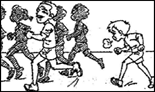
Think back to a time in your life when you tried something new.
When I was a teenager I volunteered to pass out water at a local race. I was so excited to see all the different runners who passed by and quickly took a cup of water. Some ran past,some walked past and a few wheeled past.
I saw so many types of people doing it. I thought maybe I could do it too! The next year I decided to run for the race,but I had little running practice. I just wanted to finish.
On the day of the race,it was terribly hot. After running for about 5 miles,I was thinking,“I must be crazy. Why did I do this? What was I thinking?” And at one moment,I said to myself,“I am never doing this again!”
That first 10 km race was quite an experience. I jogged (慢跑),I walked,I jogged and walked. At times,I didn’t know if I could finish.
Near the end,a 70yearold man ran past me,very fast,and I felt a little embarrassed (尴尬的) that I was more than 50 years younger than he and I couldn’t even keep up with him. But then I realized something. He was running his race and I was running mine. How often in life do we compare(比较) ourselves to others when we really shouldn’t? I decided that I would not give up on running races,and that one day I would be one of those 70yearolds who were still running.
As I crossed the finishing line,I was proud of myself. I didn’t regret (后悔) having such an experience.
【小题1】What did the writer do at a local race as a volunteer?
| A.He helped old runners. |
| B.He cheered up the runners. |
| C.He passed out water to the runners. |
| D.He took back the cups from the runners. |
| A.He just wanted to experience. | B.He was crazy about running. |
| C.He had practiced running very hard. | D.He wanted very much to win a prize. |
| A.①—②—③ | B.②—①—③ | C.①—③—② | D.②—③—① |
| A.To be No.1. | B.Let’s compare. |
| C.A volunteering job. | D.Running your own race. |
FUN TIME
Are you tired of the puzzles you usually do? Sudoku is a new choice. Sudoku consists of the Japanese characters Su (meaning “number”) and Doku (meaning “single”), but it was not invented in Japan. It was created by Howard Garnes in 1979. The puzzle was first introduced into Japan by Nikoli Puzzle Company in 1984. In 1986, Kaji Maki, the president of Nikoli made the rules strict and clear. Soon in the same year Sudoku became popular in Japan. In November 2004, The Times, a British newspaper, first printed it in the newspaper. It became an international hit in 2005. Now Sudoku becomes very popular all over the world.
The rule of the puzzle is to fill in the grids (格子) so that every row, every line and every 3×3 box has the numbers 1 to 9. Here is a Sudoku. Please relax and enjoy. It’s fun!
|
9 |
2 |
4 |
7 |
6 |
3 |
1 |
5 |
8 |
|
5 |
3 |
6 |
8 |
9 |
1 |
4 |
2 |
7 |
|
X |
7 |
8 |
2 |
5 |
4 |
9 |
6 |
3 |
|
7 |
1 |
9 |
3 |
4 |
2 |
5 |
8 |
6 |
|
4 |
8 |
3 |
6 |
1 |
5 |
2 |
7 |
9 |
|
2 |
6 |
5 |
9 |
8 |
7 |
3 |
4 |
1 |
|
3 |
9 |
7 |
4 |
2 |
Y |
6 |
1 |
Z |
|
6 |
5 |
2 |
1 |
7 |
9 |
8 |
3 |
4 |
|
8 |
4 |
1 |
5 |
3 |
6 |
7 |
9 |
2 |
根据以上杂志专栏内容,回答下列问题。
1.Who created Sudoku?
A. Howard Garnes. B. Sudoku. C. Kaji Maki. D. Nikoli.
2.Which is true about Kaji Maki according to the reading material?
A. He was the boss of Nissan Company.
B. He helped to make Sudoku popular in Japan.
C. He was the president of The Times.
D. He is an American.
3.Which is NOT true about Sudoku?
A. Sudoku wasn’t invented in Japan.
B. It was The Times that first printed Sudoku in the newspaper.
C. Each grid has more than one number.
D. It became popular around the world in 2005.
4.In the puzzle above, what should “X” be?
A. 5. B. 4. C. 3. D. 1.
5.What should “Z” be in the puzzle?
A. 8. B. 5. C. 2. D. 4.
Last Sunday was fine, Mike 1 stay at home. He was on a 2 to the zoo.
A woman with a baby got on the bus. Mike stood up and 3 to her, “Come and sit here, please. ” He helped the woman 4 . “Thanks 5 , good boy, ” the woman said. “You’re welcome, ” said Mike.
The bus went on. Thirty minutes later, it 6 at the zoo. Mike got off the bus and said 7 to the woman. The woman smiled(微笑) at him in a friendly way.
Mike went into the zoo. 8 of the people there were students. He 9 a lot of animals, and he also took many photos. He spent a happy weekend 10 he helped others and had a good time in the zoo.
|
1. |
|
|
2. |
|
|
3. |
|
|
4. |
|
|
5. |
|
|
6. |
|
|
7. |
|
|
8. |
|
|
9. |
|
|
10. |
|
|
Hans Bethe The late German-American physicist(物理学家)Hans Bethe once described himself as “the H-bomb’s midwife(氢弹的半路妻子)”. He left Nazi Germany in 1933, after which he helped develop the first atomic bomb(原子弹), won the Nobel Prize in Physics in 1967 for his contribution to the theory of nuclear reactions(核反应)and advised controls over nuclear weapons(武器)for the peaceful use of the nuclear energy. |
|
Francis Crick The late Francis Crick, one of Britain’s most famous scientists, won the Nobel Prize in Physiology(生理学)or Medicine in 1962. He is best known for his discovery with James Watson and Maurice Wilkins, of the double helix structure(双螺旋结构)of the DNA, though he also made important contributions in other fields. He died in 2004. |
|
Peter Hall Sir Peter Hall’s life in the theatre has seen him running the Arts Theatre, founding the Royal Shakespeare Company when he was only 29, and directing the National Theatre. He also directed Akenfielf for London Weekend Television and runs the Peter Hall Company, which has 40 productions worldwide to its name. |
1. The above information is about _________.
A. famous physicists B. great people C. great directions D. Nobel Prize winners
2. Francis Crick won the Nobel Prize before ________ years of his death.
A. 32 B. 24 C. 42 D. 45
3. Peter Hall founded the Royal Shakespeare Company at the age of _________.
A. 42 B. 92 C. 39 D. 29
4. ________ has 40 productions all over the world.
A. The Peter Hall Company B. The Royal Shakespeare Company
C. The Arts Theatre D. The National Theatre
| |||||
湖北省互联网违法和不良信息举报平台 | 网上有害信息举报专区 | 电信诈骗举报专区 | 涉历史虚无主义有害信息举报专区 | 涉企侵权举报专区
违法和不良信息举报电话:027-86699610 举报邮箱:58377363@163.com