
题目列表(包括答案和解析)
For several years, Americans have enjoyed teleshopping—watching TV and buying things by phone.Now teleshopping is starting in Europe (欧洲).In a number of European countries, people can turn on their TVs and shop for clothes, jewelry, food, toys, and many other things.
Teleshopping is becoming popular in Sweden, for example.The biggest Swedish company sells different kinds of things on TV in 15 European countries, and in one year it made $100 million.In France there are two teleshopping channels, and the French spend about $20 million a year to buy things through these channels.
In Germany, until last year teleshopping was only possible on one channel for 1 hour every day.Then the government allowed (允许) more telepshopping.Other channels can open for telebusiness, including (包括) the largest American teleshopping company and a 24?hour teleshopping company.German businessmen are hoping this new teleshopping will help them sell more things.
Some people like teleshopping because it allows them to do their shopping without leaving their homes.With all the problems of traffic in the cities, this is an important reason.But at the same time, other Europeans do not like this new way of shopping.They call teleshopping “junk (垃圾) on the air”.Many Europeans usually worry about the quality (质量) of the things for sale on TV.Good quality is important to them, and they believe they cannot be sure about the quality of the things on TV.
The need for high quality means that European teleshopping companies will have to be different from the American companies.They will have to be more careful about the quality of the things they sell.They will also have to work harder to sell things that the buyers cannot touch or see in person.
【小题1】Teleshopping is ____ in Europe.
| A.not popular | B.growing | C.not possible | D.cheap |
| A.American | B.cheaper | C.easier | D.more popular |
| A.don’t like to buy things |
| B.don’t watch TV |
| C.believe the things sold on TV are expensive |
| D.think the things sold on TV are bad quality |
| A.help businessmen get more money | B.keep the shops open longer |
| C.have fewer buyers | D.bring better TV programmes |
| A.American Teleshopping | B.Teleshopping Companies |
| C.Teleshopping in Europe | D.Teleshopping—Junk on the Air |
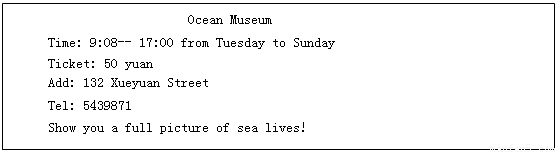
|
Health Centre Time: 9:00 17:00 Add:16 Yongle Street Tel: 3801451 Free examinations for those over 70, Give you good advice on keeping healthy! |
|
Sunny English Club for Students 16:00 18:00 every Saturday 200 yuan a month Add: 9 Zhouyu Street Tel: 3785290 Foreign teachers, English songs ~d films and more! |
|
IT’S MY BIRTHDAY! Ann hopes you can come to her party! Time: Twenty to six in the afternoon Date: Monday, March 1st Place: Flat 9B Westwing Tower Tel :8754615 The more friends, the better. |
1.Suny English Club is for __________.
A nurses B policemen C businessmen D students
2.You will pay ________ if you want to stay in the English club for half a year.
A.100 yuan B. 600 yuan C. 1,200 y~n D. 2,400 yuan
3. You can't visit Ocean Museum on________.
A. Monday B. Tuesday ' C. Wednesday D. Saturday
4. One can get a free examination in Hmlth Centre if he is_____
A. 9 B 17 C. 67 D. 73
Dear Dad,
Happy birthday to you!
On this special day, I’d like to talk to you 36 a special way.
I don’t think I’m good at 37 you my thought (想法)face to face with you, so I’m writing to show my deep love for you.
You aren’t a rich man or a famous person. But in my heart, you are one of the greatest 38 in the world. I’m 39 you.
You are 40 interested in fame and wealth (名和利). You do 41 things like paying bills on time, and working as a worker in your factory. The smile on your face shows you are happy with the family. You take good care of my grandparents. You help me with my schoolwork and do some shopping with Mom on Sundays.
In the past, I didn’t care 42 you were with me or not . Now I am sorry to say I 43 you the respect (尊重) before. But I am thankful for what you have done for me.
I am quite lucky that I have 44 a great father. I want to let you 45 how much I love. You are a successful as a son, a husband, a father, and a friend.
Yours,
David”
1.A.in B. at C. by D. on
2.A.talking B. saying C. speaking D. telling
3.A.businessmen B. man C. men D. worker
4.A.worries about B. proud of(自豪) C. afraid of D. sorry for
5.A.always B. ever C. already D. never
6.A.common B. interesting C. wonderful D. popular
7.A.whether(是否) B. that C. what D. where
8.A.will show B. don’t show C. didn’t show D. have shown
9.A. too B. so C. very D. such
10.A.to know B. know C. knew D. knowing
Close contacts between Japan and the rest of the world were created in the twentieth century. In the last forty years, business contacts between Japan and the West have become very important. Many foreign companies now have offices in Japan and Japanese businessmen do business around the world. Differences between Japanese and Western ways of doing business, however, often bewilder foreign businessmen and make doing business in Japan difficult for foreigners.
The American businessman, for example, wants to start talking business immediately. He does not want to wait. The Japanese businessman, on the other hand, likes to arrive at decisions after giving them serious thought. Another thing foreign businessmen have difficulty in understanding is when a Japanese means “Yes” or “No”. This is because of cultural differences between Japanese and Western society(社会), Which make it difficult for a Japanese to say “No” directly.
In the USA, it is easy to say “No” to something one does not want to do. But in Japan, it is very difficult to say “No”. To refuse an invitation or a request(请求) with “No” is felt to be impolite. It is thought to be selfish and unfriendly. So instead of saying “No” directly, the Japanese have developed many ways to avoid(避免) saying “No”. These can help them avoid hurting other people’s feelings. However, this often makes their ways of doing business rather difficult for foreigners to understand and follow.
【小题1】What often makes foreigners feel difficult to do business in Japan?
| A.Their different ways of doing business. |
| B.Their different lifestyles. |
| C.The fact that the Japanese never say “No”. |
| D.The fact that the Japanese are slow to take action. |
| A.cause foreign businessmen to change their minds. |
| B.give a feeling of surprise to foreign businessmen. |
| C.attract foreign businessmen’s attention. |
| D.make foreign businessmen think wrongly. |
| A.American businessmen do things more slowly than Japanese ones. |
| B.American businessmen like to say “Yes” and “No”. |
| C.Americans usually say what they are thinking. |
| D.Americans do not say what they think or feel clearly. |
| A.Japanese businessmen are good at business |
| B.foreign businessmen should try to know Japanese ways of doing business |
| C.foreign businessmen must be more polite |
| D.you must learn from Japanese businessmen if you want to succeed |
How do you pay for things? Do you usually use cash(现金), or do you like to pay by credit card(信用卡)? If you are like a lot of people, you probably have at least one credit card. Also, you might use it more often than you probably should.
Credit cards first became popular in the 1920s, At that time, businesses, such as hotels and companies, gave credit cards to their best customers(顾客). Unlike today's credit cards, customers could only use these cards at the Store or business that gave out the card. Customers had to pay for things in full. They couldn't pay for something a little at a time.
In 1950, a businessman named McNamara started a credit card company — Diners Club. Unlike earlier credit cards, this card could be used by customers at many restaurants. Customers liked the card because they didn't have to carry a lot of cash with them. Restaurant owners liked the card, too. Why? They found out that customers usually spent more money when they could pay by credit card.
In its first year of business, Diners Club issued 200 cards, The customers who got the cards from the Diners Club could use them at 27 different restaurants. Today, Diners Club has about 8 million customers, and they can use their cards in over 7. 6 million businesses in more than 200 countries.
【小题1】What can we know about the earlier credit cards from the passage?
| A.They could be used everywhere. |
| B.Customers had to pay for things in full. |
| C.They were very popular before the 1920s. |
| D.Everyone could get this kind of credit card. |
| A.showed | B.took | C.borrowed | D.provided |
| A.part of the development of credit cards |
| B.how to use cash |
| C.the number of people who use credit cards in the world |
| D.how credit cards help businessmen |
湖北省互联网违法和不良信息举报平台 | 网上有害信息举报专区 | 电信诈骗举报专区 | 涉历史虚无主义有害信息举报专区 | 涉企侵权举报专区
违法和不良信息举报电话:027-86699610 举报邮箱:58377363@163.com