
题目列表(包括答案和解析)
| |||||||||||||||||||||||||||||||||||||||||||||||||||||||||||||||||||||||||
| 阅读理解. |
| Everyone talks about the weather, but no one does anything about it. It is true. People usually begin their talks with "Isn't it a nice day?" "Do you think it will rain?" "What a fine day!" Many people think they can tell what the weather is going to be like. But they hardly agree with (同意) each other. One man says, "Do you see how cloudy it is in the east? It's going to rain tomorrow." Another man will say, "No, its going to be fine tomorrow." People often look for the weather they want. When a farmer needs water, he looks for something to tell him it's going to rain. He won't believe (相信) anything else. When friends have a journey, they are sure th e weather is going to clear up very quickly. Almost (几乎) everything listens to what the weatherman says, but it doesn't always tell us what we want, and sometimes he makes a mistake. Still he probably comes closer to being correct than anyone else. |
| 1. "No one anything about the weather" means ______. |
| A. No one can make the weather B. No one can change (改变) the weather C. No one can talk about the weather D. Everyone likes the weather |
| 2. ______ is a common (普通的) way to start a talk. |
| A. Talking about the weather B. Keeping silent (沉默) C. Asking each other's name D. Talking about yourself |
| 3. Many people hope the weather will be ______. |
| A. fine B. rainy C. snowy D. like what they like to be |
| 4. The weatherman probably is a man who ______. |
| A. reports the weather B. can see the weather C. can change the weather D. likes the weather very much |
| 5. "The weatherman" ______ makes a mistake. |
| A. often B. never C. sometimes D. always |
 I
love it at night. It’s peaceful. And when it cools
down I sometimes do some ironing. I don’t
really care for it. I work full-time and I am too busy for most housework. I
remember the old woman who taught me to iron. I was about 15 and I had to get a
job taking care of a woman to make a living. She had been an able-bodied,
healthy woman until the accident that caused her to be paralyzed.
I
love it at night. It’s peaceful. And when it cools
down I sometimes do some ironing. I don’t
really care for it. I work full-time and I am too busy for most housework. I
remember the old woman who taught me to iron. I was about 15 and I had to get a
job taking care of a woman to make a living. She had been an able-bodied,
healthy woman until the accident that caused her to be paralyzed.
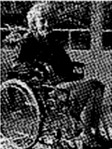
The woman sat in an electric wheelchair all day. She could only move her head and arms. She would tell me how to do things. She would teach me in great detail on the correct ways to do things. Her home was perfect and beautiful. She would follow me around in her electric wheelchair to make sure I did everything exactly right. I’m sure she had been a perfect homemaker. She would have me fold(折叠) everything, including socks. I would complain silently and wish terrible things on her. She taught me the right way to make the bed. I know sometimes she’d get frustrated(沮丧) and impatient with me. I knew she wanted to do it herself. But she never shouted or scolded. She only insisted I do it right. I didn’t like it much, but I did it.
Today I can iron pretty well. I know where to start on a shirt and the right way to do the trousers. Now when I think about it, I don’t think she is an old lady. I think she might have been about my age now. Anyway, when I iron, I think of her and silently thank her for all the things I learned.
1.The writer used to take care of the lady because ________.
A. she wanted to learn to do housework
B. she was a friend of the lady’s
C. she had to earn some money
D. she couldn’t find a room to live in
2.The underlined word ‘paralyzed’ in the first paragraph may mean ‘______’.
A. destroyed B. deaf C. seriously ill D. unable to walk
3.The little girl was ______ when the lady taught her how to do housework.
A. encouraged to learn B. unwilling to learn
C. delighted to learn D. recommended to learn
4.Now the writer ______.
A. is still afraid of the lady B. hates the strict lady
C. admires the disabled lady D. is very grateful to the lady
In London, there has always been a main problem. In order to solve this problem, the government has decided to have a bike revolution(革命). It has decided to provide 6,000 bikes for the people to rent. The government encourages local people to ride bikes in order to solve the traffic problem.
More than 12,000 people have agreed to the idea. Some of them ask for more than one key. Although there are not enough bikes, an official(官员) from the government said that they would find some ways to deal with such a shortage.
Local people can get these bikes at special docking stations(停靠站).There are about 315 docking stations across the city. About 12,450 keys have already been handed out to the local people, but only 6,000 keys can be used now.
Let’s see the cost you need to pay. One key costs £3, and the cost of using the bike is £1 for an hour. The cost per hour increases as the hours increase, so it will cost £50 if you rent the bike for 24 hours.
The official from the government said they also needed to face a lot of problems, for example, some bikes may be lost. But they said they would try their best to solve all the problems to make sure the success of the program.【小题1】About ____________ keys have already been handed out to the local people.
| A.315 | B.6.000 | C.12.000 | D.12.450 |
【小题2】In the passage, the underlined word “shortage” means “_________” in Chinese.| A.挑战 | B.缺点 | C.短缺 | D.困难 |
【小题3】Which of the following is TRUE according to the passage?| A.The government provides a bike for each family. |
| B.Local people can get these bikes at special docking stations. |
| C.If you want a key, you need to pay £5. |
| D.Few people have agreed to the idea. |
【小题4】What’s the best title for the passage?| A.The people in London. |
| B.The transportation in London. |
| C.The traffic problem in London. |
| D.The bike revolution in London. |
湖北省互联网违法和不良信息举报平台 | 网上有害信息举报专区 | 电信诈骗举报专区 | 涉历史虚无主义有害信息举报专区 | 涉企侵权举报专区
违法和不良信息举报电话:027-86699610 举报邮箱:58377363@163.com