
题目列表(包括答案和解析)
| A.the only Tibetan postman in China | B.the first postwoman in the world |
| C.doing a hard job as a postwoman | D.making her village famous overnight |
| A.he once fell into the river. | B.He was killed by a snake. |
| C.He died when swimming in the river. | D.He got hurt when building the bridge. |
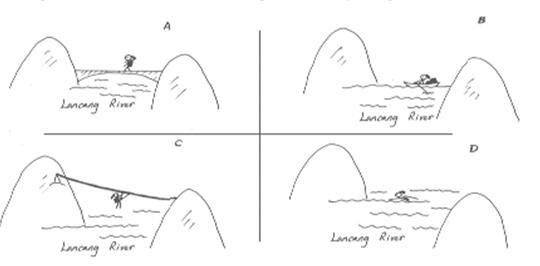
| A.Kill it with stones. | B.Keep it off and go on. |
| C.Throw it away and leave. | D.turn around and run. |
| A.She is building a bridge across the Lancang River. |
| B.She has realized all the villagers’ dreams. |
| C.She got her job as a post woman before 2000. |
| D.She doesn’t need to do her work now. |
单词填空(每小题1分,共10分)
请根据所给首字母或中文提示,写出单词在句中的正确形式。每空只能填一词,将单词完整地写在答题卡上。
1. My brother’s schoolbag is small, but Jim’s is b .
2. Look! That is my lovely c . It’s running after a mouse.
3. Please o the door and come in.
4. Miss Qin is a good t . She teaches English well.
5.Don’t ride your bike too f in the street. It’s very dangerous.
6. Boys and girls, please take out your (钢笔) and write down the new words.
7.--- How about this (红色的) skirt? --- It’s vey nice. I will take it.
8. A girl from a primary school in Guilin was very (幸运的) to get a free ticket to the 2010 World Expo in Shanghai.
9. When you (接受) a present, you must use both hands. It’s a traditional custom in China.
10.The villagers (庆祝)the Dragon Boat Festival by having a dragon boat race last Wednesday.
Once upon a time, there was a spider(蜘蛛) with the name Anansi. He knew that he was clever but he also knew he wasn't wise. He didn’t like this,but he did not know what to do. One day he had an idea. He went around the village with a basket and asked each person to give him some of their wisdom. All people laughed at Anansi because they knew that he needed wisdom the most. So each person put a bit in his basket and wished him good luck.
Soon his basket was full,but Anansi was worried that his neighbors might be jealous of his wisdom and take it from him. He decided to hide it at the top of a tall tree. When he had tied the basket to the front part of his body,he tried to climb the tree,but it was too difficult. He tried again and again without success.
Then his youngest son walked by. “What are you
doing,father?” he asked and Anansi told him.“Why
don’t you carry the basket on y our
back instead?” his son said.
our
back instead?” his son said.
Anansi put the basket on his back and climbed the tree easily,but he wasn’t happy.“1 walked all over the village and collected so much wisdom that I am the wisest person ever,but my baby son is still wiser than me. Take back your wisdom!”he said. And he threw the basket of wisdom into the air and went home. And that's how wisdom went all over the world.
1.Anansi went around the village because .
A. he knew he was very clever
B. he wanted to show his good luck
C. he hoped to meet his son
D. he thought he wasn't wise enough
2.Anansi wanted to get his wisdom from .
A. his son B .his father C. the villagers D. the neighbors
3.The underlined word “it” in Paragraph 2 refers to (指的是) .
A. the tree B .the basket C. the luck D. the wisdom
4.The passage above is .
A. a report B. a story C. an advertisement D .a diary
5.The best title for the passage would be .
A. Anansi’s wisdom B. The wisdom of Anansi’s son
C. Anansi and his son D. Anansi and the villagers
Have you been back to the place where your ancestors lived, worked, studied and played? Robert Qian , a Chinese Canadian, already has.Now in China, he has found that his family is like a tall tree with long roots.
Robert is just one young overseas Chinese who has come to visit his ancestors’ homeland, as part of the In Search of Roots summer camp program. The program is organized by the local government of Guangdong Province. This program started in 1980, and so far has brought thousands of overseas Chinese students to China to look for their families’ roots. The young people are usually between 16 and 25 years old. (1) Most, like Robert, can hardly speak any Chinese and have never been to China before.
The students mainly visit parts of Guangdong Province in southern China. During the two-week camp, they study Chinese culture, see changes that have happened in that area, and visit interesting sights. (2) Going to their ancestors’ village is often the most exciting part of the trip. The students feel that they are part of the village, and experience village life. They drink from the village well, go for walks through the countryside, and watch the villagers do their daily activities.
Cathy Qian, a young American student, had this to say, “ Thanks to In Search of Roots, I am beginning to understand my Chinese roots and who I am. It has been a great trip, and I have so many memories of China to take with me .”
The program leaders believe strongly in the program and say that the purpose of it is to give young overseas Chinese the chance to learn more about themselves. “I’ve really enjoyed the trip so far,” says Robert.“This has been a big step for me, and I’m looking forward to finding out more about my roots during my time here. ”
【小题1】将(1)处划线部分译成汉语。
。
【小题2】根据(2)处完成下面的句子。
often the most exciting part of the trip their ancestors’village.
【小题3】根据短文内容完成下面的句子。
The program In Search of Roots has helped Robert and many other overseas Chinese learn more about their and .
Last Friday, a Tibetan(藏族的) postman became the first woman postal worker to give a speech at the World Postal Meeting in Bern, the capital of Switzerland. She was Nima Lamu, a postwoman of Yunling Post office, Yunnan Province.
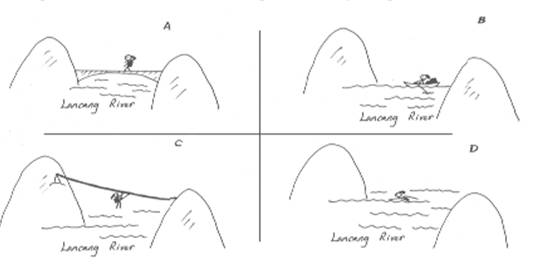
She said, “I had to cross the Lancang River along a steel wire. My younger brother nearly died in the river before. I felt so afraid when I was asked for the first time to cross the river. But when I reached the other side, I found that I was flying.”
Her area is locked in (封闭) two snowy mountains and three big rivers. She said, “:What worries me most is the snakes on the way. Sometimes, I throw little stones toward them and I often tell my self ‘Keep going’. ”
Ten years ago, it took Nima five days to finish each week’s mail. She had to face snowstorms, floods, snakes and loneliness on her 350-kilometer journey. Nima said, “The situation has developed a lot these years. Now we have a bridge that was built across the Lancang River in 2006.”
Nima never dreamed she would become famous one day when she first look up her job, 12 years ago. Changes have been seen in recent years as more tourists visit Nima’s hometown. But one thing remains unchanged: she is still the carrier of the villagers’ hopes and dreams.
1.Nima was invited to the meeting in Bern because she was _________.
A. the only Tibetan postman in China B. the first postwoman in the world
C. doing a hard job as a postwoman D. making her village famous overnight
2. What happened to her brother according to Nima Lamu?
A. he once fell into the river . B. He was killed by a snake.
C. He died when swimming in the river. D. He got hurt when building the bridge.
3.Which picture is TRUE about Nima’s crossing the river ten years ago?
4.What will Nima do if she finds a snake on the way?
A. Kill it with stones. B. Keep it off and go on.
C. Throw it away and leave. D. turn around and run.
5.What is RTUE about Nima?
A. She is building a bridge across the Lancang River.
B. She has realized all the villagers’ dreams.
C. She got her job as a post woman before 2000.
D. She doesn’t need to do her work now.
湖北省互联网违法和不良信息举报平台 | 网上有害信息举报专区 | 电信诈骗举报专区 | 涉历史虚无主义有害信息举报专区 | 涉企侵权举报专区
违法和不良信息举报电话:027-86699610 举报邮箱:58377363@163.com