
题目列表(包括答案和解析)
| A letter to the editor(编辑) |
13 October
Dear Editor,
I am writing to ask what has happened to the young. They are not as polite, hardworking or clever as my generation(一代人). I'll give you an example.
Last Friday, I got on the underground at 9:15 a.m. it was very busy so there were no free seats. There were some teenagers(青少年) sitting on the seats near me. I don't know why they were not at school. They were talking loudly and laughing. It was difficult to read my newspaper with all the noise. A heavily pregnant(怀孕的) woman and her daughter got on at the next stop, with lots of shopping bags. I expected the teenagers to let them sit down. They slowly did so but gave me an impolite look. I took off at the next stop and was glad that the teenagers didn't follow me.
I worried about the future of our country. How could these young people become responsible (有责任心的)workers and parents? They sit around McDonald's after School instead of going to the library like I did at their age. Maybe they have too much money. Perhaps another reader can give us an idea about what to do with this "lost generation ".
Franz Johnson
| A reply to Mr. Johnson's letter |
20 October
Dear Editor,
I read Mr. Johnson’s letter about the problem of today’s young people with much interest.
He described teenagers on a train not giving seat to a pregnant woman and her daughter. I was the woman. We must have seen things differently. I found the teenagers helpful and kind. Did Mr.
Johnson see the teenagers help me off the train? Did he see them carry me shopping bags to a taxi for me? Did he see them friendly to my daughter? Obviously(明显地) not.
"Older" people often say today's youth isn't as good as their generation. Their parents said that about them. Mr Johnson must accept(接受.) that the world is changing and young people are changing with it. I find today's young people are changing with it. I found today's young people mostly kind and more fun than my generation.
Perhaps Mr. Johnson should really try to get to know some young people before he calls them the "lost generation".
Linda Black 1. Mr. Johnson wrote the letter to .
A. ask for help from the newspaper B. find the way to solve the problem
C. show his worry towards the young D. teach the young people a lesson
2. When Mr. Johnson was young, he usually after school.
A. went to the library B. read newspaper
C. went to McDonald' s D. helped people in trouble
3. In the second letter, Mrs. Black .
A. discussed the problem with the old
B. told another story about the young people
C. wanted to show her thanks to the young people
D. wanted the "older" to understand the young
4. Which of the following is the correct order of what happened?
①Mrs. Black wrote to the newspaper.
②Mrs. Black took a taxi With her daughter.
③Mrs. Black got on the train with her daughter.
④Mr. Johnson asked the young to give her seat.
⑤Mr. Johnson thought the young might follow him.
A. ②③④⑤① B. ③②④⑤① C. ③④⑤②① D. ⑤③①④②
5. From the two letters we can learn that .
A. Mrs. Black didn't like the old like Johnson
B. people have different ideas about the young
C. older people are more helpful than the youth
D. people should talk more about the same story
| 阅读理解。 | ||
Dear Editor, I am writing to ask what has happened to the young. They are not as polite, hardworking or clever as my generation (一代人). I'll give you an example. Last Friday I got on the underground at 9:15 a. m. It was very busy so there were no free seats. There were some teenagers (青少年) sitting on the seats near me. I don't know why they were not at school. They were talking loudly and laughing. It was difficult to read my newspaper with all the noise. A heavily pregnant (怀孕的) woman and her daughter got on at the next stop, with lots of shopping bags. I expected the teenagers to let them sit down. They slowly did so but gave me an impolite look. I got off at the next stop and was glad that the teenagers didn't follow me. I worried about the future of our country. How could these young people become responsible (有责任心的) workers and parents? They sit around McDonald's after school instead of going to the library as I did at their age. Maybe they have too much money. Perhaps another reader can give us an idea about what to do with this "lost generation". Franz Johnson
Dear Editor, I read Mr. Johnson's letter about the problem of today's youth (青少年) with much interest. He described teenagers on a train not giving seats to a pregnant woman and her daughter. I was the woman. We must have seen things differently. I found the teenagers helpful and kind. Did Mr. Johnson see the teenagers help me off the train? Did he see them carry my shopping bags to a taxi for me? Did he see them friendly to my daughter? Obviously (明显地) not. "Older" people often say today's youth isn't as good as their generation. Their parents said that about them. Mr. Johnson must accept (接受) that the world is changing and young people are changing with it. I find today's youth mostly kind and more friendly than my generation. Perhaps Mr. Johnson should really try to get to know some young people before he calls them the "lost generation". Linda Black | ||
| 1. Mr. Johnson wrote the letter to _____. | ||
| A. ask for help-from the newspaper B. find the way to solve the problem C. show his worry towards the young D. teach the young a lesson | ||
| 2. When Mr. Johnson was young, he usually _____ after school. | ||
| A. went to the library B. read newspapers C. went to McDonald's D. helped people in trouble | ||
| 3. In the second letter, Mrs. Black _____. | ||
| A. discussed the youth problem with the old B. told another story about the young people C. warned to show her thanks to the young people D. wanted the "older" people to understand the young | ||
| 4. Which of the following is the correct order of what happened? ① Mrs. Black wrote to the newspaper. ② Mrs. Black took a taxi with her daughter. ③ Mrs. Black got on the train with her daughter. ④ Mr. Johnson asked the young people to give her a seat. ⑤ Mr. Johnson thought the young people might follow him. | ||
| A. ②③④⑤① B. ②④⑤③① C. ③④⑤②① D. ⑤③①④② | ||
| 5. From the two letters we can learn that _____. | ||
| A. Mrs. Black didn't like the old like Johnson B. people have different ideas about the young C. older people are more helpful than the youth D. people should talk more about the same story |
听力录音材料:
一、听对话,从下面各题所给的A、B、C三幅图片中选择与对话内容相符的图片。每段对话你将听两遍。
Number 1
M: Hey, Betty! How do you study for a test?
W: I study by listening to tapes.
Number 2
M: Sally, did you use to be afraid of tigers?
W: Yes, I did.
Number 3
M: I think we should be allowed to play soccer after class.
W: I agree.
Number 4
M: It’s Celia’s birthday tomorrow. I don’t know what I should get her.
W: If I were you, I would get her a scarf.
二、听对话或独白,根据对话或独白的内容,从下面各题所给的A、B、C三个选项中选择最佳选项。每段对话或独白你将听两遍。
请听一段对话,完成第5至第6小题。
M: Hi, Maria! Whose backpack is this?
W: I don’t know. Look, there is a hair band in it. So the owner can’t be a boy.
M: It could be Lily’s hair band. She has long hair.
W: You’re right. The backpack might belong to Lily.
请听一段对话,完成第7至第8小题。
W: Have you done your homework, John?
M: Not yet.
W: Then why are you watching TV now?
M: This is my favorite baseball game.
W: You can watch it after you finish your homework.
M: But the show will be over.
W: There will be another game next week.
M: Please?
W: You know the rules, John.
M: I hate the rules! I can’t wait till I grow up.
请听一段对话,完成第9至第10小题。
W: Hi, Lewis! I’m so glad the holiday is finally here.
M: Me too. Imagine! We’ve got three days in a row.
W: So, where’re you going?
M: I don’t have any plans yet. I’ll just play it by ear. How about you, Tina?
W: We’re going hiking and camping in the mountains.
M: That sounds exciting!
W: Would you like to join us?
M: Hmm, let me think about it. I’ll let you know later.
请听一段对话,完成第11至第13小题。
M: Gina, I was invited to a party. I don’t know what to wear and I need your help.
W: Well, what kind of party is it?
M: It is an important party for all junior students.
W: When is the party?
M: 8:00 pm, next Friday evening.
W: Oh, that is one week from today. You have enough time to get prepared. And if I were you, I
would wear a shirt and tie. But don’t wear a suit. That makes you look old.
M: I agree. But what if I don’t know anyone?
W: Well, if I were you, I would talk to someone first. It is not good to be too shy, right?
M: Yes, you are right.
W: Don’t worry. Everything will be fine. Have a good time at the party.
M: Thanks.
请听一段独白,完成第14至第16小题。
Hello, boys and girls. Welcome to our Summer Camp Day! It is a team competition taking place once every year both at the festival and on our website!
There are four teams: red, yellow, blue, and purple. You can join a team by joining the team’s Facebook group. Within each group, team members work together on how they can win the competition, and decide more fun things like team songs, team flags and so on.
Each year, one team will be named the Summer Camp Day Champion. The winning team will be decided at the end of the festival, and we will fly their flag that day. The winning team will also get a party.
As a team member, you have to wear your team color and encourage your teammates, or join in games. The games include spelling game, guessing game, water ball game and soccer game. If you win a game, you will get prizes like T-shirts or some other souvenirs. Most of the games will be during the day on Saturdays, and the winning team’s party will be on Sunday afternoon.
I hope you will enjoy yourself in our summer camp!
三、听对话,根据所听到的对话内容和提示词语,将所缺的关键信息填写在答题卡的相应位置上。对话你将听两遍。
W: Hello, Hoffman Travel Agency.
M: Hello. I’d like to book a flight from Beijing to Shanghai, please.
W: I see. May I have your name, please?
M: Thomas Green. T-H-O-M-A-S. Thomas. G-R-E-E-N, Green.
W: Got it. So when are you travelling?
M: I’d like to fly next Monday, November 25th.
W: Wait a moment, please. (Pause) We have one ticket left.
M: Perfect! How much is the ticket?
W: It is only 840 RMB.
M: Well, that’s a pretty fair price.
W: A ticket to Shanghai for next Monday, November 25th. OK, your ticket has been booked. The flight number is CA1589 from Beijing International Airport Terminal Three to Shanghai Hongqiao Airport. The departure time is 8:30 p.m.
M: Thank you so much! By the way, can I bring my pet with me?
W: I’m sorry. Pets are not allowed.
M: Oh, I see. Thanks.
W: You are welcome. Goodbye.
M: Bye.
一、听对话,从下面各题所给的A、B、C三幅图片选项与对话内容相符的图片。每段对话你将听两遍。(共4分,每小题1分)
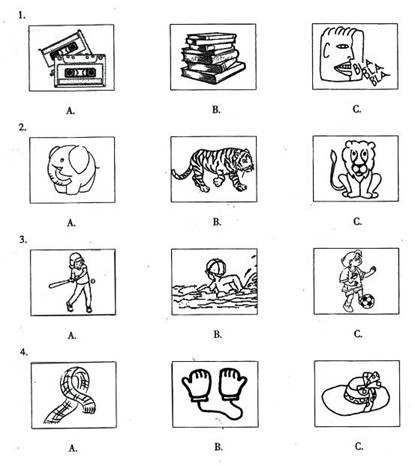
二、听对话或独白,根据对话或独白的内容,从下面各题所给的A、B、C三个选项中选择最佳选项。每段对话或独白你将听两遍。(共12分,每小题1分)
5. What’s in the backpack?
A. A notebook. B. A pencil box. C. A hair hand
6. Whose backpack could it be?
A. Jack’s B. Lily’s C. Maria’s
请听一段对话,完成第7至8小题。
7. What is John doing now?
A. Watching TV. B. Doing homework. C. Playing baseball.
8. What does John hate?
A. The shows. B. The rules C. The games.
请听一段对话,完成第9至10小题。
9.How long will the holiday be?
A. Two days. B. Three days. C. Four days.
10. What is Tina going to do during the holiday?
A. Go hiking and camping. B. Go to the beach. C. Visit the museum.
请听一段对话,完成第11至13小题。
11. When is the party?
A. Next Sunday evening. B. Next Saturday evening. C. Next Friday evening.
12. What will the boy probably wear for the party?
A. A shirt and tie. B. A suit and shirt. C. A suit and tie.
13. What can we know about the boy?
A. He has no friends. B. He needs more time. C. He wants some advice.
请听一段对话,完成第14至16小题。
14. How can you join the team?
A. By joining a party on Saturdays.
B. By joining a group on Facebook.
C. By joining games on the Internet.
15. Which game is not talked about?
A. Guessing game. B. Spelling game. C. Dancing game.
16. What does the speaker want to do?
A. To tell us about a competition.
B. To introduce a competition team.
C. To encourage us to win the game.
三、听对话,根据所听到的对话内容和提示词语,将所缺的关键信息填写在答题卡的相应位置上。对话你将听两遍。(共10分,每小题2分)
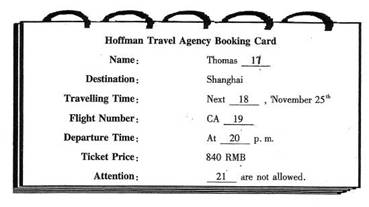
知识运用
湖北省互联网违法和不良信息举报平台 | 网上有害信息举报专区 | 电信诈骗举报专区 | 涉历史虚无主义有害信息举报专区 | 涉企侵权举报专区
违法和不良信息举报电话:027-86699610 举报邮箱:58377363@163.com