
题目列表(包括答案和解析)
阅读理解
Santa Fe, the capital of New Mexico, U. S. A., is in the central part of the state, on the Santa Fe River, which flows into the Rio Grande 35 kilometers west of the city. More than two thousand meters above sea level, it lies in the Sangre de Cristo Mountains with the Ortiz Mountains to the southeast.
Santa Fe was founded in 1609 by the Spanish on an old Indian village. In 1680 the Indians seized the place but only held it for twelve years before the Spanish retook it. The city remained under Spanish rule until Mexico won its independence in 1821. From then on it was a Mexican city until 1846 when it was taken over by American troops.
With a population of 48 953, Santa Fe is now the second largest city in the state. Because of its sunny weather, rich history and surrounding mountains, it is a good place for holiday makers. Besides hunting and skating in the mountains people enjoy shopping in the Indian and Spanish shops, which brings a large income to the city every year. In summer there is an international opera season when operas are shown in a partly-roofed, open-air theatre daily for people from all over the world.
1.Which of the drawings below gives an idea of what Santa Fe is like?
RG=the Rio Grande SFR=the Santa Fe River OM=the Ortiz Mountains
[ ]
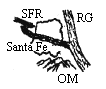


2.Santa Fe was under the rule of the Mexicans in ________.
[ ]
3.The people who held Santa Fe for the longest period in history were the ________.
[ ]
4.What is of special interest to people who visit Santa Fe in summer?
[ ]
5.Santa Fe is best described as a ________.
[ ]
6.One of the reasons for visitors to come to Santa Fe is that it ________.
[ ]
A.has fine weather
B.is the state capital
C.has historical monuments
D.is on the Santa Fe River
The word“day”has two meanings. When we talk about the number of days in a year, we are using“day”to mean 24 hours. But when we talk about day and night, we are using“day”to mean the time between sunrise and sunset. Since the earth looks like a ball, the sun can shine on only half of it at a time. Always one half of the earth is having day and the other half night. A place is moved from day into night and from night into day over and over by the spinning(旋转)of the earth. At the equator(赤道)day and night are sometimes the same length(长度). They are each twelve hours long. The sun rises at 6 o’clock in the morning and sets at 6 o’clock in the evening. For six months the North Pole is tilted(倾斜)toward the sun. In those months the Northern Hemisphere(半球)gets more hours of sunlight than the Southern Hemisphere. Days are longer than nights. South of the equator nights are longer than days. For the other six months the North Pole is tilted away from the sun. Then the Southern Hemisphere gets more sunlight. Days are longer than nights. North of the equator nights are longer than days. Winter is the season of long nights. Summer is the season of long days.
【小题1】A place is moved from day into night and from night into day over and over by ____ of the earth.
| A.the pushing | B.the pulling | C.the spinning | D.the passing |
| A.sometimes | B.never | C.usually | D.always |
| A.less | B.more | C.all | D.no |
The word “day” has two meanings. When we talk about the number of days in a year, we are using “day” to mean 24 hours. But when we talk about day and night, we are using “day” to mean the time between sunrise and sunset. Since the earth looks like a ball, the sun can shine on only half of it at a time. Always one half of the earth is having day and the other half night. A place is moved from day into night and from night into day over and over by the spinning(旋转)of the earth. At the equator(赤道)day and night are sometimes the same length(长度). They are each twelve hours long. The sun rises at 6 o’clock in the morning and sets at 6 o’clock in the evening. For six months the North Pole is tilted(倾斜)toward the sun. In those months the Northern Hemisphere(半球)gets more hours of sunlight than the Southern Hemisphere. Days are longer than nights. South of the equator nights are longer than days. For the other six months the North Pole is tilted away from the sun. Then the Southern Hemisphere gets more sunlight. Days are longer than nights. North of the equator nights are longer than days. Winter is the season of long nights. Summer is the season of long days.
( )6.When the Western Hemisphere is having day, the Eastern Hemisphere is having ________.
A. both day and night B. day
C. neither day nor night D. night
( )7. A place is moved from day into night and from night into day over and over by ________ of the earth.
A. the pushing B. the pulling
C. the spinning D. the passing
( )8. At the equator day is as long as night ________.
A. sometimes B. never C. usually D. always
( )9. When the North Pole is tilted toward the sun, the Northern Hemisphere gets ________ sunlight.
A. less B. more C. all D. no
( )10. When it is winter in China, ________.
A. the USA is tilted toward the sun
B. the South Pole is tilted away from the sun
C. the North Pole is tilted toward the sun
D. the North Pole is tilted away from the sun
The word “day” has two meanings. When we talk about the number of days in a year, we are using “day” to mean 24 hours. But when we talk about day and night, we are using “day” to mean the time between sunrise and sunset. Since the earth looks like a ball, the sun can shine on only half of it at a time. Always one half of the earth is having day and the other half night. A place is moved from day into night and from night into day over and over by the spinning(旋转)of the earth. At the equator(赤道)day and night are sometimes the same length(长度). They are each twelve hours long. The sun rises at 6 o’clock in the morning and sets at 6 o’clock in the evening. For six months the North Pole is tilted(倾斜)toward the sun. In those months the Northern Hemisphere(半球)gets more hours of sunlight than the Southern Hemisphere. Days are longer than nights. South of the equator nights are longer than days. For the other six months the North Pole is tilted away from the sun. Then the Southern Hemisphere gets more sunlight. Days are longer than nights. North of the equator nights are longer than days. Winter is the season of long nights. Summer is the season of long days.
( )6.When the Western Hemisphere is having day, the Eastern Hemisphere is having ________.
A. both day and night B. day
C. neither day nor night D. night
( )7. A place is moved from day into night and from night into day over and over by ________ of the earth.
A. the pushing B. the pulling
C. the spinning D. the passing
( )8. At the equator day is as long as night ________.
A. sometimes B. never C. usually D. always
( )9. When the North Pole is tilted toward the sun, the Northern Hemisphere gets ________ sunlight.
A. less B. more C. all D. no
( )10. When it is winter in China, ________.
A. the USA is tilted toward the sun
B. the South Pole is tilted away from the sun
C. the North Pole is tilted toward the sun
D. the North Pole is tilted away from the sun
The word “day” has two meanings. When we talk about the number of days in a year, we are using “day” to mean 24 hours. But when we talk about day and night, we are using “day” to mean the time between sunrise and sunset. Since the earth looks like a ball, the sun can shine on only half of it at a time. Always one half of the earth is having day and the other half night. A place is moved from day into night and from night into day over and over by the spinning(旋转)of the earth. At the equator(赤道)day and night are sometimes the same length(长度). They are each twelve hours long. The sun rises at 6 o’clock in the morning and sets at 6 o’clock in the evening. For six months the North Pole is tilted(倾斜)toward the sun. In those months the Northern Hemisphere(半球)gets more hours of sunlight than the Southern Hemisphere. Days are longer than nights. South of the equator nights are longer than days. For the other six months the North Pole is tilted away from the sun. Then the Southern Hemisphere gets more sunlight. Days are longer than nights. North of the equator nights are longer than days. Winter is the season of long nights. Summer is the season of long days.
1.When the Western Hemisphere is having day, the eastern Hemisphere is having ________________.
A. both day and night B. day C. neither day nor night D. night
2.A place is moved from day into night and from night into day over and over by _______________ of the earth.
A. the pushing B. the pulling C. the spinning D. the passing
3.At the equator day is as long as night _______________.
A. sometimes B. never C. usually D. always
4.When the North Pole is tilted toward the sun, the Northern Hemisphere gets _______________ sunlight.
A. less B. more C. all D. no
湖北省互联网违法和不良信息举报平台 | 网上有害信息举报专区 | 电信诈骗举报专区 | 涉历史虚无主义有害信息举报专区 | 涉企侵权举报专区
违法和不良信息举报电话:027-86699610 举报邮箱:58377363@163.com