A. for B. to C. of D. towards 查看更多


题目列表(包括答案和解析)

A few minutes before six o’clock, Mr. Smith left the house. He just wanted to    the car when a gunman (持枪者) jumped up from the back seat. He    a gun to Mr. Smith’s head. “Drive me to Paris!” he shouted.

  “All right,” Mr. Smith answered. He started the engine (发动机), pulled away (开走) from the side of the street and    down. Being 81 years old, he knew he could not fight with the gunman. He knew he needed help . Where were the police? As he drove     each crossing, he looked up and down the side streets, hoping to find a police car, but he could see      . “Just my luck,” he thought. “If I were driving too  , there would be a police car on every corner.”

  Suddenly he pushed his foot down on the accelerator (加速器), and the car went    faster. “What are you doing?” shouted the gunman. “To     the police,” Mr. Smith answered. “I thought I saw a police car near there.”

  He ran red lights, drove wrong on one-way streets. On the two-way streets, he drove on the wrong side of the road. None of the policemen saw him. Again, Mr. Smith’s plan was not working. He had to try a new plan.

  He turned at a corner and saw the    in front. Then he drove his car as fast as he could towards the police gate. The car knocked a police motorbike over and stopped. Mr. Smith shouted, “Help! Help!” Then he    back to grab (抓住) the man’s gun. At the same time the policemen heard the noise and quickly caught the gunman.

1.A.stop    B.begin    C.leave    D.start

2.A.brought  B.pointed   C.held     D.carried

3.A.drove    B.left     C.took    D.pushed

4.A.past    B.over     C.through  D.towards

5.A.somebody B.anybody  C.everybody  D.nobody

6.A.fast    B.slowly   C.generally   D.commonly

7.A.more    B.much   C.very    D.quite

8.A.look for   B.keep away from  C.look at  D.care about

9.A.train station B.police station  C.hospital  D.bank

10.A.got     B.looked   C.turned   D.came


查看答案和解析>>

A little boy invited his mother to attend his school’s first teacher-parent meeting. To the little boy’s dismay (沮丧), his mother said she would go. This would be the first time that his classmates and teachers met his mother and he was embarrassed by her appearance(出现). There was a severe (严重的) scar (伤疤) that covered nearly the whole right side of her face. The boy never wanted to talk about why or how she got the scar.
At the meeting, the people were impressed by the kindness of his mother with the scar, but the little boy was still embarrassed and hid himself from everyone. However, he could hear clearly the conversation between his mother and the teacher.
“How did you get the scar on your face?” the teacher asked.
The mother replied, “When my son was a baby, he was in a room that caught on fire. Everyone was too afraid to go in because the fire was out of control, but I went in. As I was running towards his bed, I saw a burning wood falling down and I placed myself over him trying to protect him. I was knocked to be unconscious (无知觉的), but luckily, a fireman came in and saved both of us.” She touched the burned side of her face. “This scar will be forever, but until today, I have never regretted doing what I did.”
When the little boy heard this, he couldn’t help running towards his mother with tears in his eyes. He hugged her and felt his mother was greater than anyone. He held her hand tightly for the rest of the day.
【小题1】The underline world “embarrassed” means ______ in Chinese.

A.焦虑的 B.尴尬的
C.悲伤的 D.悔恨的
【小题2】In fact, the boy’s mother was ______.
A.beautiful B.ugly
C.kind D.ugly but kind
【小题3】We know from the passage that the little boy ______.
A.wasn’t moved by what her mother said
B.didn’t ask his mother to attend the meeting
C.wanted his mother to attend the meeting at first
D.didn’t really want his mother to attend the meeting at first
【小题4】After listening to his mother’s words about the scar, the boy might feel ______.
A.moved B.unhappy
C.worried D.dismay
【小题5】Which of the following is true?
A.The boy’s mother was brave but foolish
B.The boy hated what his mother had done
C.We should love our parents whatever they are like
D.The people at the meeting didn’t like the boy’s mother

查看答案和解析>>

For hundreds of years, Japan has been hit, from time to time, by enormous (巨大的) tsunamis(海啸). These awful sudden risings of the sea are caused by earthquakes or underwater volcanic actions. The story of the boy Yuuki is the story of such a disaster.
Yuuki lived with his family in a seaside village, below a small mountain. One day, as he played on top of the mountain, Yuuki felt a small earthquake but it was not strong enough to frighten anybody and passed quickly. Soon after, however, Yuuki noticed the sea darken and begin running away from the shore very fast, leaving behind wide stretches of beach that had never been seen before.
With a grasp, Yuuki remembered reading that just before a terrible tsunami, the sea suddenly and quickly rolls backward. He ran to the beach, warning the villagers who had gathered to admire the new beach land.
“Get back!” shouted the boy, “There is a terrible danger!”
But no one listened. They laughed at him and continued playing in the new sand and watched the sea roll backward even more.
Desperate, Yuuki could think of only one thing to do. He lit a tree branch, raced to the rice fields and began burning the harvested rice. Then he called out, “Fire! Fire! Everyone run to the mountain! Now!”
When everyone reached the mountain-top, a villager cried out, “Yuuki is mad! I saw him set the fire.” Yuuki hung his head in shame, but said nothing as the villagers cursed him. Just then, someone shouted, “Look!”
In the distance what seemed to be a huge dark line was speeding towards the shore. As it got nearer the people realized the long thin line of darkness was the returning sea, towering like a mountain.
The villagers watched in terror as the water struck the shore, smashing over their homes then tearing out the land as it receded.
On the mountain everyone stared speechlessly at the destruction below.
“I'm sorry I burned the fields,” said Yuuki, his voice trembling.
“Yuuki,” village-chief answered. “You saved us all.”
The villagers cheered and raised Yuuki into the air. “We were going to
celebrate our rice harvest tonight,” said one, “but now we’ll celebrate that we’re all still alive!”
小题1:Where was Yuuki when the earthquake struck?
A.On the beach.
B.On the mountain.
C.In the rice fields.
D.At his family home.
小题2: In what order did the following events take place?
a. Yuuki set fire to the rice fields.
b. The villagers laughed and played on the beach.
c. The land was torn away by the water.
d. Yuuki ran to warn the villagers.
e. The villagers stared at the destruction.
f. The people were cursing Yuuki.
A.d, b, e, a, c, f
B.b, a, d, e, c, f
C.d, b, a, f, c, e
D.a, d, b, e, f, c
小题3:How did Yuuki save the villagers from the disaster?
A.He told them about the earthquake.
B.He explained why the sea was flowing out.
C.He told the village chief to warn the people.
D.He set fire to the rice field.
小题4:What were the people planning to do before the tsunami struck their village?
A.Harvest the rice crop.
B.Play on the beach.
C.Climb the mountain.
D.Celebrate the rice harvest.

查看答案和解析>>

A little boy invited his mother to attend his school’s first teacher-parent meeting. To the little boy’s dismay (沮丧), his mother said she would go. This would be the first time that his classmates and teachers met his mother and he was embarrassed by her appearance(出现). There was a severe (严重的) scar (伤疤) that covered nearly the whole right side of her face. The boy never wanted to talk about why or how she got the scar.
At the meeting, the people were impressed by the kindness of his mother with the scar, but the little boy was still embarrassed and hid himself from everyone. However, he could hear clearly the conversation between his mother and the teacher.
“How did you get the scar on your face?” the teacher asked.
The mother replied, “When my son was a baby, he was in a room that caught on fire. Everyone was too afraid to go in because the fire was out of control, but I went in. As I was running towards his bed, I saw a burning wood falling down and I placed myself over him trying to protect him. I was knocked to be unconscious (无知觉的), but luckily, a fireman came in and saved both of us.” She touched the burned side of her face. “This scar will be forever, but until today, I have never regretted doing what I did.”
When the little boy heard this, he couldn’t help running towards his mother with tears in his eyes. He hugged her and felt his mother was greater than anyone. He held her hand tightly for the rest of the day.
小题1:The underline world “embarrassed” means ______ in Chinese.
A.焦虑的B.尴尬的
C.悲伤的D.悔恨的
小题2:In fact, the boy’s mother was ______.
A.beautifulB.ugly
C.kindD.ugly but kind
小题3:We know from the passage that the little boy ______.
A.wasn’t moved by what her mother said
B.didn’t ask his mother to attend the meeting
C.wanted his mother to attend the meeting at first
D.didn’t really want his mother to attend the meeting at first
小题4:After listening to his mother’s words about the scar, the boy might feel ______.
A.movedB.unhappy
C.worriedD.dismay
小题5:Which of the following is true?
A.The boy’s mother was brave but foolish
B.The boy hated what his mother had done
C.We should love our parents whatever they are like
D.The people at the meeting didn’t like the boy’s mother

查看答案和解析>>


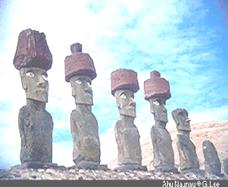
One of the greatest mysteries on Earth is the statues which stand on Easter Island. Easter Island, which was almost uninhabited when it was discovered on Easter Day in 1722 by a Dutch captain, is the most distant island in the world covered with hundreds of giant statues, each weighing several tons and some standing more than 30 feet tall.
Who built these statues and why and how did they get there? Nobody knows the answer for sure.
One theory suggests that Easter Island was first inhabited by Polynesians, who traveled thousands of miles in their canoes(独木舟)in 400 A.D. However, the ocean currents(洋流)which carried them there would not take them back, so that they could not leave.
The statues appear to have been made out of the top edge of the walls of a volcano on the island. Then, it may have been rolled or dragged down to the foot of the volcano(火山). Then, it was stood upright(直立)and ropes were tied around it, which was made to act as a pulley(滑轮). Over a period of months, a statue could be walked for miles down to the ocean. Finally, it was placed in line with other statues, all of them looking towards the center of the island.
This process was difficult. If a statue fell over, it was too heavy to be pulled upright again, so the islanders went back and carved another statue.
The population of Easter Island must have reached 11,000. Later, the resources of the island were used up and people began fighting and eating each other. Work on the statues stopped and the statues were knocked over. When the first Europeans finally arrived on the island, most of these people had died out.
【小题1】This passage is mainly about ________ .
A.the discovery of Easter IslandB.the statues on Easter Island
C.the history of Easter IslandersD.the earliest population on Easter Island
【小题2】 Which of the following correctly tells of the possible working process after a statue was made?
a. It was stood upright and ropes were tied around it.
b. It was walked for miles down to the ocean.
c. It was placed in line with other statues.
d. It was moved to the foot of the volcano.
A.c-d-a-bB.d-b-a-cC.a-c-b-dD.d-a-b-c
【小题3】 It’s not a fact that ________ .
A.Easter Island is the most distant island in the world
B.Easter is the name of a holiday
C.not all the statues were placed in a line
D.the island was once rich in natural resources
【小题4】The underlined word uninhabited most probably means ________.
A.mysteriousB.lost
C.unknown to the worldD.with no people living there

查看答案和解析>>


同步练习册答案