
题目列表(包括答案和解析)
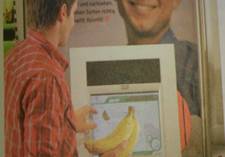
It’s Tuesday afternoon, and I’m in Rheinburg, Germany, visiting the Extra Future Store. The “store of the future” is attracting a lot of attention these days– but not for it’s prices. Instead, people are coming from all over to experience a new way to shop.
The experience is less like shopping in a supermarket and more like playing some kind of high–tech game. It starts as I enter the store and choose a shopping cart(购物车). First, I swipe my store ID card through a computer on the cart. The computer’s screen comes on, a map of the store shows, and the journey begins.
As I shop, antennas(天线) around the store send information about different specials to the computer on my cart. Attracted by one of the ads, I choose a box of cheese. I hold up the box to the computer. It displays the price and also suggests that a certain type of bread would be good with it. The map on my chart shows me where to find the bread. It’s like the store is helping me to shop.
How does the store make this kind of shopping experience possible? The answer is radio frequency identification chip (or RFID射频识别). Each chip has a special number. Using an RFID reader on the computer, we can get information from a chip about the product(产品). RFID will help shoppers find the things in a store more quickly– products that are just right for them. In addition, people won’t have to wait in long lines to pay. The things in your cart will be read by the computer and the money will be paid by your store ID card automatically(自动地). So you can simply walk out of the store with your shopping bags.
Sounds good, right? Maybe you will experience the new shopping soon in your city.
1.Why are so many people coming to the Extra Future Store?
A. They hope to buy a new kind of computers.
B. They want to play some new high– tech games.
C. They expect to experience a new way of shopping.
D. They plan to learn how to use the FRID readers.
2.What is the right order to shop in this store?
①Look for the things you want to buy and find them.
②Swipe your store ID card through the computer.
③Walk out of the store without waiting in lines.
④The computer shows you a map and some ads.
⑤Hold up the things to the computer to be charged.
A.②①④③⑤ B.①②⑤③④ C.②①⑤③④ D.②④①⑤③
3.What are Not so necessary for this kind of new stores?
A. Carts with computers. B. RFID readers.
C. Many shop assistants. D. Good products.
4. Which of the following is the advant age
of this new store?
age
of this new store?
A. The things in the shop are much cheaper.
B. It costs more time to find the things you need.
C. You will buy more things than you really need.
D. It’s more convenient to find the products and to pay.
Sometimes we feel good, such as when we get good grades or when something good happens. Sometimes we feel bad, such as when we argue with our classmates or when the teachers criticize us. Both kinds of feelings are common. Of course, we all enjoy good feelings, but when we feel unhappy, sometimes we don’t know what to do about it. Here is a plan that will help you when your feelings are bothering you.
I. ACCEPT your feelings. Say to yourself, “I am sad.” “I am seared.” “I am angry.” “I am embarrassed.” It’s all right to have these feelings.
2. RELAX and have a rest before you act. Take slow deep breaths (呼吸)and relax your body. Imagine that you are in a safe place. You can listen to some music or sing a beautiful song!
3. THINK about ways to help yourself. Thinking helps you do something smart instead of hurting yourself or making things worse.
4. DO something to help yourself. Maybe you can talk to someone, or do something you enjoy. If it doesn’t work, go back to Step3.
1.We feel unhappy when .
|
A.we get good grades |
|
B.everything goes well |
|
C.someone is proud of us |
|
D.we have a fight with our classmates |
2.If you want to relax yourself before you act, you can .
|
A.say to yourself, “I am sad.” |
|
B.listen to some music or sing a beautiful song |
|
C.think about ways to help yourself |
|
D.watch thrillers with your friends |
3.The underlined part (划线部分) “If it doesn’t work,” in the passage probably means
|
A.If it is broken |
|
B.If it can’t interest you |
|
C.If it is wrong |
|
D.If it can’t help you |
4.Which of the following is NOT TRUE according to the passage?
|
A.We felt good when we won the prize in the competition. |
|
B.We felt bad when we lost our expensive things. |
|
C.We can say to ourselves that we are pleased when we feel bad. |
|
D.We can tell someone about our bad feelings when we are sad. |
5.The passage tells us .
|
A.what we can do when we feel unhappy |
|
B.we can do nothing when we feel bad |
|
C.we all enjoy good feelings, but bad feelings are unusual to us |
|
D.what we can do when we feel happy |
Maybe you are an average(普通的)student. You probably think you will never be a top student. In fact, anyone can become a better student if he or she wants to. Here is how:
【小题1】 When planning your week, you should make a list of things that you have to do. After making this list, you should make a plan of your time. A weekly plan may not work out all your problems, but it will push you to realize what is happening to your time.
【小题2】 Look around the house for a good study place which may be a desk or simply a corner of your room, nothing but study materials. No game, radio, or TV!
【小题3】Listen to everything the teacher says. Really listening in class means less work later. Taking notes will help you remember what the teacher says.
【小题4】When you get home from school, go over your notes. You should preview the materials that the teacher will discuss the next day. It will be useful. If you do these things regularly, you will study better.
【小题5】The purpose of a test is only to show what you have learned about a subject. The world won’t end if you don’t pass a test, so don’t be worried.

Most students think my reasons for this rule include negative experiences in the past when students made wrong use of technology. There’s a bit of truth to that. I’ve seldom had students make wrong use of technology in my classes; however, I have been e-mailed by students while they were in other teachers’ classrooms.
Some students think that I am anti-technology. There’s no truth in that at all. As I noted above, I love technology and try to keep up with it.
The real reason why I ask students to leave technology at the door is I think there are very few places in which we can have deep conversations. Interruptions (中断) by technology often break students’ thoughts and make them depend too much on outside information for ideas. I want students to dig deep in themselves for ideas. I want them to push each other to think differently and to make connections between the course material and the class discussion.
I have been teaching my history class in this way for many years and the evaluations (评价) show student satisfaction with the environment that I create. Students realize with deep conversation and difficult tasks, they learn at a deeper level – a level that helps them keep the course material beyond the classroom.
I am not saying that I won’t ever change my mind about technology use in my history class, but until I hear a really good reason for the change, I will continue my plan. A few hours of technology-free dialogue is just too sweet to give up.
1.The writer’s rule for his History Matters class is ____.
A. discussing historical ideas deeply
B. studying and discussing the materials
C. leaving technology out of the classroom
D. making right use of technology in class
2.The word “negative” in Paragraph 3 means ____.
A. similar B. unforgettable C. special D. unpleasant
3.What can we know from the passage?
A. Students make right use of technology in other teachers’ classes.
B. The classroom is one of the good places to have deep conversations.
C. The writer encourages students to agree with others after discussion.
D. Students are unhappy with the writer’s way of teaching history.
4.The writer wants to tell us that ____.
A. technology has different influences in different classes in college
B. technology makes it difficult to have true communication in class
C. history classes can help students to develop their deep thinking
D. it is time for him to give up his teaching method in history class
阅读短文,根据要求完成下面各小题。
There is a Chinese saying: Time and tidy wait for no man. Have too many things to do in too little time? Well, 76if you make a good plan, everything will be in order. This chart will certainly help. If you can do all this, every your single day will be productive(高效率的).
●Make a list
It all begins with listing. If you don’t have a list, create one.
●Worst first
We often have one thing on the list, which is hanging over our heads and makes us worried. Work on it first and make the rest of your day easier.
●Just do it
Those small thing are easier to deal with. Complete them and cross them off the list.
●Make things enjoyable
Have small breaks, enjoy music, or even a snack when you are tired.①________
●Pack times
Which part of your time is most productive?②__________
●Re-list
a. Sometimes you will not complete everything on your list. This is okay. Add them to tomorrow’s list with a star so that you will know they should be done first the next day.
b. By the day’s end you will have a rough (粗略的)idea of things you need to do tomorrow. Go ahead and list them. Tomorrow when you start fresh, you will not forget to do them.
1.请把划线部分的句子译成汉语。
2.What should you do if you are tired according to the passage?
___________________________________
3.从A、B、C中为78①②选出两个适当的选项,并将其字母标号分别填入在下面横线上。
A. Replay all the e-mail at a time and make all the phone calls at another time. This will help keep your mind and your job clear.
B. When this time comes around, close your door so that it is just you and your work.
C. Life is short. Enjoy your work.
①________________②_______________
4.What should you do if you can not finish today’s work?
____________________________________
5.Give a title(标题)in the passage.
____________________________________
湖北省互联网违法和不良信息举报平台 | 网上有害信息举报专区 | 电信诈骗举报专区 | 涉历史虚无主义有害信息举报专区 | 涉企侵权举报专区
违法和不良信息举报电话:027-86699610 举报邮箱:58377363@163.com