
题目列表(包括答案和解析)
| |||||
| |||||||||||||||||||||||||||||||||||||||||||||||||||||||||||||||||||||||||||||||||||||||||||||||||||||||||||||||||||||||||||||||||||||||||||||||||||||||||||||||||||||||||||||||||||||||||||||||||||||||||||||||||||||
阅读理解
FishingMr. Turner liked fishing, It was his favourite sport. He often fished for hours without catching anything. But this did not worry him. Some fishermen couldn’t catch fish. Sometimes they caught old boots or rubbish(靴子或拉圾),Mr. Turner was even worse than the fishermen. He never caught anything--not even old boots. After he spent the whole morning on the river, he always went home with an empty bag.
“You must give up fishing!” his friends said, “It is a waste(浪费)of time.
“But they don' realize(意识到)one important thing. I'm not really interested in fishing. I am only interested in sitting in a boat nothing at all. It can make me forget the noise of the city and live quietly for some time” He always said to himself.
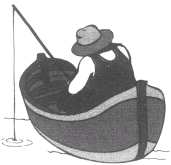
(1)Mr Turner always went fishing because ________.
[ ]
A. he could sell the fish and get some money
B. he thought it was a good sport
C. he could cook the fish for supper
D: he could sit in a boat
(2)Mr Turner liked to fish ________.
[ ]
A. by the river
B. in a boat on the river
C. in the river
D: with other fishermen
(3)He always went home with an empty bay because ________.
[ ]
A. he couldn't fish at all
B. there were not any fish in the river
C. he gave the fish to other fishermen
D: he didn't pay attention to fishing at all
(4)His friends told him ________ when they knew he couldn't catch anything.
[ ]
A. to learn how to fish
B. to change the way of fishing
C. not to fish any more
D: to buy some fish
(5)From the story we know ________.
[ ]
A. Mr. Turner lived in the country
B. Mr. Turner was a good fisherman
C. Mr. Turner was not good at fishing
D: Mr. Turner hated the noise in the city
It is a thousand kilometers across that desert (沙漠). The road is 16 nearly all the way. Sometimes there is a deep sand. A driver must then put his foot down hard and drive through! There are three small 17 along the way. Vick reached the first place at ten o‘clock p. m. He had his 18 in a little restaurant there. It was a warm 19 in August. Vick wanted to 20 through the night. The nights are warm enough in August, but the days are very, very 21 .
He left the restaurant at 11:30 and drove over 22 hours. There wasn’t a moon, but the 23 were wonderful. There was nothing else on the road. Vick thought, “It‘s an empty desert. No tree, house, man.” He could 24 the endless, white road in the car’s headlights(车灯). A million stars looked down on him.
It was two o‘clock in the morning. Vick stopped the car. He was two hundred kilometers from the 25 town: “I’ll light the cooker,” he thought, “and make some tea. ” He got out of the car.
He heard some sounds, ten or fifteen meters 26 . He could not see anything in the darkness. A man said, “Good morning. It‘s a 27 morning, isn’t it?” The man came forward,out of the darkness; out of the desert. Vick did not move. The man said, “You are going to 28 some tea, aren‘t you? I often get a cup of tea at this time. It’s two o’clock. Cars always 29 near here at this time. Sometimes I get a 30 . Now listen, and I’ll tell you a story. Then you‘ll give me…”
( ) 16. A. bad B. good C. busy D. well
( ) 17. A. cities B. hotels C. villages D. towns
( ) 18. A. tea B. supper C. lunch D. breakfast
( ) 19. A. night B. day C. season D. month
( ) 20. A. live B. stay C. drive D. walk
( ) 21. A. cold B. cool C. hot D. warm
( ) 22. A. two B. seven C. ten D. fourteen
( ) 23 A. trees B. animals C. stars D. clouds
( ) 24. A. see B. ride C. pass D. find
( ) 25. A. home B. whole C. next D. another
( ) 26. A. about B. from C. far D. away
( ) 27. A. noisy B. lovely C. sleepy D. sunny
( ) 28. A. eat B. make C. cook D. drink
( ) 29. A. leave B. stop C. meet D. run
( ) 30. A. bread B. car C. rest D. meal
My father woke me up early one summer morning when I was fourteen and announced: “Get up, you're going with me to cut the grass in the garden. ”
The idea that my father thought I was old enough to help him in his business made me feel proud and excited. From sunup to sundown, my father, my younger brother and I worked in the large garden. By the end of the day I was too tired to say a word but I felt good. This was my first time to help my father in his business. I got $ 6 for my work that day.
One day my father found some leaves I had missed and pulled me aside. “Take away these leaves! ”he said, “and don't make me have to tell you to do it again.” The message was clear. Today I value(珍视)the importance of doing a job well the first time. It will never fail to impress(给……留下印象) the person you are working for.
After two years, my father told me and my brother that he felt we were old enough to cut the grass by ourselves. Every Saturday during my last two years of high school, we set off early in the morning with the same strong wish we had gained while working under our father.
Looking after the garden was neither exciting nor high paying, but that didn't matter. It taught me that any job was a good job and that whatever I was paid was more than I had before.
A newspaper reporter once asked me how someone could possibly live with hard work and low pay. “If you're only thinking about hard work and money, you probably don't want to do any better than you are doing.” I answered. In every job, from cutting the grass to washing dishes, I've learned much. I've learned something that helps me in my next job.
If you work hard enough, you can learn from any job you do.
46. The writer felt proud and excited when he was asked to cut the grass because he thought______.
A. he could cut the grass himself
B. he could make much money
C. he could enjoy sunup and sundown
D. he could help his family
47. The underlined word "message" in the passage probably refers to_____.
A. not leaving leaves behind
B. giving no excuse for your mistakes
C. doing a good job at the very beginning
D. missing things which can be found out
48. When the writer finished high school, maybe he was _____ years old.
A. fourteen B. eighteen C. twenty D. twenty-two
49. Which of the following does the writer probably think is the most important?
A. Keeping learning from any job you had.
B. Asking no money for work.
C. Finishing work as quickly as possible.
D. Keeping looking for different jobs.
50. The writer probably thinks his father is_____.
A. lazy B. helpful C. careless D.interesting
湖北省互联网违法和不良信息举报平台 | 网上有害信息举报专区 | 电信诈骗举报专区 | 涉历史虚无主义有害信息举报专区 | 涉企侵权举报专区
违法和不良信息举报电话:027-86699610 举报邮箱:58377363@163.com