Not having finished his homework, to watch TV. A. Mother forbade him B. so he was forbidden C. and he wanted D. he was forbidden 查看更多


题目列表(包括答案和解析)

阅读理解

  Spiderman is one of the most famous comic book heroes of all time.He was created by Stan Lee in 1963 and was first introduced to the world in the pages of Marvel comic books.

  Spiderman's story is the story of Peter Parker,a child who lost his parents and lives with his aunt and uncle.Peter is a shy,quiet boy wearing glasses and has few friends.One day,on a high school class trip to a science lab,he gets bitten by a special spider.Soon Peter realizes he has amazing powers:he is as strong and quick as a spider and also has a type of sixth sense.He no longer needs his glasses and he can use his super power to fly through the city streets!Remembering something his Uncle Ben has told him,that“with great power,there must also come great responsibility(责任),”Peter decides to use his powers to fight enemies who do cruel things to people.And so,Spiderman is born.

  Life is not easy for Peter even though he is a superhero.He is in love with Mary Jane but cannot tell her about his amazing powers.Besides,his best friend Harry hates Spiderman!Peter is also short of money and time.He has to sell photos of Spiderman(himself!)to a newspaper and he keeps losing his other jobs because he's so busy saving people!Yet he has to fight different kinds of cruel enemies.

(1)

Who created Spiderman?

[  ]

A.

Stan Lee.

B.

Marvel.

C.

Peter Parker.

D.

Superman.

(2)

What happened to Peter Parker after he was bitten by the spider?

[  ]

A.

He could not see with his eyes.

B.

He became a spider.

C.

He developed spider-like powers.

D.

He was sick.

(3)

What does“with great power,there must also come great responsibility”mean?

[  ]

A.

Powerful people can do whatever they like.

B.

People with power are always good.

C.

Powerful people should have a responsibility to do good.

D.

Powerful people are to blame for all the bad things that happen.

(4)

In what areas does Peter have problems that are similar to normal people?

[  ]

A.

Money,time,studying,reading.

B.

Money,work,time,relationships.

C.

Relationships,sport,money,work.

D.

Money,work,time,sleep.

查看答案和解析>>

I think ________.

[  ]

A.

you are wrong

B.

you are not right

C.

you aren't wrong

D.

you wrong

查看答案和解析>>

阅读理解

  In England,people don't usually talk very much.You can go on a bus or in a train,and everyone sits looking out of the window.Often they read.They read books and newspapers.But they don't talk much.When you meet English people,they often talk one thing-weather.So when you meet someone in England,you can say,“Nice weather for this time of year!”“But it was a little cold yesterday,”someone may answer.“But it got a little warmer later,”you can say.If you talk like this,the English people will think:“How friendly you are!”

(1)

________ people don't talk much in a train.

[  ]

A.

Japanese

B.

English

C.

American

(2)

In England,people often ________ on a bus.

[  ]

A.

stand

B.

look at

C.

read

(3)

They often talk about ________ when they meet.

[  ]

A.

many things

B.

the weather

C.

books

(4)

When you meet someone in England,you can say,“________”

[  ]

A.

Where are you going?

B.

Do you have lunch?

C.

Fine day,isn't it?

(5)

The English ________ when you talk about the weather with them.

[  ]

A.

will think you are friendly

B.

will think you are enjoying the weather

C.

will not think you are friendly

查看答案和解析>>

阅读理解

  Living in a foreign culture can be exciting,but it can also be confusing(令人迷惑的).A group of Americans who taught English in other countries recently discussed their experiences.They agreed that miscommunications were always possible,even over something as simple as“yes”and“no”.

  On her first day in Micronesia,an island in the Pacific,Lisa thought people weren't paying any attention to her.The day was hot.She went into a store and asked,“Do you have cold drinks?”The woman there didn't say anything.Lisa repeated the question.Still the woman said nothing.She later learned that the woman had answered her:she had raised her eyebrows(眉毛),which in Micronesia means“yes”.

  Jan remembered an experience she had in Bulgaria,a country in Europe.She went to a restaurant that was known for its cabbage.She asked the waiter,“Do you have cabbage today?”He nodded his head.Jan waited,but the cabbage never came.In that country,a nod means no.

  Tom had a similar problem when he arrived in India.After explaining something in class,he asked his students if they understood.They answered with many different nods and shakes of the head.He thought some people had not understood,so he explained again.When he asked again,they did the same thing.He soon found out that his students did understand.In India,people nod and shake their heads in different ways depending on where they come from.You have to know where a person is from to understand whether they mean“yes”or“no”.

(1)

These Americans teaching English in other countries found that they ________.

[  ]

A.

should go abroad for vacations

B.

needed to learn foreign languages

C.

should often discuss their experiences

D.

had problems with communications

(2)

People in Micronesia show“yes”by ________.

[  ]

A.

nodding heads

B.

raising eyebrows

C.

shaking heads

D.

saying“no”

(3)

Tom misunderstood his class at first because ________.

[  ]

A.

he did not know much about Indian culture

B.

he didn't explain everything clearly enough

C.

some students didn't understand his questions

D.

he didn't know where the students came from

(4)

Which of the following is TRUE according to(根据)this passage?

[  ]

A.

In Bulgaria,nodding heads means no.

B.

Jan taught English on a Pacific island.

C.

Lisa was trying to buy some cabbage.

D.

In India,only shaking heads means“YES”.

(5)

The passage is mainly about ________.

[  ]

A.

body language in foreign restaurants

B.

class discussion in Indian schools

C.

miscommunication in different cultures

D.

English teaching in other countries

查看答案和解析>>

阅读理解。

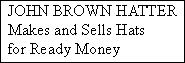
  A man is going to open a shop selling hats.He wanted to put up a good sign.He wrote.

  The first friend gave him the advice that the word “HATTER” wasn't needed.So John crossed out the word “HATTER”.Then he came to another friend for advice.This friend said that it was not polite to say “for Ready Money”.So he crossed out “for Ready Money”.The sign now said:

  One day a friend was passing his shop.He saw this sign and said that when a man bought a hat,he didn't care who made it.So John crossed out that word,too.

But when another friend saw “John Brown Sells Hats”,he said.“Of course you sell hats.No one thinks you give them away for free.” So,at last the sign read:

(1)

“For Ready Money”means “________”.

[  ]

A.

pay for the hat here when you buy it

B.

if you buy the hat you can pay for it in a few days

C.

hats here ale only for the people with much money

(2)

How many friends gave John some advice on how to write the sign?

[  ]

A.

Three.

B.

Four.

C.

Two.

(3)

________ was crossed out first.

[  ]

A.

“John Brown Sells Hats”

B.

“HATTER”

C.

“for Ready Money”

(4)

Each friend has ________ thought.

[  ]

A.

no

B.

the same

C.

his own

(5)

This story tells us that ________.

[  ]

A.

it isn't possible to please everybody

B.

it's easy to sell hats

C.

sellers must please everybody

查看答案和解析>>


同步练习册答案