
题目列表(包括答案和解析)
What do you do if you're stranded(处于困境的)on a lonely island? Surely you need to find a way to get in touch with the outside world. Your best chance of doing this is to draw the attention of a passing plane.
Body signals(信号)
Pilots from different countries understand body signals if they have the correct training. When you wave your arms up and down in a straight line, it means "yes". When you point downwards and swing your arm from side to side, it means "no". If you want the pilot to know that it's safe to land, push your hands out in front of you and bend(弯曲)your knees. If you want to say that it's not safe to land, put your arms in the air and move them to one side.
Smoke signals
The smoke from a fire can be seen from far away, so it's a good way to draw attention. If the weather is dry, it isn't hard to start a fire. Remember, however, that fires can be very dangerous if they get out of control. Never light a fire unless you're sure that it can't spread. If the ground is dark, light smoke can be seen more easily. Green grass and leaves produce light smoke.
Ground-to-air signals
It's a good idea to build some signals, too. Use large pieces of wood to make the symbols(标记). If you can't find any wood, use earth. Some useful symbols are:
F "I need food and water."
II "I need medicine."
I "I am badly hurt."
X" I am unable to move from here."
Pilots' replies
If the pilot lowers the plane's wings from side to side, this means "message received and understood". (At night, the pilot flashes the plane's green lights.) If the pilots flies the plane in a clockwise circle, this means "message received but not understood".(At night, the pilot flashes the plane's red lights.)
However, there is no signal which means "message not received". Why not?
1. Which picture means "it's not safe land"?
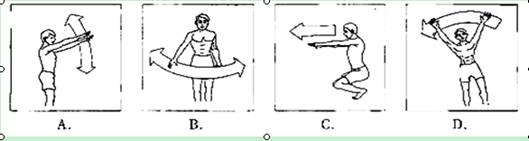
2. What can we learn from the passage?
A. Swinging your arm from side to side means "yes".
B. If the ground is dark, light smoke can't be seen.
C. If you need some medicine, make a symbol "II".
D. The pilots make replies with a blue light at night.
3. What is the passage mainly about?
A. The explanation of building signals on an island.
B. The importance of making signals on an island.
C. Ways of sending out signals on a lonely island.
D. Ways of receiving signals from a lonely island
Monday morning is an important time at our school. All of the students go to the playground. We liste n to music, and we 36 the national flag (国旗) go up.
Usually, one student gives a talk on Monday mornings. One Monday last year, a boy gave the talk. He was 37 and excited! When I saw him, I wanted to have a try, too. Can I really do it?
Last week, our teacher said our class should give the talk. My teacher 38 me, "I know you want to have a try. Next Monday, you can give the talk. Go and write something down. 39 for it. I'm sure you'll do well." "Thank you," I answered. It was such a great 40 for me!
When I got home, I was excited. I wrote two pages for the talk. I read them again and again. When I read, I asked my parents 41 _ it. I  wanted to make my teacher happy.
Monday morning came. I began to feel 42 . When did I last give a talk to 43 many people? Never! This was my first time. Could I really 44 it? Maybe I couldn't finish the talk.
When I got to school, we all went out to playground. I 45 in front of everyone. I opened my mouth, but I couldn't say anything.
36. A. watch B. see C. notice D. look at
37. A. surprising B. proud C. amazed D. careful
38. A. told B. asked for C. said to D. showed
39. A. Look out B. Come on C. Take care D. Get ready
40. A. chance B. news C. time D. message
41. A. to listen to B. to listen C. listen to D. listen
42. A. excited B. happy C. nervous D. surprised
43. A. after B. such C. before D. so
44. A. do B. speak C. talk D. take
45. A. stand B. stood C. was standing D. have stood
Monday morning is an important time at our school. All of the students go to the playground. We listen to music, and we 36 the national flag (国旗) go up.
Usually, one student gives a talk on Monday mornings. One Monday last year, a boy gave the talk. He was 37 and excited! When I saw him, I wanted to have a try, too. Can I really do it?
Last week, our teacher said our class should give the talk. My teacher 38 me, "I know you want to have a try. Next Monday, you can give the talk. Go and write something down. 39 for it. I'm sure you'll do well." "Thank you," I answered. It was such a great 40 for me!
When I got home, I was excited. I wrote two pages for the talk. I read them again and again. When I read, I asked my parents 41 _ it. I wanted to make my teacher happy.
Monday morning came. I began to feel 42 . When did I last give a talk to 43 many people? Never! This was my first time. Could I really 44 it? Maybe I couldn't finish the talk.
When I got to school, we all went out to playground. I 45 in front of everyone. I opened my mouth, but I couldn't say anything.
36. A. watch B. see C. notice D. look at
37. A. surprising B. proud C. amazed D. careful
38. A. told B. asked for C. said to D. showed
39. A. Look out B. Come on C. Take care D. Get ready
40. A. chance B. news C. time D. message
41. A. to listen to B. to listen C. listen to D. listen
42. A. excited B. happy C. nervous D. surprised
43. A. after B. such C. before D. so
44. A. do B. speak C. talk D. take
45. A. stand B. stood C. was standing D. have stood
In England people usually don't talk very much. On a bus or a train, you can see everyone sits looking out of the window(看着窗外). And they often read books and newspapers. But they don't talk much. When you meet English people, they often talk about one thing-the weather. So when you meet someone in England, you can say, "It's fine today, isn't it?"
"But it was a little cold yesterday." He may answer.
"Oh, it will be warmer later!" you can say. Talk like this, and the English will think, "How friendly you are!"
( )36. In England people often ______ on a bus or train.
A. read books B. read newspapers C. talk much D. A and B
( )37. When you meet English people, you can talk one thing-______.
A. the newspaper B. the family C. the weather D. the books
( )38. When you meet a young woman on a train, you can say, ______
A. "You are beautiful." B. "It's fine day today, isn't it?"
C. "How old are you?" D. "It's very kind of you."
( )39. The woman may answer, ______.
A. "Thank you." B. "I'm twenty-five."
C. "You are beautiful, too." D. "But it was a little cold yesterday."
( )40. If you talk about the weather with English people, they may think you are ______.
A. friendly B. friend C. beautiful D. good
根据句意补全下列单词。
1.They are t________lking about a story.
2.What do you want to be in the f________ture?
3.I like ph________s________cs best.
4.I w________sh you good health.
5.M_______ _______be the pen is Li Ping's.
湖北省互联网违法和不良信息举报平台 | 网上有害信息举报专区 | 电信诈骗举报专区 | 涉历史虚无主义有害信息举报专区 | 涉企侵权举报专区
违法和不良信息举报电话:027-86699610 举报邮箱:58377363@163.com