
题目列表(包括答案和解析)
Every morning, the newspaper chief editor(主编) holds a meeting with the reporters. They discuss the main events(事件) of the day. Reporters are then sent to cover the events.
As soon as the reporters know what to write about, they get down to work. They telephone people and fix a time for a face-to-face interview with them. Sometimes they do telephone interviews. Checking information is very important. They go to the newspaper's own library to look up any information that they need. This is called “doing one's homework”.
At the same time, the picture editor decides which photographs will be used for the next day's paper. All the people who work on a newspaper must be able to work fast. Reporters have to stop working on one story and start working at once on the important new one. They must find out the new information as quickly as possible. Later in the day, everything is put together at the news desk. Reporters return, type their stories into the computer and hand them to the editor.
The chief editor decides which will be the most important story on the front page. Sometimes this will have to be changed if something more important happens late in the day. Other editors read the stories which the reporters have written and make any necessary changes.
Finally, there is no more time left for adding new stories, and the time for printing(印刷) the newspaper has come. This is done on fast-moving printing machines. The newspapers are then delivered(发送) by truck, plane or rail. Speed is important. People want to buy the latest newspaper; nobody wants to buy yesterday's.
1.What is the work in a newspaper office like?
A. Interesting and confusing B. Important and patient.
C. Particular and necessary. D. Fast and busy.
2.According to the passage, the right order for a reporter's work is ____________.
a. writing stories b. doing interviews c. joining in a discussion
d. doing homework e. handing stories to the editor
A. c-b-a-d-e B. c-d-e-a-b C. c-b-d-a-e D. c-a-d-b-e
3.The front page contents(内容) are decided by ___________.
A. the importance of the events
B. how well the stories are written
C. the knowledge of the chief editor
D. whether they are the latest
4.Word editors' work is to ____________.
A. help the chief editor with the morning discussion
B. decide when and how the papers can be printed
C. read the stories and make necessary changes
D. get together information from reporters and photographers
5.The best title for this passage is “____________”。
A. How a newspaper is produced B. How newspapers are delivered
C. What kind of papers readers like D. Whose work is more important
The train leaves at 6:00 p. m. So I have to be at the station ________ 5:40 p. m. at the latest.
[ ]
Spring can be rainy or windy, (3) the weather is getting warmer and you can hope more sunny days. In fact there (4) as much sunshine in spring as in summer. Summer is (5) time for visitors to the seaside and other places of interest. The weather can be sunny and nice. People often go out to have a walk or swim. Autumn is a beautiful season, (6) trees in the woods and parks changing color. During autumn it is still nice to be outside, too. In winter, it gets colder. It might snow, especially on high and in the north. There are (7) very high winds in this season.
January and February are the coldest (8) of the year, while the warmest (9) often July and August. The difference (10) temperature between winter and summer is not so great in Britain. The average temperature for winter is about 4. 5℃,and for summer about 15. 5℃.
( ) (1). A. For B. As C. Because D. Since
( ) (2). A. make B. stay C. change D. take
( ) (3). A. but B. and C. or D. for
( ) (4). A. can B. can be C. have D. can have
( ) (5). A. the earliest B. the latest C. the worst D. the best
( ) (6). A. with B. like C. without D. from
( ) (7). A. also B. too C. either D. as well
( ) (8). A. seasons B. weather C. months D. month
( ) (9). A. is B. are C. was D. were
( ) (10). A. for B. on C. by D.in
根据短文内容选词填空。

What to do if you find yourself in a quake?
A little knowledge(知识)can make a difference at a time of life or death.Do you know what to do in an earthquake?
If you're inside:
1.Quickly move 1 a strong desk, a strong table or along a wall.You also can go into a small room 2 the bathroom.This will 3 you from fallimg things.Do not get into a lift(电梯).
2.Don't stand 4 windows, large mirrors, heavy furniture or fireplaces.
If you're outside:
1. 5 away from building and streetlights.These could fall on you.
2.Squat(蹲下)and protect your head 6 the shaking stops.
After the earthquake:
1.Check for injuries(受伤处),take 7 of injuries and help make sure people around you are all right.
2. 8 out for aftershocks(余震).
3.Protect 9 by wearing long pants, a longsleeved(长袖的)shirt, strong shoes and gloves.
4.Listen to the radio for the latest 10 .
1.________ 2.________ 3.________ 4.________ 5.________
6.________ 7.________ 8.________ 9.________ 10.________
In the summer of 1978 an English man named Steven was driving his tractor through a field of wheat when he discovered something strange. Some of his wheat was lying on the ground. The flattened wheat formed(形成)a circle about six meters across . Around this circle were four smaller circles of flattened wheat.
Three years later a farmer who lived nearby discovered almost the same circles in one of his fields. These circles were larger—nearly 15 meters across . That same year , another English farmer discovered three circles of flattened wheat on his land—one large circle between two small circles. During the following years, farmers in England found circles in their fields more and more often.
The circles are called “crop circles” because they usually appear in fields of wheat or corn. The wheat in the circles lies on the ground but is never broken; it keeps on growing, and the farmers can later harvest it. Farmers always discover the crop circles in the morning, so the circles probably form at night. They appear only in the months from May to September. What causes the crop circles?
At first, people thought that some kids were making them as a joke, or that farmers were making them to attract tourists.(In fact, in 1991, two men said they made the circles themselves, but many scientists don’t believe them.) People tried to copy them: They tried to make circles exactly like the ones the farmers had found. They couldn’t do it. They couldn’t enter a field of wheat without leaving tracks, and they couldn’t flatten the wheat without breaking it.
Several times people reported seeing stranger objects near the fields where crop circles later appeared. Many people believe that these crop circles are the messages sent by living things from outer space(外层空间)or the marks left by their spaceships.
Scientists who have studied the crop circles try to find out what causes them. In the summer of 1990 some scientists spent three weeks in the part of England where many circles have appeared. They had all the latest high-tech equipment(最新高科技设备). The equipment—worth 1.8 million dollars—got nothing. But one night, as the scientists were watching a field, crop circles formed in the field behind them, which were quite different from the others. The scientists had neither seen nor heard anything.
When Steven discovered the crop circles on his land in 1978, he said, “It was just like something that had landed in the field from the air and gone back up again. I don’t know what to make of these things.”
Crop circles have appeared in England, Japan, the United States and Russia. Experts from all over the world have studied them, and they say what Steven said: They don’t know what to make of these things.
【小题1】Which picture is probably the one formed in the field behind the scientists?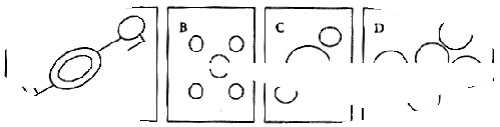
【小题2】“Flattened wheat” means ___________.
| A.broken wheat | B.lying wheat | C.harvested wheat | D.growing wheat |
| A.that is done by living things from outer space |
| B.that cannot be solved but found all around the world |
| C.that cannot be made clear or understood |
| D.that is discovered and copied by the farmers |
湖北省互联网违法和不良信息举报平台 | 网上有害信息举报专区 | 电信诈骗举报专区 | 涉历史虚无主义有害信息举报专区 | 涉企侵权举报专区
违法和不良信息举报电话:027-86699610 举报邮箱:58377363@163.com