
题目列表(包括答案和解析)

| A.visiting historical places in China |
| B.traveling cheaply with just one bag |
| C.who love to travel and see the world alone |
| D.who love to buy local things as souvenirs |
| A.Come close to nature in the holiday carefully. |
| B.Protect the living things in the area. |
| C.Be careful not to destroy the nature beauty. |
| D.Keep the local people unhappy. |
| A.the hotel and the companies hire local people to help them earn money |
| B.local people used to hunt and kill whales and dolphins but now they don't |
| C.not many boats are used at the same time so animals aren't disturbed |
| D.the cars and boats use fuel to cause pollution and make the sea dirtier |
| A.It's a cheap and popular way to travel and see the world as a backpacker. |
| B.We believe an ecotourism can greatly protect the nature beauty and living things. |
| C.China's tourist attractions can be protected because of being visited by tourists. |
| D.We’d better find good ways to share our treasures and keep them good. |
一、录音中有五个句子,每个句子听一遍,然后从每小题后的A、B、C中选出能对每个句子作出适当反应的答语。
1.
[ ]
|
A.A good idea. |
B.Enjoy yourself. |
C.I think so. |
2.
[ ]
A.Take care.
B.Have a good time.
C.Good luck.
3.
[ ]
A.You are too young.
B.Better wait until spring.
C.You need more exercise.
4.
[ ]
|
A.My pleasure. |
B.That's all right. |
C.Sure. |
5.
[ ]
|
A.She is a teacher. |
B.She is my sister. |
C.She is English. |
二、录音中有五组对话,听两遍对话后,从每小题后的A、B、C中选出能回答所给问题的正确答案。
6.How much time is left for the woman?
[ ]
|
A.Twenty minutes. |
B.Ten minutes. |
C.Thirty minutes |
7.How will the man go to Beijing?
[ ]
|
A.By plane. |
B.By train. |
C.By car. |
8.Who is the man speaking to?
[ ]
A.His daughter.
B.His daughter's teacher.
C.His teacher.
9.What is Mary going to do after supper?
[ ]
A.See a film.
B.Go to a meeting.
C.Prepare for her speech.
10.Which of the following pictures is right about Jane?
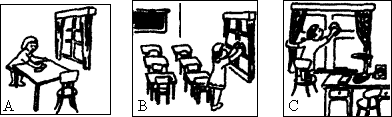
三、录音中有一段对话,听两遍对话后,从每小题后的A、B、C中选出能回答所给问题的正确答案。
11.How long has the man had the radio?
[ ]
A.Two days.
B.Two weeks.
C.Two months.
12.Why does the man come to the shop?
[ ]
A.He wants to buy a radio.
B.He wants to get a different radio.
C.There is something wrong with his radio.
13.Why can't the man wait long?
[ ]
A.He needs the money very much.
B.The factory is too far away.
C.He is using it to learn English.
14.What does the man hope to do?
[ ]
A.Change his radio for another one.
B.Send it back to the factory.
C.Get it repaired.
15.What may be the result?
[ ]
A.The man gets back his money.
B.The man gets a new radio.
C.The man gets his radio repaired.
四、录音中有一篇短文,听两遍短文后,从每小题后的A、B、C中选出能回答所给问题的正确答案。
16.Who is the speaker?
[ ]
A.Mr. James.
B.A student.
C.A geography teacher.
17.What are the students going to do tomorrow?
[ ]
A.Have a picnic.
B.Have a writing class.
C.Have a field trip.
18.What will the students have to do tonight?
[ ]
A.Look at the rocks.
B.Study the piece of paper.
C.Write a report.
19.What will the students try to look at in the field?
[ ]
|
A.Rocks. |
B.Plants. |
C.Animals. |
20.What should the students do to make it a rewarding(值得的) experience?
[ ]
A.Take care of plants and animals.
B.Put their hearts into it.
C.Put some money in the bank.
 Children are natural scientists, very interested in the world around them. Helping them enjoy science can be easy; there’s no need for a lot of scientific terms(科学术语)or modern labs. You only have to share your children’s interests.
Firstly, listen to their questions. I once visited a classroom of seven-year-old children to talk about science as a job. The children asked me “textbook questions” about schooling, the money I got and whether I liked my job. When I finished answering, we sat facing each other silently. Finally I said, “Now that we’ve finished with your lists, do you have questions of your own about science?”
After a long wait, a boy put up his hand, “Have you ever seen a grasshopper(蚱蜢) eat? When I try eating leaves like that, I get a stomachache. Why?” This began a lot of questions that lasted nearly two hours.
Secondly, give them time to think. Studies over the past 30 years have shown that, after asking a question, many teachers usually wait only one second or less for an answer, no time for a child to think. When teachers increase their “wait time” to three seconds or more, children give better answers.
Thirdly, watch your language. When the child is having a science discussion, don’t jump in with “That’s right” or “Very g ood”. These words work well when i
 t comes to encouraging a child to help others. But in talking about science, these words make a child think that the discussion is over. Instead, keep things going by saying, “That’s interesting” or “I’ve never thought of it that way before”, or coming up with more questions or ideas.
Lastly, show; don’t tell. Let children look at their hands through a microscope(显微镜), and they’ll understand why you want them to wash before dinner….
81. To help children enjoy science, the most important thing for teachers to do is ___________.
A. let them see the world around B. let them study in modern labs
C. tell them the difficult terms on science D. share the children’s interests
82. In the last sentence of the second paragraph, the words “your lists” mean ____________.
A. your answers to the questions B. your own questions about science
C. your questions from textbooks D. all the questions of your own
83. According to the passage, children can give better answers to the questions if teachers ____.
A. ask them to answer quickly B. wait for one or two seconds after a question
C. tell them to watch their language D. wait at least three seconds after a question
84. The writer talks about all of the following ways except that teachers should ____________.
A. tell their children stories instead of telling them to remember facts
B. offer their children chances to see things for themselves
C. allow enough time for their children to find answers to the questions
D. encourage their children to ask questions of their own
85. The writer of the passage is probably ____________.
A. a teacher B. a scientist
C. a seven-year-old boy’s father D. a reporter
| |||||||||||||||||||||||||||
People who remember other people’s names enjoy a huge advantage(优势). They may become the most popular person simply by recalling(记起) people’s names and introducing them to each other.
★Listen.
Improving your memory, in any field, begins with one simple rule: paying attention. When you want to remember a new person’s name, you have to listen when he says it. Forget for a moment what you want to say and simply listen.
★Repeat it immediately.
Pretend you don’t hear the name clearly and repeat it, “You said your name was John.” Or you may say it out loudly when you shake hands. Try to use the name several times in conversation like “What do you think about this, John?” Or “See you, John.”
★Write the name on their forehead.
John Smith. Imagine his name is written on his forehead. This may seem childish(孩子气的), but the more unusual the picture we see, the better we recall it.
★ .
Look for a special feature(特征) of the person, like a long face or big eyes. Next time you meet this familiar person, you will remember his name.
★Find the famous name in the person.
Imagine the person standing in front of you as a famous person with the same name and you will remember his name. And then you have it, the secret of your amazing memory.
49. How many ways does the writer tell us to remember people’s names?
A. Two. B. Three. C. Four. D. Five.
50. What is the advantage of remembering people’s names?
A. You can become clever. B. You will become a popular person.
C. You can remember more things. D. You don’t need the introduction.
51. Which sentence can help you remember Kate’s name?
A. How do you do? B. Nice to meet you. I am Linda.
C. Hello! Kate. D. Is your sister Lucy there?
52. Which of the following can be put in the blank (空白处) ?
A.Find the picture in the person. B. Find the name in the person.
C. Find the size in the person. D. Find the weight in the person.
湖北省互联网违法和不良信息举报平台 | 网上有害信息举报专区 | 电信诈骗举报专区 | 涉历史虚无主义有害信息举报专区 | 涉企侵权举报专区
违法和不良信息举报电话:027-86699610 举报邮箱:58377363@163.com