It’s n of you to give your seat to the elderly on the bus. 查看更多


题目列表(包括答案和解析)

读对话,判断正(T)误(F)

  A:Hello,Tom.Nice to meet you.

  B:Nice to meet you,too,Gina.

  A:What's this in English?

  B:It's a dictionary.

  A:How do you spell it?

  B:D-I-C-T-I-O-N-A-R-Y.

  A:Is it your dictionary?

  B:No,it isn't.It's John's.

  A:Is that John's notebook?

  B:No,it isn't.It's mine.

  A:Is this my computer game? Your brother(兄弟) borrowed(借)it from me.Right?

  B:Yes,it's your computer game.

1.Tom can(能够)not spell dictionary.

(  )

2.The dictionary is John's dictionary.

(  )

3.That notebook is Gina's notebook.

(  )

4.The computer game is Gina's computer game.

(  )

查看答案和解析>>

完形填空

A:What's  1  name?

B: 2  name's Jack.

A:What's your  3  name?

B: 4  Cooper.

A:How do you  5  it?

B:C-O-O-P-E-R.

A: 6  this your backpack?

B:No, 7 .It's  8  backpack.

A:What's this  9  English?

B:It's  10  notebook.

1.

[  ]

A.I'm
B.your
C.you

2.

[  ]

A.His
B.Your
C.My

3.

[  ]

A.first
B.given
C.last

4.

[  ]

A.It's
B.Is
C.It

5.

[  ]

A.say
B.spell
C.call

6.

[  ]

A.Are
B.Is
C.Am

7.

[  ]

A.it is
B.it isn't
C.it's my

8.

[  ]

A.she
B.he's
C.her

9.

[  ]

A.in
B.on
C.for

10.

[  ]

A.he
B.she
C.my

查看答案和解析>>

-What's this?

-It's ________ “N”and “U”.

[  ]

A.an, a

B.an, an

C.a.an

D.a.a

查看答案和解析>>

阅读下面短文,从各题A、B、C、D四个选项中选出最佳选项。

  More and more new languages appear on the Internet.We call them "cyber* languages” .Recently “geili” is everywhere.It is a Chinese word in English alphabet*.Since “geili” sounds like “geli” in pinyin, netizens* invented the word “geli” .And Chinese does not have part of speech, so it can be a noun, a verb, an adjective or adverb at the same time.To fit into different parts of speech, they created “gelivable” the adjective, and “gelivability” the noun.It means “giving power” or “cool” .

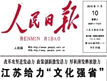
  We have many cyber words like this.Some of these words and expressions were even picked up in serious media* reports.On November 10, the People's Daily, carried a front-page* news story with the title “Jiangsu gelivable cultural province” .

  David Tool, a professor with the Beijing International Studies University, first heard the word “gelivable” from his students.He said it was very interesting to combine Chinese with English to create new words.

  Sergey Dmitriev, a student from Russia studying international politics at Liaoning University, believed the words are a way to learn more about Chinese society.“In Russia, similar words were created, as well, ” he said, adding that creation of the English words showed greater influence and more of an opening of China to the world.

  “Cyber language is more vivid*, ” Wu Zhongmin, a professor at the Party School of the Central Committee of the Communist Party of China, said.A writer, Wang Pei, thinks language is always developing.

  But an unnamed official said that, in fact, many senior* staff from news media were worried that years later, the younger would forget how to use formal* Chinese expressions.

  “My father is Li Gang” is another popular cyber language.What other cyber language do you know? What do you think of them?

(1)

“Geli” is a(n) ________ word in English alphabet.

[  ]

A.

Chinese

B.

English

C.

Russian

D.

Japanese

(2)

Words like “gelivable” were created by ________.

[  ]

A.

professors

B.

netizens

C.

some senior staff

D.

English people

(3)

It's clear that ________.

[  ]

A.

David Tool doesn't think it's good to create new words like “gelivable”

B.

Sergey Dmitriey is a professor at the Party School of the Central Committee of the Communist Party of China

C.

Wu Zhongmin were worried that years later, the younger generation would forget how to use formal Chinese expressions

D.

some serious media also use cyber languages

(4)

The main idea of the passage is ________.

[  ]

A.

people and “gelivable”

B.

how “gelivabe” come into use

C.

cyber languages like “gelivable”

D.

what is “gelivable”

查看答案和解析>>


一、听句子,选择恰当的答语。(每个句子读一遍)

1.

[  ]

A.It's a pleasure.

B.That's right.

C.That's OK.

2.

[  ]

A.I'm sorry to hear that.

B.Hold on, please.

C.Very well, thank you.

3.

[  ]

A.I used to go to bed at ten.

B.I go to bed late.

C.It's ten o'clock.

4.

[  ]

A.It's fifty yuan.

B.There're two coats.

C.It's green.

5.

[  ]

A.To the park.

B.At the library.

C.On foot.

二、根据所听句子,从A、B、C三个选项中选出一个意思与其相同或相近的句子。(每个句子读一遍)

6.

[  ]

A.I like eating apples.

B.Apples are my favourite.

C.I want to eat an apple.

7.

[  ]

A.My little brother is young, but he can look after himself.

B.My little brother is very young, he can't look after himself.

C.My little brother can look after himself because he is young.

8.

[  ]

A.We didn't have a good time on our way home.

B.We were unhappy when we got home.

C.We enjoyed ourselves on our way home.

9.

[  ]

A.You can borrow the two books.

B.You can't borrow the two books.

C.You can borrow only one of the two books.

10.

[  ]

A.He walked to her house yesterday.

B.He got to her house in a car yesterday.

C.He went to her house by train.

三、听对话和对话后的问题,选择正确的答案。(每段对话和问题读两遍)

11.

[  ]

A.To the cinema.

B.To the library.

C.To the museum.

12.

[  ]

A.To the classroom.

B.To the library.

C.To the teacher's office.

13.

[  ]

A.The man likes winter.

B.Winter will come.

C.The woman likes winter.

14.

[  ]

A.A conductor and a passenger

B.A clerk and a customer

C.A shop assistant and a customer

15.

[  ]

A.She was first.

B.She was third.

C.She was fourth.

四、听短文及其后面的问题选择正确答案。(每段对话和短文及问题读两遍)

16.

[  ]

A.A young man.

B.A girl.

C.A woman.

17.

[  ]

A.Nothing

B.Something

C.The woman's son.

18.

[  ]

A.Yes. He is the woman's friend.

B.No. He is only a stranger to her.

C.No. He is a conductor on the train.

19.

[  ]

A.The woman's son should stop smoking.

B.The woman's son is a good young man.

C.The woman's son has a good mother.

20.

[  ]

A.Fifteen years old.

B.Five years old.

C.Five months old.

查看答案和解析>>


同步练习册答案