
题目列表(包括答案和解析)
阅读理解。
Mr Young worked in a factory. He was an able (有能力的) worker and could get more money than
his workmates. His wife was able, too. She did all the housework and took good care of her
children. They were never worried about food or clothes. But they were both miserly (吝啬) and tried to
save everything. Their family wore old and broken clothes. He always went to work and their children
went to school on foot.
One afternoon, while Mrs Young was cooking supper, she heard the bell. A man said on the
telephone, "I'm sorry to tell you something unlucky. Your husband died in an accident. "
The woman hardly believed her ears. "When did it happen?" she shouted sadly. "At four, Mrs Young. "
"It's half past five!" the woman said angrily. "Why didn't you tell me about it an hour ago? I've cooked
supper for him ! "
"Everything was confused (混乱的) here at that moment and all of us forgot it. "
"What were his last words? "
"He asked us to retell you he wouldn't go back for supper!"
1. Mr Young was able, so_____.
A. he wore old clothes
B. he spend twenty to work on foot
C. he lived a happy life
D. he got more money
2. Mr Young's children went to school on foot because_____.
A. they were poor
B. his parents tried to save money
C. there were no buses in the town
D. they hoped to do morning exercises
3. Mrs Young began to cook supper at_____.
A. four
B. half past four
C. five
D. half past five
4. The phrase "last words " in the story means_________.
A. 最后一些词语
B. 最后一些话
C. 遗言
D. 嘱托
5. Mrs Young became angry because .
A. she wasn't told about the bad news before she cooked supper.
B. the factory didn't retell her husband's last words in time.
C. she couldn't see her husband before he died.
D. she didn't know whether her husband's last words were real.
How often does one hear children wishing they were grown ups, and the old wishing they were young again? Each are has its pleasure and its pains,and the happiest person is the one who enjoys what each age gives him without washing any time in useless regrets (悔恨).
Childhood is a time when there are few duties to make life hard.If a child has good parents,he is fed,looked after,and loved whatever he may do.It’s impossible for him to be given so much again in his life without having to do anything in return.Also,life is always giving new things to the child.A child finds pleasure in playing in the rain, or in the snow.His first visit to the seaside makes him wild.But a child has his pains he is not free to do things as he wishes.He is always being told not to do this,not to do that,or being punished (惩罚) for what he has done wrong.So his life is not quite happy.
When the young man starts to make his own living he becomes,free from the discipline (约束) of schools and parents.But at the same time he is made to accept duties.He can no longer expect others to pay for his food,his clothes and his room,but has to work if he wants to live comfortably.If he spends most of his time pitying about in the way that he used to as a child,he will go hungry.And if he breaks the law of the society as he used to break the laws of his parents,he may go m prison (监狱).If,however,he works hard,keeps out of trouble,and in good health,he can have the great happiness of seeing himself do better in his job and building up his own place in the society.Old age has always been thought of as the worst age to be in,but it is not necessary for the old to be unhappy.Old age should come with wisdom and the ability to help others.They can have the joy of seeing their children doing better in life; they can watch their grandchildren growing up around them and,perhaps,best of all,they can,if their life has been a useful one,feel the happiness of having come through the fight of life safely and of having reached a time when they can lie back and rest,leaving others to go on with the fight.
1.According to the passage,to a child,______.
A.he is free of duties,but he is short of freedom
B.everything may give him pleasure,but he can't do anything as he wishes to
C.life is always new to him,but he can't do anything
D.he is always loved and has no worries,but he can't be happy
2.The writer mainly tells us that______
A.everyone lives a happy life B. each age has its pleasure and its pains
C.children are the happiest D.time is everything
3.A young man who starts to make his own living_______
A.can spend his time playing about in the way he used to as a child
B.can wait for others to feed him
C.is free to break the law of society
D.is happy to see himself getting on well with his job
4.In the writer's opinion,the old _______.
A.are useless people B.have to help others
C.have their own pleasure D.are the best group
5.Which period of one's life is the best according to the writer?
A.Childhood. B.Youth.
C.Old age. D.He doesn't tell us.
听力部分(20分)
1)本部分共10道小题,每小题你将听到一段对话,每段对话听两遍。(10分)
1.Where does Lily come from?
A.
B.
C.
2.When does the shop open today?
A.
B.
C.
3.Which is Daniel's?
A.
B.
C.
4.What is the boy going to do this Saturday?
A.
B.
C.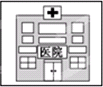
5.Where are Kate's glasses?
A.On the table.
B.Under the chair
C.In the bag.
6.Whose books are these?
A.Kitty's
B.Sandy's
C.Millie's
7.Can Mary speak English?
A.Yes, she can
B.No, she can't
C.Sorry, I don't know.
8.Where is the mother going?
A.To the sports shop
B.To the supermarket
C.To the clothes shop
9.How much does he spend?
A.10 yuan
B.20 yuan
C.40 yuan
10.Is the desk heavy or light?
A.Big
B.Small
C.Heavy
2)听对话和短文回答问题。你将听到两段对话和一篇短文,听两遍。(10分)
听第一段对话,回答11-12小题。
11.Where does the boy see the strange(奇怪的)bird?
A.In the park
B.In the zoo
C.Behind his house
12.What colour is the bird?
A.Black
B.White
C.Red
听第二段对话,回答13-15小题。
13.What will Mary do this evening?
A.Go to Beihai Park
B.Study at the aunt's home
C.Meet her friends
14.How will she go tomorrow ?
A.By bus
B.By taxi
C.By car
15.When will they meet?
A.8∶30 a.m
B.7∶30 a.m
C.9∶00 a.m
听一篇短文,回答16-20小题。
16.How old is Nick?
A.13 years old
B.12 years old
C.15 years old
17.Where is he from?
A.America
B.England
C.Canada
18.Can Nick speak a little Chinese?
A.Yes, he can't.
B.No, he can't.
C.Yes, he can.
19.What does Nick often do with his father on Sundays?
A.Goes swimming.
B.Goes shopping.
C.Plays basketball.
20.How many people are there in Nick's family?
A.9
B.8
C.7
根据短文内容及首字母提示,填写所缺单词,使短文意思完整。
John gets up early from Monday to S 1. , because he must go to school before 7:30 on weekdays(工作日) and go to the D 2. Club at 8:00 on Saturday mornings. He draws very well. He usually goes to the b 3. to look at the new books on Saturday afternoons, and after supper he watches TV until(直到) m. 4.
He doesn’t get up early on Sundays. John’s parents b 5. work on Sundays. John always watches TV after he gets up. Then he usually goes to KFC to have a h. 6. and some juice for lunch. After that, he goes back home and b 7. to play computer games until his parents come back. He does his homework after supper. He usually has a lot of w 8. homework, so he must s 9. three hours on it. He usually goes to bed at about 11:00 p.m. on Sundays. He often complains(抱怨) he has too m 10. homework to do.
湖北省互联网违法和不良信息举报平台 | 网上有害信息举报专区 | 电信诈骗举报专区 | 涉历史虚无主义有害信息举报专区 | 涉企侵权举报专区
违法和不良信息举报电话:027-86699610 举报邮箱:58377363@163.com