
题目列表(包括答案和解析)
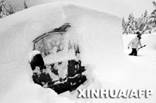
Europeans are being dug out from heavy snow after a week of very cold weather. The snowstorm is the harshest to hit Europe. Airports were shut down. And schools have been closed for a week.
Until Wednesday, at least 400 people across Europe had died because of the cold temperature. Several countries have said a state of emergency. In Ukraine, temperatures dropped as low as -33℉.
Although the situation is bad, at least one country is hoping the weather will last a little longer. In the Netherlands, the government is preparing for the country’s “11 Cities Tour”. The 125-mile ice-skating marathon will be held along a network which joins 11 towns and cities together in Friesland Province.
The ice along the way must be inches thick for the event. Up to 2 million people are thought to cheer on the race’s 16,000 competitors.
On Wednesday, Dutch soldiers joined in the preparations. They cleaned snow along the way. This will be the 16th time that the event has taken place since the first race in 1909. Dutch General Hans said his soldiers were happy to lend a hand. “We want to do our bit for this national party.” he said.
1.What is “11 Cities Tour”?
A. It’s a 125-mile ice skating marathon.
B. It’s a 11-mile ice skating marathon.
C. It’s a 16000-mile ice skating marathon.
D. It’s a 33-mile ice skating marathon.
2.Which of the following statements is TRUE according to the passage?
A. Thousands of people across Europe died because of the weather.
B. The ice should be less than 6 inches thick for the event.
C. No country is glad to see the cold weather.
D. The first “11 Cities Tour” began in 1909.
3.Who helped clean snow along the way?
A. French soldiers B. Dutch soldiers
C. Ukrainian soldiers D. American soldiers
4.The underlined word “harshest” means _______ in the passage.
A. safest B. most enjoyable C. most serious D. happiest
5.The passage is mainly about______.
A. the hard situation Europe faces
B. the European cold weather
C. preparations for a national party
D. the coldest season in Europe
"Everything happens for the best," my mother said whenever things weren’t going my way. "Don’t worry. One day your luck will change."
Mother was right, as I discovered after I had finished my college education, I had decided to try for a job in radio. One day, I wanted to host a sports programme. I went to Chicago and knocked on the door of every station. But I got turned down every time.
In one station, a kind lady said my problem was that I hadn’t got enough experience. "Get some work with a small station and work your way up," she said.
I went back home. I couldn’t get a job there, either. Then my dad told me a businessman had opened a store and needed someone to help him. But again, I didn’t get the job.
I felt really down. "Your luck will change," Mom said to me. Dad lent me the car to help me to look for my job. I tried another radio station in Lowa. But the owner, a nice man, told me he had already had someone.
As I left his office, I asked, "How can someone be a sports announcer(播音员) if he can’t get a job in a radio station?"
I was waiting for the lift when I heard the man call. "What did you mean? Do you know anything about football?" He put me in front of a microphone and asked me to try to imagine that I was giving my opinion on a football game, I succeeded.
On my way home, Mom’s words come back to me, "One day your luck will change, Son. And when it happens, it’ll feel doubly good because of all the hard work you’ve had." At that moment I knew just what she meant.
16. What’s the writer’s ideal job?
A. A sportsman. B. A shop assistant.
C. A sports announcer. D. A businessman.
17. Why didn’t the writer get the job in Chicago?
A. Because he was too young.
B. Because he didn’t get college education.
C. Because he’s got a good-looking person.
D. Because he hadn’t got enough experience.
18. The sentence "But I got turned down every time. "means" ".
A. But I was refused every time
B. But I was successful every time
C. But I lost my way every time
D. But the door of every station was always closed
19. What made the writer succeed in the end?
A. His mother’s words. B. A kind lady’s help.
C. His father’s car. D. His own hard work.
20. What’s the best title of this passage?
A. Mother’s Words. B. Everything Happens for the Best.
C. No One Is Always Lucky. D. To Find a Job in Radio Is Difficult.
As you are soon on your way to Eastern Europe, here are a few tips on what you should pack. In general, pack lightly, with only the most basic clothes. People dress casually(随便地) in Eastern Europe, so you don’t need to bring along your smartest clothing.
Batteries: If your camera, flash, or other appliances run on batteries, bring enough supply along. Certain types of batteries don’t exist in Eastern Europe, and those that do often don’t last very long.
Cash: We have found it good to have supply of small-unit U.S. bills($1and $5) to use in hard–currency stores, to buy international train tickets, etc. The hard–currency stores never seem to have the right change.
Electric Current Adapter(转换器): If you bring any appliances, remember that the electricity in Eastern Europe uses 220 volts A.C., not the standard 110 volts of North America. A 110 volts appliance will soon burn out when attached to an unchanged 220-volt plug.
Language Tools: One of Europe’s biggest challenges is communicating with the local people since their languages are so different from our own. To help overcome difficulties, you might buy phrasebooks before you go — you won’t find them once you are in Eastern Europe.
Money Belt: A money belt is especially helpful when you have many documents to carry around ( as you always do in Eastern Europe). The best one we find is made by Eagle Greek Travel Gear, 143 Cedros Ave. (P. O. box 651), Solona Beach, CA 92075 (tel. 619/755 – 9399, or toll free 800/874 – 9925) outside California.
Traveler’s Checks: These are necessary. Bring your traveler’s checks in small to medium unit ($10, $20, or $50) to change a little bit at a time, so as not to be left with a lot of local money. To be on the safe side, be sure to copy down the check numbers in two places, just in case something happens to the checks.
【小题1】How many tips are mentioned in the passage?
| A.6 | B.7 | C.8 | D.9 |
| A.Appliances. | B.Money. | C.Language. | D.Clothes. |
| A.To tell you it’s not easy to stay in Eastern Europe. |
| B.To give you some advice on what you should pack when you’re in Eastern Europe. |
| C.To tell you something about the life in Eastern Europe. |
| D.To show you the life in Eastern Europe is different from that in your country. |
| A.1; 3 | B.3; 3 | C.2; 3 | D.2; 2 |
Green is an important color in nature. It is the color of grass and the leaves on trees. It is the color of most growing plants, too.
Sometimes, the word green means young, fresh and growing. Sometimes, it describes something that is not yet finished or plants that are not ripe.
For example, a greenhorn is someone who has no experience, who is new to a situation. In the fifteenth century, a greenhorn was a young cow or ox whose horns had not yet developed. A century or so later, a greenhorn was a soldier who had not yet had any experience in war (战争). By the eighteenth century, a greenhorn had the meaning it has today--a person who is new in a job.
About one hundred years ago, greenhorn was a popular expression in the American west. Old-timers used it to describe a man who had just arrived from one of the big cities in the east. The greenhorn didn’t have the skills that he would need to live in the hard, rough country.
Someone who has the ability to grow plants well is said to have a green thumb. The expression comes from the early nineteen hundreds.
A person with a green thumb seems to have a magic touch that makes plants grow quickly and well. You might say that the woman next door has a green thumb if her garden continues to grow long after your plants have died.
The Green Revolution (革命) is the name which was given some years ago to the development of new kinds of rice and other grains. The new plants produced much larger crops. The Green Revolution was the result of hard work by agricultural (农业的) scientists who had green thumbs.
【小题1】According to the passage, a greenhorn means________ now.
| A.a young cow or ox whose horns have not yet developed |
| B.a soldier who has not had any experience in war |
| C.a person who is new in a job |
| D.a man who doesn’t have the skills to live in the country |
| A.未完成的 | B.成熟的 | C.青涩的 | D.老练的 |
| A.If there weren’t the Green Revolution, we would have no rice to eat. |
| B.The expression “the Green Revolution” appeared several years ago. |
| C.Because of the Green Revolution, we have more kinds of rice and other grains. |
| D.Agricultural scientists with green thumbs started the Green Revolution. |
| A.all growing plants is green |
| B.green is the most important color in nature |
| C.a person with a green thumb can make plants grow well |
| D.the expression “a green thumb” has a history of two hundred years |
| A.a greenhorn | B.a green thumb |
| C.the Green Revolution | D.the word “green” and its story |
Fans often only see the good side of fame. They see the happy smiles and great success of famous people. But it’s difficult for them to understand everything that comes before then. They can’t see the hard work or the hours of practice.
Li Yundi, the Chinese piano prodigy(天才), recently released his first concert recording. He talked with Teens about his art and his job.
“Of course, the job is hard work,” Li, 25, said. “You need to work hard to be a professional. But you also have to play hundreds of concerts, meet fans, and listen to critics(评论) of your music.”
In 2000, when Li was 18, he won the top prize at the International Chopin(肖邦) Competition in Warsaw, Poland. This was the first time the top prize had been given in 15 years. Li was also the youngest, and the first Chinese to win the prize. Since then, Li became famous and his list of honors goes on and on.
Born in Chongqing, Li began to play piano when he was seven. His parents spent all their money and bought a piano for him--- a luxury in 1980s China.
He worked hard. Every day, Li played for eight hours or more at a piano school. He often played even after the school had closed.
Today, Li still can’ t play a beautiful tune without careful preparation.
“ You need to be ready on stage.” Li said. “People are waiting for you. Nobody knows whether you have slept enough, or whether you have another problem in your life. But you need to play great music for your audience. That’s what they want to hear.”
【小题1】What is Li Yundi? ______.
A. A music-critic B. A music fan C. A pianist
【小题2】What does the underlined word “luxury” mean in Chinese? ______.
A. 奢侈品 B. 流行品 C.豪华
【小题3】How long did it take Li to get the prize of Chopin Competition and became famous? ______.
A. 7 years B. 11 years C. 15 years
【小题4】What does the underlined sentence in the last paragraph mean? ______.
A. You need to sleep well the night before the performance
B. You should prepare carefully before the performance.
C. You need to know your audience.
【小题5】What does the passage mainly tell us? ______.
A. You need to be a prodigy to be successful.
B. You need to be happy to be successful.
C. You need to work hard to be successful.
湖北省互联网违法和不良信息举报平台 | 网上有害信息举报专区 | 电信诈骗举报专区 | 涉历史虚无主义有害信息举报专区 | 涉企侵权举报专区
违法和不良信息举报电话:027-86699610 举报邮箱:58377363@163.com