What happened you, David? A. to B. for C. at D. in *12. By the time we got there, the film already. A. began B. has begun C. have begun D. had begun *13. Your voice sounds quite . A. strangely B. stranger C. strangest D. strange *14.His gate at this time of day. Maybe you can see something if you come . A. closed, closer B. closes, close C. is closed, closer D. will close, closer *15. Why not order some flowers online for the shop everywhere? A. instead of looking B. instead looking C. instead of look D. instead look 查看更多


题目列表(包括答案和解析)

阅读理解。
     All over the planet, they are disappearing. Scientists are worried. It may mean the end of the world. I'm
not talking about disappearing frogs. I'm talking about absent vowels (元音). I got a message the other day
that said," Mt@ 3rd st crnr@ 12", signed (签字) "BT". What did it mean? A young man in the office told
me that BT meant" beauty" and translated:" A beautiful young woman wants to meet you at the corner of
Third Street at noon."  
     The following week I was at a private dining club when a Hong Kong banker named David told me he
had met with a man who pronounced his name Choong,but spelt C - H - N - G." There can't be many names
with no vowels in them," he said. It turned out he was sitting next to a Singaporean doctor named Ng. Vowels
are disappearing at high speed among businesses, too. Ever wondered what happened to Reebok, the
sportswear company? It's still around but has renamed itself Rbk. Kentucky Fried Chicken became KFC.
      I've read articles saying that the no-vowels trend (趋向) is caused by companies trying to give their
products the shorthand spelling liked by young people. But a research finds that the real reason is often more
uninteresting. Flickr,one of the busiest websites on the Internet, was set up by people who wanted the name
Flicker but were too careless to register (注册) that word.
     Have any readers ever been to a small town in the mountains of California called Zzyzx? A man named
Curtis Howe Springer founded it as a health club and called it Zzyzx because he thought it sounded different.
The business failed. People who looked through lists for somewhere to go never reached it.
     Older readers may remember the computer game Zzyzzyzz that appeared in 1982. Fans did not know
how to ask for it. James Gleick's book Faster has been re-titled FSTR. But the revision is half-hearted with
the main text of the book still having vowels. Why not write the whole book in the simpler way? U cn stll rd
the wtht vwls. On the other hand,just know that vowel-free words can be explained in different ways. One
day I'll get a message from a BT  who may be a beauty. But I'm afraid a bat (蝙蝠) will be out there.
1. The writer's purpose in the passage is _______.
A. to introduce a new trend
B. to study a new language
C. to correct a new mistake 
D. to show a new method
2. The word "around" in the third paragraph means _______.
A. on every side
B. here and there
C. present in a place
D. without special purposes
3. What's the result of the use of vowel-free words,according to the passage?
A. It makes communication easier.
B. It helps us write more quickly.
C. It bringsa lot of fun to people.
D. It causes some trouble in life.
4. What does the writer think of the use of vowel-free words?
A. He doubts the idea a little.
B. He doesn't mind the matter.
C. He doesn't think it's good to do so.
D. He accepts the idea at last.

查看答案和解析>>

听力(25分)

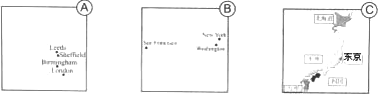
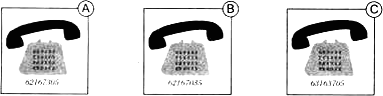
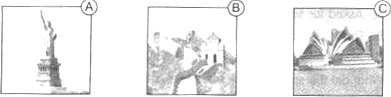
A、听句子,选图片。(听两遍。)

1.

2.

3.

4.

5.
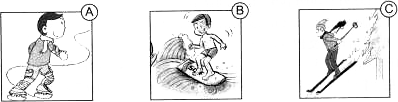
B.听对话和短文回答问题。(听两遍。)

听第一段对话,回答第6~7小题

6.How will the weather be tomorrow?

A.Cloudy.

B.Rainy.

C.Windy.

7.What will the boy probably do tomorrow?

A.Have a picnic.

B.Read books.

C.Play the piano.

听第二段对话,回答第8~10小题

8.What is the message about?

A.Telling Ann to go to a meeting.

B.Telling Ann to write a report.

C.Telling Mary to call the principal.

9.When will the meeting be held?

A.Tomorrow morning.

B.Next Tuesday morning.

C.Next Thursday morning.

10.Where is Peter calling from?

A.His school.

B.His home.

C.A friend’s home.

听第三段对话,回答第11~12小题

11.How often does David go on holiday?

A.Once a year.

B.Twice a year.

C.Three times a year.

12.Why does he travel with a tour group?

A.Because the tour guide is always helpful.

B.Because he can stay in better hotels.

C.Because it can save him a lot of time.

听第四段对话,回答第13~15小题

13.Where does Ken come from?

A.Australia.

B.America.

C.China.

14.What will Ken learn with the speakers?

A.All of the subjects.

B.Most of the subjects.

C.Pottery.

15.How long will Ken stay?

A.One year.

B.At least half a year.

C.One and half a year.

听第五段对话,回答第16~17小题

16.Where is Lily going for lesson?

A.Her school.

B.A language school.

C.An art school.

17.What is she planning to do in France?

A.To have fun.

B.To improve her French.

C.To learn painting.

C.听短文,完成信息表
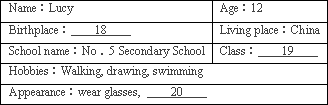
18.A.England

B.the USA

C.France

19.A.Class 7 Grade 6

B.Class 6 Grade 8

C.Class 6 Grade 7

20.A.tall and strong

B.slim and tall

C.slim and strong

D.听短文,回答问题。

21.Where did the accident happen?

A.In a shop.

B.At a hospital.

C.On the road.

22.What was the speaker going to do by bike?

A.To buy a pen.

B.To go to hospital.

C.To look for a missing pen.

23.What happened to the speaker?

A.He was badly ill at home.

B.He was hurt by a truck.

C.He was hit by a car.

24.What did the taxi driver do?

A.Call 110.

B.Send the speaker to the hospital.

C.Leave the speaker alone.

25.What do you think of the taxi driver?

A.He was very bad.

B.He was kind and helpful.

C.He was unfriendly.

查看答案和解析>>


同步练习册答案