
题目列表(包括答案和解析)
BBC News on TV, radio and online often brings you stories from across the world. Today we can hear “Life in China”. Have you got a story about life in China today? If you do, please put your stories here.
Wu Peng, Anhui  | I am a 14-year-old boy from a poor village in Anhui Province. Like many other left-behind children in China, I live with my grandparents now. My parents went to work in Shanghai several years ago. They call me twice a month to ask about my study. I really miss my parents and I hope I can go to school in Shanghai. I think every child needs parents’ love and care. |
Cindy, Shenzhen | I like traveling and I have traveled a lot around China. During the trip, I often find that a number of Chinese often break the rules in public. For example, when I traveled in Hong Kong this year, I saw a kid eating noodles on the underground, which was against the rules. However, the kid’s mother didn’t think she did wrong. Can you believe it? Let’s improve our public manners. |
Mike, Shanghai  | These days, we’re asked to “clear our plates” when having our meals and say no to wasting. Some of us used to order more than what we could eat. That was a big waste of food. Now we need to finish the food we order. We should also stop wasting in some other ways. For example, we should turn off the lights when we leave the classroom. |
| A.By writing letters. | B.On the telephone. |
| C.On the Internet. | D.By sending text messages. |
| A.Cindy. | B.Mike. | C.Wu Peng. | D.The kid’s mother |
| A.Care about left-behind children | B.Obey the rules in public. |
| C.Improve their public manners | D.Stop wasting |
Four years ago my sweet mom went to be with her Lord. She did it her way.
I got the call at work, and I headed home quickly. Mom and Dad lived on a small farm that they had owned since I was seven. I hated going there every weekend. There was nothing for a young girl to do but watch the one station on the old TV set, if the weather allowed reception(接收).
My mom, on the other hand, loved the peace and quiet of the land and loved to work in the garden among her flowers and vegetables. The place was simple, with no indoor plumbing or heat. We had a big wood stove in the kitchen that did its best to heat the little farmhouse, but it always seemed cold and too quiet to me.
In the evenings, my mom and I would sit for hours singing in the little kitchen. I sang the melody and Mom harmonized. Her favorite song was "Moon River" and we sang it over and over. Mom told me stories about how when I was a little girl, I could sing before I could talk. She loved to tell how my playpen(婴儿圈栏)sat in the kitchen next to the radio and there was one song I particularly loved called "Ivory Tower".
As time passed, I had my own children and went to visit the farm every week or two. The kids loved the farm and the tractor rides with my dad. Me, well, I still hated the silence of the farm. While my mom loved to sit at her kitchen table and look out at her garden and flowers and retell all the old stories, I missed the hustle and bustle(喧闹)of my life at home. But I sat there listening quietly as she reminisced.
Now, I sat back in the silence and the silence was deafening so I finally leaned over to turn on an old radio. Music always comforted me.
My heart skipped a beat. "Moon River" was playing on the radio. I sat there stunned, with a tear running down my cheek, as I listened to every familiar note.
Then the radio announcer of this oldie station came on. "Here's one we haven't heard in a while," and an unfamiliar song began. I began to cry harder as I heard the words sung over the airwaves. “Come down, come down from your Ivory Tower...”.
1.The writer didn’t like staying in the farm for the following reasons EXCEPT that
________.
A. it was too cold and quiet
B. she could only sing one song on the small farm
C. there was nothing more that could make her excited
D. The place was simple, with no indoor plumbing or heat
2.From the first paragraph, we know that the writer’s mother ________.
A. passed away four years ago
B. left the small farm with Lord
C. left for Lord to live her own way
D. preferred to be with Lord
3.The underlined word reminisced in the fifth paragraph probably means ________.
A. recalled B. comforted C. shouted D. sighed
4.Which of the following statements is NOT true according to the passage _______.
A. The writer was able to sing before she could speak.
B. The writer preferred to live a busy life in the city.
C. The writer was still quite familiar with the song "Ivory Tower".
D. The writer treasured all her childhood memories in the small farmhouse.
5.Which of the following would be the best title for this passage? _______
A. Cherish life B. My happy childhood
C. Our small farmhouse D. Mom’s music
根据句意、单词或汉语注释,在空格内填入适当的单词。
【小题1】How many ___________(业余爱好) do you have? Only one.
【小题2】It is going to rain this afternoon. You should take an _____________(雨伞) with you.
【小题3】Daniel is _____________(有礼貌的). All his classmates and teachers like him.
【小题4】I often have lunch with my friends in a small ________________(餐馆).
【小题5】My sister and I are in the same school but we are in different ___________(年级).
【小题6】Tom often does some _____(shop) with his mother on Saturday.
【小题7】There are many new comic books on the ________(teacher) desk.
【小题8】My grandfather has two old _______ (radio). I want to buy a new one for him.
【小题9】Millie is a kind girl. She is always ______(help) to others.
【小题10】--Do you know those football __________ (play)? --Yes, they’re my friends.
Tony Buzan’s grades were going down at university. Disappointed with his low marks, he went to the library to find a book on how to use his brain. He was directed to the medical section. Confused, he said to the librarian, “I don’t want to take my brain out, I just want to learn how to use it.” Her reply was simple: “There’s no book on that.”
“I thought to myself,” says Buzan, “if I buy a little radio, I get an instruction manual (说明书). If I buy a microwave, I get an instruction manual. But for the most important machine in the world, no instruction manual?”
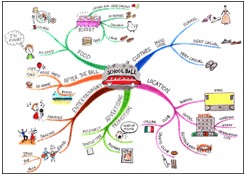
Fifty years later, Buzan has become the world’s leading speaker on the brain and learning. In the late 1960s, he invented the mind map, a visual representation of thought processes.
This kind of thinking has become a popular tool for planning, organizing, problem solving, and communicating across the world. He has since authored and co-authored over 100 books that have appeared in more than 30 languages.
“I think in most cases, people use less than 1 percent of their brains,” he says.
But how do you expand this 1 percent? How do you become the best student you can be?
According to Buzan, the answer is simple. You take a section of whatever it is that you are trying to learn, he says, and you read it for its essence (精髓、要素). Then you make a mind map of all the important details. For a truly effective mind map, you start with a colored image in the center of your page. Draw the first image that comes to mind on the topic you are mind mapping. Branch off from your central image and create one of your main ideas. From your main branches draw some sub-branches and from those sub-branches you can draw even more branches. He emphasizes that you should use plenty of images and colors as these help with memory recall and encourage creativity.
By using this visual format (形式), according to Buzan, your mind will begin to make associations that will help you remember more information for longer periods of time.
Buzan believes that traditional note-taking methods, such as lists and summaries, do not stimulate the brain’s recall capacity or ability in the same way. Because of this, students will often find themselves locked away in their rooms for hours, trying hard to memorize separate details. Buzan believes that for a more effective and lasting way of studying, you must first understand how your brain works.
“Everyone is born smart,” he says. “You just have to learn how to learn.”
1.What is the main purpose of the first two paragraphs?
A.To show that Tony Buzan was worried about his study.
B.To invite us to think about the importance of manuals.
C.To prove that the mind map is a useful tool for the brain.
D.To show why Tony Buzan studies the brain and learning.
2.What does the word “stimulate” mean in the passage?
A.Excite. B.Improve. C.Encourage. D.Affect.
3.What can we infer from the passage?
A.If we learn the mind map, we will become the best student.
B.The mind map will help your brain connect separate details.
C.The mind map will be more effective if we put more details in it.
D.We will solve the problem if we make connections between ideas.
4.What is the best title for the passage?
A.How to make the mind map?
B.Is the mind map widely used?
C.Can your memory be mapped?
D.Is the mind map helpful in thinking?
Tony Buzan’s grades were going down at university. Disappointed with his low marks, he went to the library to find a book on how to use his brain. He was directed to the medical section. Confused, he said to the librarian, “I don’t want to take my brain out, I just want to learn how to use it.” Her reply was simple: “There’s no book on that.”
“I thought to myself,” says Buzan, “if I buy a little radio, I get an instruction manual (说明书). If I buy a microwave, I get an instruction manual. But for the most important machine in the world, no instruction manual?”
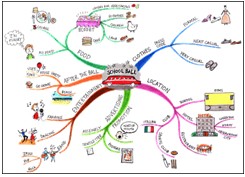
Fifty years later, Buzan has become the world’s leading speaker on the brain and learning. In the late 1960s, he invented the mind map, a visual representation of thought processes.
This kind of thinking has become a popular tool for planning, organizing, problem solving, and communicating across the world. He has since authored and co-authored over 100 books that have appeared in more than 30 languages.
“I think in most cases, people use less than 1 percent of their brains,” he says.
But how do you expand this 1 percent? How do you become the best student you can be?
According to Buzan, the answer is simple. You take a section of whatever it is that you are trying to learn, he says, and you read it for its essence (精髓、要素). Then you make a mind map of all the important details. For a truly effective mind map, you start with a colored image in the center of your page. Draw the first image that comes to mind on the topic you are mind mapping. Branch off from your central image and create one of your main ideas. From your main branches draw some sub-branches and from those sub-branches you can draw even more branches. He emphasizes that you should use plenty of images and colors as these help with memory recall and encourage creativity.
By using this visual format (形式), according to Buzan, your mind will begin to make associations that will help you remember more information for longer periods of time.
Buzan believes that traditional note-taking methods, such as lists and summaries, do not stimulate the brain’s recall capacity or ability in the same way. Because of this, students will often find themselves locked away in their rooms for hours, trying hard to memorize separate details. Buzan believes that for a more effective and lasting way of studying, you must first understand how your brain works.
“Everyone is born smart,” he says. “You just have to learn how to learn.”
【小题1】What is the main purpose of the first two paragraphs?
| A.To show that Tony Buzan was worried about his study. |
| B.To invite us to think about the importance of manuals. |
| C.To prove that the mind map is a useful tool for the brain. |
| D.To show why Tony Buzan studies the brain and learning. |
| A.Excite. | B.Improve. | C.Encourage. | D.Affect. |
| A.If we learn the mind map, we will become the best student. |
| B.The mind map will help your brain connect separate details. |
| C.The mind map will be more effective if we put more details in it. |
| D.We will solve the problem if we make connections between ideas. |
| A.How to make the mind map? |
| B.Is the mind map widely used? |
| C.Can your memory be mapped? |
| D.Is the mind map helpful in thinking? |
湖北省互联网违法和不良信息举报平台 | 网上有害信息举报专区 | 电信诈骗举报专区 | 涉历史虚无主义有害信息举报专区 | 涉企侵权举报专区
违法和不良信息举报电话:027-86699610 举报邮箱:58377363@163.com