
题目列表(包括答案和解析)
Being able to multitask—doing several things at the same time—is considered (考虑,认为) a welcome skill by most people. But if we consider the situation of the young people aged from eight to eighteen, we should think again.
What we often see nowadays is that young people juggle a larger number of electronic devices (电子产品) as they study. While working, they also surf on the Internet, send out emails, answer the telephone and listen to music on their iPods. In a sense, they are spending a large amount of time in fruitless efforts (努力) as they multitask.
Multitasking is even changing the relationship between family members. As young people give so much attention to their own worlds, they seem to have no time to spend with the other people around them. They can no longer greet family members when they enter the house, nor can they eat at the family table.
Multitasking also has an effect (影响) on young people’s performance at university and in the workplace. When asked about their opinions of the effects of modern gadgets (器具) on their performance of tasks, many young people gave a positive (肯定的) response (回应). However, the response from the worlds of education and business was not quite as positive. Educators feel that multitasking by children has a serious effect on later development of study skills. They believe that many college students now need help to improve their study skills. Similarly, employers (雇主) feel that young people entering the job market need to be taught all over again, as modern gadgets have made it unnecessary (没必要) for them to learn special skills to do their work.
1. What does the underlined word “juggle” most probably mean?
A. Want to buy. B. Use at the same time.
C. Take the place of. D. Search information from.
2.In Paragraph 3, the author points out that__________.
A. family members do not greet each other
B. family members do not eat at the family table
C. young people get on well with their families
D. young people hardly communicate with their family members
3.What’s the main idea of the last paragraph?
A. Young people must learn skills for future jobs.
B. Young people benefit (获益) a lot from modern gadgets.
C. Multitasking is an important skill to young people.
D. Multitasking influences young people’s development seriously.
4.Which of the following is TRUE according to the passage?
A. Young people think multitasking is good for their study and work.
B. Employers consider it unnecessary for young people to be taught all over again.
C. Educators feel that young people don’t need to improve their study skills.
D. People from the world of education believe multitasking has a good effect on children’s later study skills.
5. The author develops (阐述) the passage mainly by__________.
A. providing special examples
B. following the natural time order
C. giving out a cause and analyzing (分析) its effects
D. comparing opinions from different worlds
On Christmas Eve—the night before Christmas, children are very happy. They put their stockings at the end of their beds before they go to bed. They want Santa Claus to give them some presents.
Mr. Green tells his children that Santa Claus is a very kind man. He comes on Christmas Eve. He lands on (降落) the top of each house and comes down the chimney (烟囱) into the fireplace (壁炉) and brings them a lot of presents.
Christmas Day always begins before breakfast. The children wake up very early. They can’t wait (等待) to open the presents in their stockings. Then they wake up their parents and shout "Merry Christmas!"
Do you know what Christmas means? Christmas Day is the birthday of Jesus Christ. When Christ was born, many people gave him presents. So today, people still do the same thing to each other.
【小题1】Christmas Eve is ____________.
| A.the night before December 24 | B.the night after December 25 |
| C.the night of December 24 | D.the night of December 25 |
| A.into Children’s hats | B.into children’s stockings |
| C.under children’s beds | D.into children’s shoes |
| A.window | B.door |
| C.chimney | D.fireplace |
| A.Good morning! | B.Thank you! |
| C.Good luck! | D.Merry Christmas! |
| A.presents | B.lucky money |
| C.Christmas trees | D.stockings |
| A.People gave Gmeiner some money. |
| B.There were many orphans at the end of the war |
| C.Gmeiner built the first SOS Children’s Village |
| D.A man called Hermann Gmeiner wanted to help the orphans |
| A.who has no brother | B.who has no sister | C.who has no parents | D.all of the above |
| A.governments | B.special organization |
| C.the orphans themselves | D.people in general(大体上) |
| A.She gives the children a lot of love and kindness | B.She lives with each group of children |
| C.She cooks meals for children | D.She looks after them |
用括号内所给动词的适当形式填空。(本大题共10分,每小题1分)
【小题1】Bad eating habits always __________ (influence) our health greatly.
【小题2】Now many families can’t afford _________ (buy) new houses because of the high price.
【小题3】Many kind people gave the poor lady many donations, but she __________ (accept) none.
【小题4】So far, nobody except Tom __________ (offer) the police any information about the murder.
【小题5】Mr Black and his two sons __________ (grow) flowers in the garden when it began to rain.
【小题6】You’ll have less difficulty _________ (learn) English with your teacher’s help.
【小题7】The idea of Mother’s Day _______ first _______ (give) by Miss Anna Jarvis of Philadelphia.
【小题8】By the year 2000, the number of the elderly in China __________ (reach) 130 million.
【小题9】Cold viruses can also _________ (spread) by objects, such as telephones, plates and keyboards.
【小题10】I supposed Mary __________ (watch) the drama the next evening.
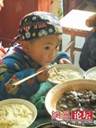
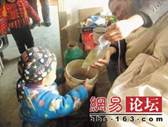
These days, a lot of photos about how a three-year-old girl looked after her disabled father are 1 spread over the Internet. Many people were 2 by her. And people gave her a 3 nickname (绰号) “little strong girl”.
The little girl is Dong Xinyi. She was born in a small 4 in Dezhou, Shangdong Province. When she was several months 5 , her father Dong Jianshe had an accident 6 riding his motorcycle and lost his 7 . Two years later her mother left her father 8 the poor life. As an old saying goes, “ The children of 9 people manage household affairs early.” Little Xinyi had to do lots of housework. She 10 her father in her power. She cooked noodles, carried water, cleaned rooms and washed clothes. The little girl brings happiness and 11 to her poor family. And 12 , the local government has 13 medical treatment to her father and promised to cover all medical expenses(费用). 14 the same time, the government is also planning to raise money for the girl’s 15 . Now Dong Xinyi has got a chance to go to nursery school(幼儿园) like other children,
1. A.happily B.certainly C.carefully D.widely
2. A.moved B.married C.made D.named
3. A.bad B.wrong C.bright D.stupid
4. A.city B.village C.hospital D.capital
5. A.young B.little C.old D.big
6. A.where B.while C.whether D.how
7. A.legs B.son C.daughter D.wife
8. A.because B.instead of C.instead D.because of
9. A.rich B.great C.poor D.disabled
10. A.took care B.took care of C.looked around D.looked for
11. A.sadness B.success C.freedom D.hope
12. A.luckily B.unluckily C.likely D.really
13. A.refused B.noticed C.offered D.bought
14. A.On B.At C.In D.To
15. A.information B.interest C.suggestion D.education
湖北省互联网违法和不良信息举报平台 | 网上有害信息举报专区 | 电信诈骗举报专区 | 涉历史虚无主义有害信息举报专区 | 涉企侵权举报专区
违法和不良信息举报电话:027-86699610 举报邮箱:58377363@163.com