
题目列表(包括答案和解析)
| A.May I speak to Mike? | B.How are you? |
| C.What’s your name? | D.I want to talk to you. |
| A.What do you do? | B.What about you? |
| C.Are you OK? | D.How are you? |
| A.He is my best friend. | B.What’s your idea? |
| C.Maybe you can’t do that. | D.Can you come? |
| A.because he is friendly. |
| B.because you are welcomed. |
| C.because he is not a student. |
| D.because he isn’t studying in our school. |
| A.Don’t leave anything. | B.Don’t forget to take your ID card. |
| C.Remember to bring your cousin. | D.Please wear your jeans. |
Please help!
Ladies and gentlemen, thank you very much for coming to this concert. I hope you have enjoyed the music.
The purpose of this concert is to (1) money for children in Africa. Every day (2) children in Africa die because they have diseases or have not enough (3) . There are two main reasons. First, there are no jobs for the children's parents, so they have no money to buy food or (4) . Second, the governments in many African countries do not have the money to take care of poor people.
Most African countries are poor. The land is not good for (5) food and the weather is also bad for farming. The organization we are trying to help, the Feed Africa Fund, _(6) a lot of money every year on food for poor people in Africa. The money comes (7) people like you kind, generous people who do not want to see children die form hunger. Just one dollar can buy enough rice or corn to (8) a family of four for three days.
How much do you spend on food every day? Ten dollars? Twenty dollars? I am sure you can spend a little (9) on your own food so that you have a few dollars for The Feed Africa Fund.
Ladies and gentlemen, we will now take a (10) . Please be generous. Thank you.
|
|
A |
B |
C |
D |
|
1. |
spend |
pay |
borrow |
raise |
|
2. |
hundred |
hundred of |
hundreds of |
hundreds |
|
3. |
to play |
to eat |
to drink |
to pay |
|
4. |
clothes |
medicine |
houses |
furniture |
|
5. |
eating |
drinking |
growing |
watering |
|
6. |
costs |
borrows |
lends |
spends |
|
7. |
to |
from |
with |
about |
|
8. |
build |
develop |
feed |
organize |
|
9. |
more |
fewer |
less |
most |
|
10. |
show |
collection |
look |
seat |
When you cough(咳嗽) or sneeze, please turn your head away from others and cover your mouth with the full part of your hand. Afterwards, you should say," Excuse me." This is a rule I set for my students.
It is so simple, but many kids have never been told to do this. In fact, I notice adults cough and sneeze in public without putting a hand over the mouth. I hate traveling by underground in New York during cold and flu(流感) season, because it is certain that someone is going to stand right behind me and cough or sneeze on my neck.
One important thing I point out to the kids is that after they sneeze or cough on their hand, they should wash their hands as soon as possible. Otherwise, they will be passing those germs along to everything and everyone they touch.
In order to help the students remember this rule, I
tell them about an old story. It says that when you sneeze, evil spirits jump
into your body. If you don't cover your mouth, the spirits will enter, but if
you cover your mouth, you will keep the m
out, We say "God bless you" when someone sneezes, and in Germany(德国) you should say "Gesundheit". That means
"Good health to you." Both expressions are said that if you didn't
cover your mouth in time and the spirits were able to enter your body. The kids
love finding out the origins(起源) of these expressions
and it encourage them to put the advice to use more often.
m
out, We say "God bless you" when someone sneezes, and in Germany(德国) you should say "Gesundheit". That means
"Good health to you." Both expressions are said that if you didn't
cover your mouth in time and the spirits were able to enter your body. The kids
love finding out the origins(起源) of these expressions
and it encourage them to put the advice to use more often.
1.The writer of this article must be _______ .
A. a reporter B. a teacher C. a doctor D. an officer
2. What does the underline word 'this" mean?
A. Don't cough or sneeze in front of people.
B. Don't stand beside someone who coughs or sneezes.
C. Many people cough or sneeze on the underground train.
D. Cover your mouth when coughing or sneezing and say sorry.
3.After coughing or sneezing on their hand, students are advised to _______.
A. say "God bless you"
B. wash their hands as soon as possible
C. go to see a doctor as soon as possible
D. go home and have a good rest
4. According to the article, the writer would like the kids _______.
A. to be polite to adults B. to be in better health
C. to have good manners D. to do well in exams
5. What does the underlined word “germs” mean in Chinese?
A. 咳嗽 B. 喷嚏 C. 鼻涕 D. 病菌
In England, people don't often talk much. You can get on a bus or a train,and everyone sits looking out of the window.
Often they read books and papers, but they don't talk much. When you meet English people they often talk about one thing--weather (天气). So when you meet somebody in England, you can say, “Nice weather for the time of year!” “But it is a little cold today,” somebody may answer. “But it will be a little warmer later,”you can say. Talk like this, and the English people will think,“ How friendly you are !”
1.On the bus, the English people often__________.
A. talk B. stand
C. eat something D. read papers
2.From the passage we know when you meet English people, you can say like this: ______________
A. How do you do? B. How are you?
C. Nice weather! D. Nice to meet you!
3.If you talk to English people about the weather, they will think________.
A. you are friendly
B. you are right
C. you are English
D. you talk too much
4.Which is right?______________
A. English people like to talk on a bus.
B. English people don't like to talk about weather.
C. English people are not friendly at all.
D. In England,the weather often changes (变化).
5.The English people talk with you about the weather to show you they are______.
A. hungry B. happy
C. kind D. worried
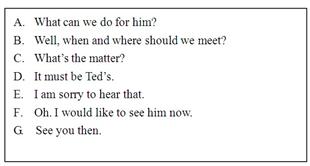
选择下列句子完成下面对话。并在答题卡上将相应的字母编号涂黑。(共 5 小题,每小题 1 分)
A: Whose notebook is this?
B: _______ 1.Look, his name Ted is on it. Let’s go and take it to him.
A: I’m afraid he isn’t at school today.
B: _______ 2.
A: He had a car accident yesterday afternoon and now he’s in hospital.
B: _______3.Let’s go to see him after school, shall we?
A: OK! He’ll be happy to see us.
B: _______ 4.
A: What about outside the school gate at 5 p.m.?
B: All right. _______ 5.
A: See you.
湖北省互联网违法和不良信息举报平台 | 网上有害信息举报专区 | 电信诈骗举报专区 | 涉历史虚无主义有害信息举报专区 | 涉企侵权举报专区
违法和不良信息举报电话:027-86699610 举报邮箱:58377363@163.com