
题目列表(包括答案和解析)
听力测试(本大题满分25分,每小题1分)
第一节
听下面的8段短对话。每段对话后有一个小题,从每小题A、B、C三个选项中选出一个最佳答案。听完每段对话后,你有10秒钟的时间来回答有关小题和阅读下一小题。每段对话只读一遍。
1.What's Jim's favourite fruit?
A.Apples.
B.Pears.
C.Bananas.
2.Where does the woman want to go?
A.To the hospital.
B.To the bank.
C.To the bookstore.
3.How often does Tom surf the Internet?
A.Every day.
B.Never.
C.Once a week.
4.What does the man mean?
A.He doesn't think Class 2 will win.
B.He thinks Class 2 will win.
C.He hopes Class 2 will win.
5.How does the man learn English?
A.By reading aloud.
B.By making flashcards.
C.By listening to tapes.
6.Why didn't the woman answer the phone?
A.She wasn't in.
B.She didn't want to.
C.She was washing her hair.
7.What time is it now?
A.It's 6∶40.
B.It's 7∶15.
C.It's 7∶45.
8.Which might be the reason why Victor failed the driver's test?
A.He was too nervous.
B.He didn't practice at all.
C.He didn't have enough time to practice.
第二节
下面你将听到5段对话或独白.每段对话或独白后有几个小题,从每小题A、B、C三个选项中,选出一个与你所听到的对话或独白内容相符的问题的答案。听每段对话或独白前,你都有10秒钟的时间阅读相关小题;听完后,每小题将给出5秒钟的作答时间,对话或独白读两遗。
听第一段材料,回答第9至11小题。
9.What is Kathy doing for vacation?
A.Studying at home.
B.Traveling abroad.
C.Doing a part-time job.
10.How does she feel these days?
A.Bored.
B.Excited.
C.Tired.
11.Where is she most probably going on vacation?
A.To Hawaii.
B.To Switzerland.
C.Somewhere cold.
听第二段材料,回答第12至14小题。
12.What's the possible rala6onship(关系)between the two speakers?
A.Friends.
B.Husband and wife.
C.Strangers.
13.How long has it been since the two speakers saw each other lint time?
A.A few months.
B.About a year.
C.A few years.
14.Whose leg was broken?
A.The woman's.
B.The man's wife's.
C.The man's son's.
听第三段材料,回答第l5至17小题。
15.Why do they collect the rubbish along the river?
A.To stop the fiver from being polluted.
B.To sell it for money.
C.To see the river every day.
16.How many volunteers do they have?
A.12.
B.16.
C.28.
17.When do they do the volunteer work?
A.At 7∶30 every morning.
B.After lunch at noon.
C.After dinner every evening.
听笔四段材料,同答第18至20小颢.
18.What's the man doing?
A.Selling the house.
B.Looking for a house.
C.Asking for a job.
19.Why does the woman want to sell the house?
A.She wants to move to the countryside.
B.She wants to move abroad.
C.She hopes to buy a bigger one.
20.How much does the house cost?
A.$ 9,680.
B.$ 9,860.
C.$ 9,618.
听第五段材料,回答第21至25小题.
21.Where did the story happen?
A.In the school.
B.In the restaurant.
C.In the library.
22.What did the man order for his meal?
A.Some noodles.
B.The cheapest things.
C.The most expensive food.
23.What did the man say when he left there?
A.He was buying a newspaper.
B.He was buying some beer.
C.He was getting some money at the bank.
24.Was the man the boy's father?
A.Yes, he was.
B.No, be wasn't.
C.We don't know.
25.When did the man ask the boy to come in and sit at his table?
A.After he left.
B.At two o'clock.
C.After paying for the meal.
| 完形填空。 |
|
A |
| ( )1. A. see ( )2. A. like ( )3. A. post ( )4. A. when ( )5. A. was ( )6. A. worst ( )7. A. exciting |
B. hear B. wish B. student B. while B. did B. best B. easy |
C. listen C. want C. report C. since C. got C. longest C. interesting |
D. notice D. hope D. teacher D. until D. made D. shortest D. difficult |
| B I don't know if the world is really more dangerous now than it was 30 years ago. But I'm sure that it seems that way. The world is a dangerous place. We want our children to know it, 1 they will stay safe. But we don't want them to be afraid all of the time. Fear is a 2 feeling. We need fear to keep us from doing stupid things. But frequent fear is more likely to come down with illness. So, what can you do to keep your child safe, without fear? First, make your home a safe place. Make it a rule that nobody 3 anybody else in your home, neither by deed nor by word. When you have to 4 a scary world, it helps to have a fear-free home base. Let your kids know that most 5 are well-mannered people. It's possible to be 6 without putting yourself in danger. I think that the "never talk to strangers"rule often does more harm than good. Take steps to help those 7 , and let your children help beside you. By helping others, they'll come to expect that others will help them if they ever need it. As parents, we can't make sure that our children will never come to harm. But we will always do everything we can to keep them safe, and to make the world safer for all children and people. The experience of being with others in a neighborhood of 8 and the safety of a peaceful home is what children need to be able to live without fear in a dangerous world. |
| ( )1. A. so that ( )2. A. terrible ( )3. A. helps ( )4. A. meet ( )5. A. parents ( )6. A. friendly ( )7. A. for money ( )8. A. hoping |
B. even if B. strange B. tells B. face B. teachers B. lovely B. in need B knowing |
C. before C. possible C. hurts C. keep C. friends C. safe C. with fear C. caring |
D. after D. useful D. warns D. make D. strangers D. afraid D. on time D. fighting |
How would you like to study at an American university in China? With the news that New York University (NYU) is considering setting up a branch(分校)on Chinese mainland, the possibility of getting an American education becomes a reality. But how will Chinese students deal with a very different style of teaching? One that encourages debate(辩论), discussion and critical thinking (批判思维); one which puts little attention on rote learning.
You know how kids ask questions all the time? Asking questions shows they are curious (好奇). So when does that natural curiosity get weak? Not at kindergarten or nursery, nor at primary school. As you grow older perhaps refusing to draw attention to yourself by asking the teacher questions, you grow quiet. If so, that's a pity, because questioning your teachers should be encouraged. After all, they're the ones who've been educated, have a lot more experience than you and perhaps have a little wisdom. When I taught joumalim at college in Scotland I enjoyed answering students' questions. Some of them raised difficult questions. I didn't always know the answers. If I didn't, I'd accept it and try to find out later.
At university we were encouraged to challenge our classmates and teachers. There was often a regular meeting between teachers and some students. A student would prepare a paper on a subject and the other students would criticize it. It could be frightening. But it was a way of developing critical thinking.
We need to differentiate critical thinking with loudmouths. We've all come across loudmouths who speak out quickly as if they knew what they were talking about. I know one loudmouth who is paid a great deal of money by a British tabloid newspaper to entertain readers with his deeply-held prejudices(偏见). You might not agree with columnist(专栏作家) Richard Littlejohn, but you have to say that he is entertaining and there is an internal logic(内在的逻辑)to his statements. Having a logical mind can help develop critical thinking.
My wife doesn't have a logical mind, but she does have emotional intelligence(情商). I can't say that I have anything like her emotional intelligence. but I'd like to think some of it rubbed off on me. If you can't at least try to put yourself in someone else's shoes, how can you understand their situation, their problems and issues?
So try to develop your powers of critical thinking. Start with books, films, music and newspapers. And don't believe everything you read or see. Think independently.
57. According to the passage, to develop your critical thinking, you can____________.
A. keep curious and follow your heart
B. think logically, not emotionally
C. do more reading and think actively
D. voice your opinion like a loudmouth
58. The underlined words 66rubbed off on mc" in Paragraph 5 probably mean " __________".
A. helped me solve the problem better
B. had some influence on me in a way
C. moved it backwards and forwards
D. advised me to wear others' shoes
59. What can be the best title for the passage?
A. Want to be different? Think critically
B. Want to be critical? Think for yourself
C. Choose NYU, choose critical thinking
D. Importance of improving critical thinking
阅读下列材料,从所给的六个选项(A、B、C、C、E、和F)中,选出符合各小题要求的最佳选项.选项中有一项是多余选项.
The people below are all willing to offer help to those who needs help.After the description of these people, there is information about six voluntary jobs(A-F).Decide which place would be most suitable for the person(s)mentioned in questions 61-65 and then mark the correct number on your answer sheet.There is one extra paragraph about one job which you don’t need to use.
1.________ Stephen:Last summer I went through a training program and became a literacy(文化知识)volunteer.When I began to discover what other people’s lives were like because they could not read, I realized the true importance of reading.
2.________ Ben:After graduation, I don’t want to apply for a job at once.Instead, I plan to spend one year to help those who need help most and try my best to improve their lives.You know, education is essential to poverty relief and at the same time I’ll get valuable experience for my future career.
3.________ Susan:I’m a girl from England and has studied French for years.I’m here in Beijing University studying Chinese.I like China as it is full of mysteries.So I hope the voluntary work will help me to get in touch with Chinese people and get to know about China.Although my study is busy, I can be free at night and at the weekends.
4.________ Tim:Since I myself have overcome a lot of difficulties in my life, I understand young people’s problems and I know how to listen patiently to others and offer some advice.I’m working now in the daytime so I can only spend two to three hours a day at night to help others.
5.________ Lisa:I burst into tears when I saw those children in a TV programme.What a sight.They are only bone and skin left.What’s worse, every day the children are dying because of lack of food.I realized how lucky I am with enough food and a good chance to get education.The summer vacation is coming and I hope I can do something for them.
A.As we know, the 2008 Olympic Games will be held in Beijing and many people from other countries will come to visit China.The taxi drivers in Dongfeng Taxi Company think the way to show kindness is to be able to greet the foreigners in their languages.They need someone who can teach them languages and the best time is at night when they are not so busy.
B.Tim is so addicted to on-line games that he cannot concentrate on his study like before.Now he often misses school in order to play games, and tells lies to his teachers and parents again and again.Though he realizes what he does is wrong, he just can’t stop it.How badly he needs someone’s help.
C.Marie, a 44-year-old single mother of three, has to walk two miles to the nearest supermarket twice a week because she doesn’t know which bus to take.What’s worse, since she does not know words, she can not write out a shopping list.Also, she can only recognize items by sight, so if the product has a different label, she will not recognize it as the product she wants.
D.“Helping hand” organization will hold an event to help the starving children in Africa.The event starts in August and those taking part in will go without food for 30 hours.In this way, it is expected that money will be raised for the poor children.
E.“Green Earth” cares a lot for the animals in danger.Still many people in the world don’t know much about the importance of animal protecting.This summer vacation a lot of events will be organized to call on people to live in harmony with our earth.
F.A group of young children in a remote village in southwest China are in great need of teachers.Because of the low salary, many teachers came and then went.The villagers hope to have a teacher who can stay for at least a year, because they know knowledge can make a difference to the children’s future.
听力部分(每小题1分,共30分)
A.单句理解:听句子,从所给六幅图中选出与所听到的句子情景相同(相近)的图画(句子读两遍,每小题1分,满分5分)
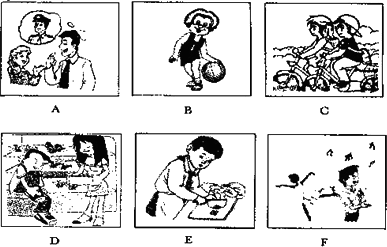
B.听对话根据所听到的内容,选择正确的答案(对话读两遍,每小题1分,满分15分)
第一节:听下面5段对话,每段对话后有一个小题,从题中所给的A、B、C三个选项中选出最佳答案。
6.What's the time now?
A.3∶30.
B.4∶30.
C.5∶30.
7.Whom does the woman want to speak to?
A.Mr.Johnson.
B.Mr.Smith.
C.Mr.Brown.
8.Why can't the man go to the birthday party?
A.Because he is iii.
B.Because he is busy.
C.Because he will go to Shanghai.
9.How will the weather be tomorrow?
A.Rainy.
B.Sunny.
C.Cloudy.
10.What do we know about the new teacher?
A.He often keeps silent.
B.He talks too much.
C.He has no chance to speak.
第二节:听下面4段对话,每段对话后有二或三个小题,从题中所给的A、B、C三个选项中,选出最佳答案。
听第一段对话,回答11、12题。
11.When does the conversation take place?
A.At breakfast time.
B.At lunch time.
C.At supper time.
12.What are they going to do?
A.To drink a cup of milk.
B.To cook at home.
C.To have a meal at a restaurant.
听第二段对话,回答13、14题。
13.What's wrong with the woman?
A.She has a stomachache.
B.She has a toothache.
C.She has a cough.
14.Where are the two speakers?
A.In a chemistry shop.
B.At home.
C.At a bus stop.
听第三段对话,回答15、16、17题。
15.What does the man do?
A.He is a teacher.
B.He is a singer.
C.He is a doctor.
16.Who wants to see the man?
A.The headteacher.
B.The teachers.
C.The students.
17.Why is the man worried about going back to that school?
A.Because he is not popular.
B.Because he made a lot of trouble there when he was young.
听第四段对话,回答18、19、20题
18.Where is the girl from?
A.America.
B.Australia.
C.England.
19.Why does the girl come to China?
A.To see her parents.
B.To go travelling.
C.To find a job.
20.What will the girl do next year?
A.She will work in China.
B.She will work in Japan.
C.She will stay in her own country.
C.听短文,根据所听到的内容,选择正确的答案(敌方读三遍,每小题分,满分5)听第五对话,回答21、22、23、24、25
21.How long did Mr.Black work in a restaurant?
A.For ten years.
B.For ten months.
C.For ten days.
22.Once Mr.Black had to see a doctor because something was wrong with his ________
A.cars
B.eyes
C.nose
23.What did Mr.Black decide to do?
A.To open a hotel.
B.To open a shop.
C.To open a hospital.
24.Who came to knock at his door one evening?
A.A stranger.
B.A woman.
C.A doctor.
25.What happened to the man after he took Mr.Black's medicine?
A.He got better.
B.He got well.
C.He became worse.
D.听一段材料,根据所听到的内容,完成26-30题(材料读三遍,每小题1分,满分5分)
Name:Diana
Age: 26
Hair: 27
Tel: 28
Job:an 29 in Micro Works
Likes:going out, 30 , music and watching TV
湖北省互联网违法和不良信息举报平台 | 网上有害信息举报专区 | 电信诈骗举报专区 | 涉历史虚无主义有害信息举报专区 | 涉企侵权举报专区
违法和不良信息举报电话:027-86699610 举报邮箱:58377363@163.com