
题目列表(包括答案和解析)
阅读短文
What are the limits(极限) of human body? The BBC’s Focus magazine has some answers.
How cold can you stand?
Normal body temperature is around 37℃. At 35℃ you’re unable to write your name. Even walking is very difficult. At 33℃ you may find it difficult to think, understand and form(形成) opinions properly. By the time you have cooled to 20℃, your heart would have stopped beating.
Limit: 0℃. Ice would form in your tissues(纤维组织), killing all the cells.
How spicy can you eat?
There is capsaicin(辣椒素) in many foods. The more capsaicin, the hotter the dishes are. If you’re healthy enough, you can survive(存活) eating a teaspoon of pure capsaicin. But you would find it impossible to eat anything else for a few hours.
Limit: 5g capsaicin.
How fast can you run?
The fastest man in the world is Asafa Powell. The runner finished the 100m in 9. 74 seconds in 2007. This gives an average(平均的) speed of 36. 96km/h.
Top runners are at their fastest around 80 metres, so a runner’s greatest speed may reach 43.06km/h.
Limit: 43.06km/h.
How loud is too loud?
The loudest sound you can hear is 168 dB(分贝). Sound louder than that may do harm to your ears. The loudest sound ever recorded was the eruption of Krakatoa(卡拉卡托火山爆发) in 1883. It was 180 dB, 160km away.
Limit: 168 dB
根据短文内容,回答问题
1.At what temperature will your cells die?
________________________________
2. What will happen if you eat a teaspoon of pure capsaicin?
________________________________
3. How fast can a runner run at most?
________________________________
4. What sound can be heard by your ears?
________________________________
5. Where can you read such an article?
________________________________
| A. With the help of B. complain about C. a good experience D. provided…with E. pick…up F. later on G. anybody else H. all the time I. in white J. woke up |
请阅读下面各小题,从方框中选择适当的短语填空,并将其序号填写到答题卷的相应位置。每个词语限用一次。
| A. With the help of B. complain about C. a good experience D. provided…with E. pick…up F. later on G. anybody else H. all the time I. in white J. woke up |
| A. With the help of B. complain about C. a good experience D. provided…with E. pick…up F. later on G. anybody else H. all the time I. in white J. woke up |
| Tourist maps, for example, have signs to show places of interest in an area. When tourists read these maps, it is easy for them to find where to go and what to see in a place and it is easy for them to go and find their ways to these places. | 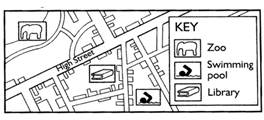 |
| Road maps show large areas so that people can plan long journeys. Different types of roads are given different numbers. For example, if you want to go to Wood Green, you just follow No. 621 Road and keep looking at the road signs. | 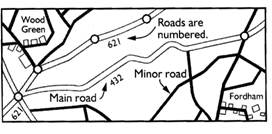 |
| Distribution maps (分布图) use colors or signs to show facts about an area. For example, where different languages are spoken, how many people live in an area, how cold and hot some places are, or whether a place is short of water. |  |
| Some maps, such as railway maps, use straightlines to show everything. This is easy for people to read. Trains are fast. People don’t have to think about small places they go past. They just need to know the two ends of their trips. | 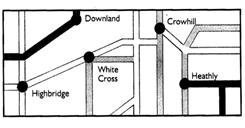 |
| A.A tourist map. | B.A road map. |
| C.A distribution map. | D.A railway map. |
| A.By using different colors. | B.By finding the numbers. |
| C.By following No. 621 Road. | D.By looking at the road signs. |
| A.Because railways are straight. |
| B.Because people like straight lines. |
| C.Because people can read them easily. |
| D.Because railways have only two ends. |
湖北省互联网违法和不良信息举报平台 | 网上有害信息举报专区 | 电信诈骗举报专区 | 涉历史虚无主义有害信息举报专区 | 涉企侵权举报专区
违法和不良信息举报电话:027-86699610 举报邮箱:58377363@163.com