
题目列表(包括答案和解析)
Nathan Sawaya's childhood was a lot of fun. He drew cartoons, wrote stories, and played with plastic toy bricks (积木). His grandparents bought his first set of toy bricks when he was five years old and he's been building with toy bricks ever since. He even took his building bricks to college with him! Instead of books and a computer, he had a model of Greenwich Village made of bricks on his desk.
Nathan started as a lawyer
but gave up His highl y-paid
(高薪的) job to become an artist that uses toys in
his art. He uses toy bricks to build everything from the Statue of Liberty(自由女神像) to Superman! He has more than 1.5 million colored
bricks in his working room in New York which he uses to make pieces of art. He
started by building small models but then decided to do something big and
created a self-portrait (自画像). It took him two days just to build the
eyes.
y-paid
(高薪的) job to become an artist that uses toys in
his art. He uses toy bricks to build everything from the Statue of Liberty(自由女神像) to Superman! He has more than 1.5 million colored
bricks in his working room in New York which he uses to make pieces of art. He
started by building small models but then decided to do something big and
created a self-portrait (自画像). It took him two days just to build the
eyes.
Nathan's work has appeared in
museums around the world. Children love his art because it is made out of the
same toys that they play with at home and adults love his work because it is
fascinating. Since it began in2007, Nathan's exhibition "The Art of the
Bri ck"
has been very popular with museum visitors everywhere.
ck"
has been very popular with museum visitors everywhere.
"I'm proud that I took a dream I had as a child, to become an artist, and I have actually made a job out of it," says Nathan. "To do what you love in life is the most important thing."
1.What did Nathan put on his desk at college?
A. The Statue of Liberty. B. Superman.
C. His serf-portrait. D. A Greenwich Village modal.
2.Why did Nathan give up his job as a lawyer?
A. Because he made little money out of a lawyer.
B. Because he wanted to make toys for the children.
C. Because he decided to become an artist of toy bricks.
D. Because he was going to work in the museum instead.
3. What does the underlined word "it" in Paragraph 3 refer to?
A. Nathan's work. B. Nathan's exhibition.
C. Nathan's art. D. Nathan's self-portrait
4.What would be the best title for the passage?
A. The Brick Artist B. The Brick Exhibition
C. Toy Bricks for Adults D. The Artist's Childhood
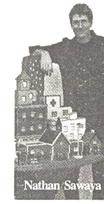
Nathan Sawaya's childhood was a lot of fun. He drew cartoons, wrote stories, and played with plastic toy bricks (积木). His grandparents bought his first set of toy bricks when he was five years old and he's been building with toy bricks ever since. He even took his building bricks to college with him! Instead of books and a computer, he had a model of Greenwich Village made of bricks on his desk.
Nathan started as a lawyer but gave up His highly-paid (高薪的) job to become an artist that uses toys in his art. He uses toy bricks to build everything from the Statue of Liberty(自由女神像) to Superman! He has more than 1.5 million colored bricks in his working room in New York which he uses to make pieces of art. He started by building small models but then decided to do something big and created a self-portrait (自画像). It took him two days just to build the eyes.
Nathan's work has appeared in museums around the world. Children love his art because it is made out of the same toys that they play with at home and adults love his work because it is fascinating. Since it began in2007, Nathan's exhibition "The Art of the Brick" has been very popular with museum visitors everywhere.
"I'm proud that I took a dream I had as a child, to become an artist, and I have actually made a job out of it," says Nathan. "To do what you love in life is the most important thing."
1.What did Nathan put on his desk at college?
A.The Statue of Liberty. B.Superman.
C.His serf-portrait. D.A Greenwich Village modal.
2.Why did Nathan give up his job as a lawyer?
A.Because he made little money out of a lawyer.
B.Because he wanted to make toys for the children.
C.Because he decided to become an artist of toy bricks.
D.Because he was going to work in the museum instead.
3.What does the underlined word "it" in Paragraph 3 refer to?
A.Nathan's work. B.Nathan's exhibition.
C.Nathan's art. D.Nathan's self-portrait
4.What would be the best title for the passage?
A.The Brick Artist B.The Brick Exhibition
C.Toy Bricks for Adults D.The Artist's Childhood

Nathan Sawaya's childhood was a lot of fun. He drew cartoons, wrote stories, and played with plastic toy bricks (积木). His grandparents bought his first set of toy bricks when he was five years old and he's been building with toy bricks ever since. He even took his building bricks to college with him! Instead of books and a computer, he had a model of Greenwich Village made of bricks on his desk.
Nathan started as a lawyer but gave up His highly-paid (高薪的) job to become an artist that uses toys in his art. He uses toy bricks to build everything from the Statue of Liberty(自由女神像) to Superman! He has more than 1.5 million colored bricks in his working room in New York which he uses to make pieces of art. He started by building small models but then decided to do something big and created a self-portrait (自画像). It took him two days just to build the eyes.
Nathan's work has appeared in museums around the world. Children love his art because it is made out of the same toys that they play with at home and adults love his work because it is fascinating. Since it began in2007, Nathan's exhibition "The Art of the Brick" has been very popular with museum visitors everywhere.
"I'm proud that I took a dream I had as a child, to become an artist, and I have actually made a job out of it," says Nathan. "To do what you love in life is the most important thing."
【小题1】What did Nathan put on his desk at college?
| A.The Statue of Liberty. | B.Superman. |
| C.His serf-portrait. | D.A Greenwich Village modal. |
| A.Because he made little money out of a lawyer. |
| B.Because he wanted to make toys for the children. |
| C.Because he decided to become an artist of toy bricks. |
| D.Because he was going to work in the museum instead. |
| A.Nathan's work. | B.Nathan's exhibition. |
| C.Nathan's art. | D.Nathan's self-portrait |
| A.The Brick Artist | B.The Brick Exhibition |
| C.Toy Bricks for Adults | D.The Artist's Childhood |

Nathan Sawaya's childhood was a lot of fun. He drew cartoons, wrote stories, and played with plastic toy bricks (积木). His grandparents bought his first set of toy bricks when he was five years old and he's been building with toy bricks ever since. He even took his building bricks to college with him! Instead of books and a computer, he had a model of Greenwich Village made of bricks on his desk.
Nathan started as a lawyer but gave up His highly-paid (高薪的) job to become an artist that uses toys in his art. He uses toy bricks to build everything from the Statue of Liberty(自由女神像) to Superman! He has more than 1.5 million colored bricks in his working room in New York which he uses to make pieces of art. He started by building small models but then decided to do something big and created a self-portrait (自画像). It took him two days just to build the eyes.
Nathan's work has appeared in museums around the world. Children love his art because it is made out of the same toys that they play with at home and adults love his work because it is fascinating. Since it began in2007, Nathan's exhibition "The Art of the Brick" has been very popular with museum visitors everywhere.
"I'm proud that I took a dream I had as a child, to become an artist, and I have actually made a job out of it," says Nathan. "To do what you love in life is the most important thing."
1.What did Nathan put on his desk at college?
A. The Statue of Liberty.
B. Superman.
C. His serf-portrait.
D. A Greenwich Village modal.
2.Why did Nathan give up his job as a lawyer?
A. Because he made little money out of a lawyer.
B. Because he wanted to make toys for the children.
C. Because he decided to become an artist of toy bricks.
D. Because he was going to work in the museum instead.
3.What does the underlined word "it" in Paragraph 3 refer to?
A. Nathan's work. B. Nathan's exhibition.
C. Nathan's art. D. Nathan's self-portrait
4.What would be the best title for the passage?
A. The Brick Artist B. The Brick Exhibition
C. Toy Bricks for Adults D. The Artist's Childhood
Americans think a great deal about time. From childhood they learn to value(珍惜)time. As children, they are taught to be on time to go to school, to do work and to do everything. When they are having a good time, they say that time flies. When a person is dying, they say he is living on borrowed time. Time is money. Time is knowledge. Time is everything in America. A working American has to work hard for 8 hours a day or 40 hours a week. This is the working time. In his free time, he also works hard for more money. Even Saturday and Sunday are filled with(充满)activities. In the street you can hardly see a man who walks slowly. They walk very fast. In fact, they are running. They love time because time brings them money, comforts and progress. But sometimes they also hate time, for they feel they have become servants(仆人)of the clock.
1.A working American has to work___ days a week in his working
time.
A. seven B. six C. five
2.An American always walks____.
A. sadly B. slowly C. fast
3.“He is living on borrowed time” means_____.
A. He has little money.
B. He has no time
C. He is dying
4.In his free time, an American usually_____.
A. plays cards with their friends
B. stays at home all day and watched TV.
C. gets more money by work.
5. Which of the following is NOT TRUE?
A. The Americans usually value time.
B. The Americans are often on time.
C. All Americans love time and don't hate time.
湖北省互联网违法和不良信息举报平台 | 网上有害信息举报专区 | 电信诈骗举报专区 | 涉历史虚无主义有害信息举报专区 | 涉企侵权举报专区
违法和不良信息举报电话:027-86699610 举报邮箱:58377363@163.com