
题目列表(包括答案和解析)
We use the Internet for many things: business, shopping, writing letters, talking to people, finding information mid so on. In recent years, a new kind of English.has grown on the Internet. There’s no real word for it yet, so we’ll call it E-talk. People don’t like typing too much. To save time, they turn phrases into a few letters (alled acronyms). Acronyms are often used in chat rooms
(聊天室). Some of them are: BTW (by the way) BRB (be right back) LOL (laughing out loud) IMO (in my opinion). People also use many abbreviations. They are shortened forms of words. Some common abbreviations are: info (information), puter (computer), pic (picture), sec (second). We usually don’t see people when we communicate(交流)on the Net, so people have new ways to show feelings. Most people use their keyboards to draw “feelings”, such as::-)(happy) ;-)(joking) :-((sad) :-O (surprised)
These days, many forums
(论坛)have picture feelings. For example: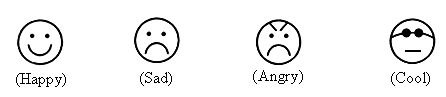
There are even whole new words, like
“newbies”(someone who is new on a chat board or forum). When you write something bad about someone else, it’s called“flaming”the person. It takes time for people to get used to(适应)E-talk. Also, different groups on the Net have their own special ways of communicating. Newbies sometimes have to ask other people what they mean. As the Intemet grows, E-talk will continue to grow and change.根据短文内容选择最佳答案。
(1) Why do people type acronyms?
[ ]
A
.To show their feelings.B
.To make jokes.C
.Because people can type them quickly.(2) What does, BTW, my purer is not working well. :-(mean?
[ ]
A
.The person is happy about getting a new computer.B
.The person has to go away from their computer.C
.The person is sad that his computer is having problems.(3) If someone is angry, what may he type?
[ ]
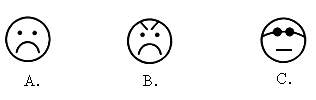
(4) E-talk will probably ________.
[ ]
A
.keep changingB
.stay the sameC
.be used by people on the telephone(5) The best title for this passage is ________.
[ ]
A
.E-talkB
.Pictnm FeelingsC
.How to Use Abbreviations通读下面短文、掌握其大意,然后在各题所给的四个选项中(A, B, C 和D)中选出一个最佳选项。
I watched quietly as my little brother was caught in the act. He sat in the corner of the living room, a pen in one hand and my father’s brand-new book in the other。
As my father __31__into the room, my brother cowered (畏缩)slowly. He __32__ that he had done something wrong. From a distance I could see that he had opened my father’s new book and scribbled(乱画) in it. Now, looking at my father ___33__, he and I both waited for his punishment.
My father __34__his prized book, looked at it carefully, and then sat down, without_ 35__ . A word. Books were precious to him. He was a clergyman(牧师) and for him, __36___ were knowledge. What he did next was ___37___. Instead of punishing my brother, he sat down, took the pen from my brother’s __38___, and then wrote in the book __39___, alongside the scribbles John had made: John’s __40__, 1959, age 2. How many times have I looked into your beautiful face and into your warm, alert eyes looking up at me and thanked God for the one who has now scribbled in my new book? “wow,” I thought. “This is __41___?”
The years and the books came and went. Our family experienced what all families __42__ and perhaps a little bit more: happiness and _43__, laughter and tears. We always knew our parents loved us and that one of the proofs of their love was __44__. From time to time, we would open it, look at the scribbles, read my father’s expressions of love and feel __45__.
( )31. A. rushed B. walked C. ran D. jumped
( )32. A. felt B. saw C. found D. knew
( )33. A. gladly B. carefully C. fearfully D. surprisely
( )34. A. picked up B. cleaned up C. fixed up D. looked up
( )35. A. listening B. hearing C. saying D. reading
( )36. A. books B. music C. money D. kids
( )37. A. unbelievable B. unimportant C. impossible D. uncomfortable
( )38. A. bag B. hand C. drawer D. desk
( )39. A. herself B. themselves C. himself .D. itself
( )40. A. problem B. mistake C. job D. work
( )41. A. development B. agreement C. payment D. punishment
( )42. A. look through B. go through C. read through D. get through
( )43. A. sadness B. kindness C. tiredness D. shyness
( )44. A. the book B. the money C. the punishment D. the family
( )45. A. happy B. sad C. proud D. upset
| |||||||||||||||||||||||||||||||||||||||||||||||||||||||||||||||||||||||||||||||||||||||||||||
听力(选择题,共三节,满分30分)
第一节 听句子(共5小题,每小题1分,满分5分)
听下面5个句子,每个句子后有1个小题,从题中所给的A、B、C三个选项中选出最佳选项。听完每个句子后,你都有10秒钟的时间来回答有关小题和阅读下一小题。每个句子仅读一遍。
听第一个句子,回答第1小题。
1.How many floors are there in that tall building?
A.Thirty-six.
B.Sixty-two.
C.Twenty-six.
听第二个句子,回答第2小题。
2.What may my mother be?
A.A teacher.
B.A nurse.
C.A driver.
听第三个句子,回答第3小题。
3.Who were the flowers given to?
A.Mary.
B.Me.
C.My sister.
听第四个句子,回答第4小题。
4.How many times has Peter been to Beijing?
A.Three times.
B.Twice.
C.Once.
听第五个句子,回答第5小题。
5.What is he weak in?
A.All his lessons.
B.Chinese.
C.English.
第二节 听对话(共15小题,每小题1分,满分15分)
听下面7段对话,每段对话后有若干小题,从题中所给的A、B、C三个选项中选出最佳选项。听每段对话前,你将有时间阅读各个小题,每小题5秒钟;听完后,各小题将给出5秒钟的作答时间。每段对话读两遍。
听第一段对话,回答第6小题。
6.How did Tom feel?
A.Happy.
B.Glad.
C.Sad.
听第二段对话,回答第7-8小题。
7.What does Tom do once a week?
A.He rides his bicycle.
B.He plays football.
C.He goes to swim.
8.How often does Kate go to dance?
A.Once a week.
B.Every day.
C.We don't know.
听第三段对话,回答第9-10小题。
9.Where is No.2 Middle School?
A.Near a large shop.
B.Near a large restaurant.
C.Near the traffic lights.
10.How will the woman go to No.2 Middle School?
A.By bus.
B.On foot.
C.By train.
听第四段对话,回答第11-12小题。
11.Which country may the man come from?
A.China.
B.England.
C.Japan.
12.Who may help the woman with her English?
A.The man.
B.The man's daughter.
C.The man's son.
听第五段对话,回答第13-14小题。
13.What's the man's full name?
A.Allen James Green.
B.James Allen Green.
C.James Green Allen.
14.What does the woman mean by “OK,I won't.” ?
A.I will no longer call you Mr.James Green.
B.I won't call you Mr.James.
C.I would like to call you Mr.James.
听第六段对话,回答第15-17小题。
15.What's the woman going to do?
A.To see a doctor.
B.To see a movie.
C.To buy tickets.
16.Who will go with the woman?
A.Joe.
B.Jim.
C.Tom.
17.When will it begin?
A.7∶15.
B.8∶15.
C.7∶45.
听第七段对话,回答第18-20小题。
18.Where do you think they are talking?
A.In a shop.
B.In a library.
C.In a hospital.
19.Where is the washing machine made?
A.In Japan.
B.In America.
C.In China.
20.Why didn't the man buy the machine at once?
A.Because he didn't have enough money.
B.Because he didn't want to buy the machine at all.
C.Because the machine is shaking(摇晃)and makes much noise.
第三节 听短文(共5小题,每小题2分,满分10分)
听下面一篇短文,短文后有5个小题,从题中所给的A、B、C三个选项中选出最佳选项。听短文前,你将有时间阅读各个小题,每小题5秒钟;听完后,各小题将给出5秒钟的作答时间。短文读两遍。
21.According to the passage, what can we do on the Internet?
A.We can write to our friends.
B.We can talk to our parents.
C.We can call a policeman.
22.Why did the boy call the police?
A.Because he was robbed(抢劫).
B.Because he wanted the police to take him home.
C.Because he was very hungry.
23.How long did the boy stay at the Internet cafe?
A.Two days.
B.Two weeks.
C.A whole night.
24.Which of the following is NOT true?
A.The boy had no money left at all.
B.The boy didn't tell the truth(事实)at first.
C.The boy still had some money left.
25.What does the writer want to tell us?
A.The Internet is very useful for students.
B.The Internet is not good for students.
C.We shouldn't copy the boy's example.
| |||||||||||||||||||||||||||||||||||||||||||||||||||||||||||||||
湖北省互联网违法和不良信息举报平台 | 网上有害信息举报专区 | 电信诈骗举报专区 | 涉历史虚无主义有害信息举报专区 | 涉企侵权举报专区
违法和不良信息举报电话:027-86699610 举报邮箱:58377363@163.com