
题目列表(包括答案和解析)
阅读短文,根据其内容回答问题。
Phys ed (physical education) is making a comeback, but with a difference. The new way is to teach skills that are useful beyond gym class, like lifting weights, balancing their diets and building physical endurance(耐力).
Considering that 15% of American children 6 to 18 are overweight, supporters say more money and thought must be put into phys ed curriculum. In many cases, that may mean not just replacing the old gym-class model with fitness programs but also starting up phys ed programs because school boards(教育委员会)often “cut P.E. completely or decrease(减少)its teachers or the days it is offered,” says Alicia Moag-Stahlberg, the director of Action for Health Kids. The difference in phys ed programs is its short of a national standard.
The wisdom of the new idea has some scientific support. Researchers at the University of Wisconsin have showed how successful the fit-for-life model of gym class can be. They observed how 50 overweight children lost more weight when they cycled and skied cross-country than when they played sports. The researchers have also found that teaching group sports like football results in less overall(全体的)movement, partly because the students who are unwilling to do may sit on the bench.
Another problem with simply teaching group sports in gym class is that only a small part of students continue playing them after finishing their high school. The new method teaches skills that translate to adulthood, which means kids are given skills and experiences so they can lead a physically active life in their future.
1.Is the new Phys ed program different from the one before?
2.What does the new P.E. program teach the students?
3.According to the passage, what do some school boards do with P.E?
4.What are the problems with simply teaching group sports?
5.What’s the passage mainly about?
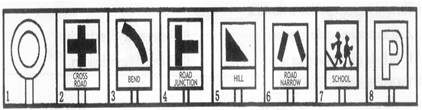
A sign is another kind of language. Here are some of them that you see on the roads.
Number One is a sign with the number thirty on it. When drivers see this sign, they must not go at more than thirty kilometers an hour. We see this sign when we are getting near a town. Number Two is a sign that we’re near a crossing. We must drive carefully. Number Three is a sign that there is a bend (拐弯) in the road. Again, we must drive slowly and carefully. It is not safe to go around a bend very fast. Number Four is a sign that there is another road coming in from the right. There is a junction (交叉) at this place. Number Five is a sign that there is a hill and Number Six is a sign that the road gets narrow. Drivers must go slowly and carefully. Number Seven has the word “SCHOOL” on it. This is a sign that there is a school at the side of the street or the road. Perhaps there are children going to or leaving school. So drivers must look carefully and go slowly. Number Eight is a sign with the letter “P” on it. The letter “P” means “Parking”. At some places, there are the signs “No parking” or “No waiting”. If a driver leaves his car near one of these signs, a policeman may come and write down the number of his car.
【小题1】At the places where you see Sign 1, ____________. .
| A.you are already out of a town |
| B.you still have thirty kilometers to go |
| C.there must be many houses and building not far away |
| D.there must be a town thirty kilometers away |
| A.near a sign with “P” on it in the daytime |
| B.near a sign with “No parking” on it |
| C.near a sign with “No waiting” if there’re no policemen there |
| D.near Sign 8 at any time |
| A.make driving even safer | B.show drivers the way |
| C.stop cars going too fast | D.learn another kind of language |
【小题1】My life is filled with p_____________, and I’m very happy now.
【小题2】Mike _____________(记忆) new words more quickly than me.
【小题3】Reading English aloud every day will of course help you to improve your __________(发音).
【小题4】If you try your best now, you are sure to have a chance of ____________(实现) your dream.
【小题5】Have you ever c___________ buying a new MP4 player?
【小题6】Be careful not to d___________ your glasses. They might be broken.
【小题7】Without my p______________ , don’t touch my things.
【小题8】I like to go out to enjoy the _____________(新鲜的) air.
【小题9】Can you have dinners with f_______________ and knives?
【小题10】I’m sorry to ______________(打扰) you. Can you tell me how to send an e—mail?
One spring day in 1950 in New Mexico, the United States, someone saw s 1. coming from a forest and called the fire station at once. The firemen saw a big fire on the ground between the trees, which was spreading(扩散)quickly because of a s 2. wind. Many people t 3. to fight the fire, but as soon as one area was under control, the fire spread to another area. S 4. , a firemen saw a baby bear close to the fire. It was t 5. in the bushes. The fireman bravely ran over and took it away from the f 6. .
After the firemen put o 7. the fire, a farmer took the bear to his farm. A reporter wrote about this lucky bear in the newspaper and soon many people knew his story. Soon he was given a home at the National Zoo in Washington DC. People wanted to remind everyone in the USA about the dangers of forests fires so they put up big signs with p 【 小题8】 of the bear, which said, ‘Only you can p 【 小题9】 forest fires from happening!’ The little bear became the most f 8. animal in the country.
湖北省互联网违法和不良信息举报平台 | 网上有害信息举报专区 | 电信诈骗举报专区 | 涉历史虚无主义有害信息举报专区 | 涉企侵权举报专区
违法和不良信息举报电话:027-86699610 举报邮箱:58377363@163.com