
题目列表(包括答案和解析)
Dear Sir,
I read your story(of the 5th may) about the cost of living in the country, and I agree with what you said. I lived in a seaside town two years ago. When my husband stopped working, we moved to a small village.
I have to do my shopping in small shops, and things are more expensive than in city supermarkets; it also costs more to travel by bus.
But it does not cost us much to enjoy the beauty and quiet in the country. We can enjoy them just by going out of the front door. Though it costs more to live here, we have an enjoyable life now.
Yours faithfully,
Helen Smith
46.Mrs. Smith moved from______to a small village.
A. a large city B. the country C. a seaside town D. another village
47.Things in small shops are______than those in city supermarkets.
A. less expensive B. more expensive C. cheaper D. cheap
48.It cost them______to live in the country than before.
A. much B. more C. little D. less
49.We can infer(推断)that the May 5th story told people the cost of living in the town was______than that in the country.
A. higher B. lower C. as high as D. as low as
[ ]
[ ]
[ ]
[ ]
[ ]
Napoleon was Emperor of the French from 1804 to 1815. He was a great general(将军) in history. In his life, there were so many important things. But he was also an ordinary person who had ordinary feel ings.
ings.
Once Napoleon stayed in a small inn(小旅馆).The next morning, he went to thank the innkeeper.
“You have served me well, innkeeper,” said Napoleon. “I wish to reward you. Tell me what you want.”
“Sir, we want nothing,” said the innkeeper. “But will you tell us something?”
“What is it?” Napoleon asked.
“We have heard a story,” said the innkeeper, “that once during the war, a small village was taken by the Russians. You happened to be in the village. You hid while they looked for you. Will you tell us how you felt when they were looking for you?” Napoleon looked very angry. He called in two of his soldiers. Then he pointed to the door. The soldiers took the innkeeper and his wife out into the yard.
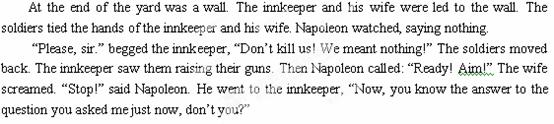
61. Which is the best title of the text?
A. Napoleon’s Trick. B. Napoleon and an Innkeeper.
C. Napoleon’s Anger. D. Napoleon’s Ride.
62. What can we infer(推断) from the passage?
A. Napoleon set the couple free. B. Napoleon killed the couple.
C. Napoleon put the couple into prison (监狱). D. Napoleon killed the innkeeper.
63. Why did the innkeeper ask Napoleon to tell him how Napoleon felt when he was being looked for?
A. He was interested in other’s failure, especially Napoleon’s.
B. He showed his sympathy (同情) to Napoleon in time of danger.
C. He wanted to know the difference between a general and an ordinary person.
D. He looked down upon Napoleon, for he thought a great man shouldn’t be defeated.
64. Why did Napoleon order his men to tie the couple?
A. To kill the couple to get rid of his anger.
B. To teach the innkeeper a good lesson for bothering him.
C. To show that he was so admiring that nobody could upset him.
D. To tell the innkeeper that a general had the same feeling as the ordinary people 。
65. How is the passage organized?
A. By giving reasons only. B. By using famous people’s words.
C. By telling a story. D. By giving numbers.
My mother loves flowers. We live next door to each other, so she often spends much time planting flowers in my garden. In summer, she often makes colourful bouquets(花束) and puts them inside the houses-both hers and mine.
One year, shortly before Christmas, a local flower shop offered an activity for mothers in each month of the next year. It seemed to be a great way to thank her for all of the flowers she had given me through the years. I couldn't wait the new year so that I could give a bouquet to her!
After the Christmas, in early January, I drove her to the flower shop to pick up her first month's bouquet. But then we found the bouquet would hardly fill a small vase(花瓶).
I was so embarrassed(尴尬的). "Mum, I'm sorry," I told her. "I didn't know how skimpy that bouquet was." She looked at me and smiled. "It's okay," she said optimistically (乐观地). "It allows me to enjoy the beauty of each one better."
I was amazed at what she said. It helped me realize something more important —we often fail to enjoy the beauty of each thing when we have too many good things. I understood that less is sometimes more.
46. The mother often spends much time ________.
A. cleaning her child's house
B. making bouquets in a flower shop
C. planting flowers in her child's garden
D. planting flowers in her own garden
47. We can infer(推断) from the story that_________ .
A. the writer couldn't afford a big bouquet
B. the mother was unhappy when receiving the bouquet
C. the writer would pick up another bouquet the next month
D. the mother would send back the bouquet to the flower shop
48. The underlined word "skimpy" means" _______”.
A. beautiful B. small C. cheap D. colourful
49. What is the mother like?
A. She is a lazy woman. B. She is a strict mother.
C. Sometimes she isn't honest. D. She is always optimistic.
50. What did the author learn from her mother?
A. How to buy flowers. B. How to enjoy flowers.
C. How to grow flowers in the garden. D. How to consider things in another way.
湖北省互联网违法和不良信息举报平台 | 网上有害信息举报专区 | 电信诈骗举报专区 | 涉历史虚无主义有害信息举报专区 | 涉企侵权举报专区
违法和不良信息举报电话:027-86699610 举报邮箱:58377363@163.com