
题目列表(包括答案和解析)
The novelist, Harriet Beecher Stowe, born 200 years ago, was a poor housewife with six children, and she suffered from various illnesses. Driven by the hatred of slavery, she found time to write Uncle Tom’s Cabin, which became the most influential novel in American history and caused great change, both at home and abroad.
Today, however, the book has a different reputation, owing to the popular image of its character, Uncle Tom, whose name has become a saying for a cowardly(懦弱的)black man who betrays his race.
But this view is wrong: the original Uncle Tom was physically and morally strong, an inspiration for black people and other oppressed(被压迫的)people worldwide. Indeed, that was why, in the mid-19th century, Southerners attacked Uncle Tom’s Cabin as a dangerously destructive book, while Northern reformers—especially black people—often praised it.
The book was influential overseas too. In Russia it inspired Vladimir Lenin, who recalled it as his favorite book in childhood. It was the first American novel to be translated and published in China, and it fueled anti-slavery movements in Cuba and Brazil.
The book’s progressive appeal was the character of Uncle Tom himself: a strong man who is notable because he does not betray his race; one reason he gives up escaping from his plantation(种植园)is that he doesn’t want to put his fellow slaves in danger. And he is finally killed because he refuses to tell his master where two runaway slaves are hiding.
Unfortunately, these themes were lost in many of the stage versions of Uncle Tom’s Cabin.
The play, seen by more people than those who read the book, remained popular up to the 1950s and still appears occasionally. But in the play, Stowe’s revolutionary themes were drowned.
But it doesn’t have to be that way; indeed; during the civil rights era it was those who most closely resembled Uncle Tom—Stowe’s Uncle Tom, not the embarrassed one of popular myth—that proved most effective in promoting progress. Both Stowe and Uncle Tom deserve our reconsideration and our respect.
【小题1】Harriet Beecher Stowe wrote Uncle Tom's Cabin because she .
| A.wanted to earn money to support her family |
| B.tried to set an example to her six children |
| C.hated slavery from the bottom of her heart |
| D.had similar life experiences to Uncle Tom |
| A.It was the first American novel to be translated into Russian. |
| B.It was the most influential book for Vladimir Lenin in his life |
| C.It also gave rise to anti-slavery movements in faraway Africa. |
| D.It inspired black people and people who were suffering in the world. |
| A.he helps his fellow slaves to avoid getting into danger. |
| B.He is a black man who betrays his race. |
| C.He manages to escape from the plantation. |
| D.He kills himself instead of giving away the slaves. |
| A.The themes of revolution and progress in the book were lost in the play |
| B.There are more people who have read the book, Uncle Tom’s Cabin, than those who have seen the stage version. |
| C.The play was very popular and it is still put on from time to time today. |
| D.It was Uncle Tom in the book that promoted the progress of mankind. |
The novelist, Harriet Beecher Stowe, born 200 years ago, was a poor housewife with six children, and she suffered from various illnesses. Driven by the hatred of slavery, she found time to write Uncle Tom’s Cabin, which became the most influential novel in American history and caused great change, both at home and abroad.
Today, however, the book has a different reputation, owing to the popular image of its character, Uncle Tom, whose name has become a saying for a cowardly(懦弱的)black man who betrays his race.
But this view is wrong: the original Uncle Tom was physically and morally strong, an inspiration for black people and other oppressed(被压迫的)people worldwide. Indeed, that was why, in the mid-19th century, Southerners attacked Uncle Tom’s Cabin as a dangerously destructive book, while Northern reformers—especially black people—often praised it.
The book was influential overseas too. In Russia it inspired Vladimir Lenin, who recalled it as his favorite book in childhood. It was the first American novel to be translated and published in China, and it fueled anti-slavery movements in Cuba and Brazil.
The book’s progressive appeal was the character of Uncle Tom himself: a strong man who is notable because he does not betray his race; one reason he gives up escaping from his plantation(种植园)is that he doesn’t want to put his fellow slaves in danger. And he is finally killed because he refuses to tell his master where two runaway slaves are hiding.
Unfortunately, these themes were lost in many of the stage versions of Uncle Tom’s Cabin.
The play, seen by more people than those who read the book, remained popular up to the 1950s and still appears occasionally. But in the play, Stowe’s revolutionary themes were drowned.
But it doesn’t have to be that way; indeed; during the civil rights era it was those who most closely resembled Uncle Tom—Stowe’s Uncle Tom, not the embarrassed one of popular myth—that proved most effective in promoting progress. Both Stowe and Uncle Tom deserve our reconsideration and our respect.
1.Harriet Beecher Stowe wrote Uncle Tom's Cabin because she .
|
A.wanted to earn money to support her family |
|
B.tried to set an example to her six children |
|
C.hated slavery from the bottom of her heart |
|
D.had similar life experiences to Uncle Tom |
2. Which of the following is TRUE about the influence of the book?
|
A.It was the first American novel to be translated into Russian. |
|
B.It was the most influential book for Vladimir Lenin in his life |
|
C.It also gave rise to anti-slavery movements in faraway Africa. |
|
D.It inspired black people and people who were suffering in the world. |
3.What can we learn about Uncle Tom in the book?
|
A.he helps his fellow slaves to avoid getting into danger. |
|
B.He is a black man who betrays his race. |
|
C.He manages to escape from the plantation. |
|
D.He kills himself instead of giving away the slaves. |
4.According to the passage, which of the following is NOT true?
|
A.The themes of revolution and progress in the book were lost in the play |
|
B.There are more people who have read the book, Uncle Tom’s Cabin, than those who have seen the stage version. |
|
C.The play was very popular and it is still put on from time to time today. |
|
D.It was Uncle Tom in the book that promoted the progress of mankind. |
阅读下面短文,按照要求完成各题。
One of the most famous English writers was a woman called Jane Austen who lived in the late 18th century.At that time English women from educated, middle class families did not work-that is, they did not have jobs or work for money.Instead, they stayed at home to do things like organizing the house, sewing, reading books and writing letters.
Jane Austen was an unusual woman because she was determined to be a writer.She wanted to write about the ordinary lives of young women like herself-their hopes, dreams and problems.She finished her first novel when she was only 20 years old.By the time she was 24, she had finished two more.
Jane’s only problem was that no one wanted to publish her novels.Her father sent one to a publisher, but he refused to look at it.He didn’t think anyone would want to read about women’s lives.For fourteen years, Jane’s work remained unpublished and unread.
Finally, Jane decided she had waited long enough.She chose one of her novels Sense and Sensibility, and paid to have it published herself.Jane’s gamble(赌博)paid off.To the publisher’s surprise, every one of her books was sold.The publisher realized that women’s novels were interesting and agreed to publish all her other novels.
Jane Austen completed six books altogether, and all of them are still being read today.In the last few years, several of her novels have been made into films, including Sense and Sensibility, the novel which she had to publish herself all those years ago.
During Jane’s lifetime, some people looked down upon her novels.They said that no one would want to read about women and women’s lives.They believed that men’s lives were much more important and interesting.Now we know that they were very wrong.In fact, Jane Austen’s novels are wonderful because they tell us ________.They give us the details of life which are not recorded in history books.Her novels show us that although nearly 200 years have passed, and modern life is very different, people are still basically the same.
Questions:
1.What were considered to be good examples of women at Jane Austen’s time?
_____________________
2.How many books had Jane Austen written by the age of 24?
_____________________
3.Why are Jane Austen’s novels still being read by many people today?
_____________________
4.Please complete the sentence in the sixth paragraph with proper words or phrases.(Please answer within 10 words)
_____________________
5.Translate the underlined sentence in the sixth paragraph into Chinese.
_____________________
Directions:
Read the following text and choose the most suitable heading from A-F for each paragraph.There is one extra heading which you do not need.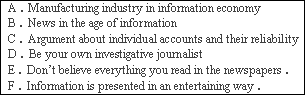
1._________
With the arrival of the age of “information economy”, intellectual work is becoming a more important source of wealth than manufacturing.Organizations in all walks of life are doing more to spread their information.So people of the Public Relations are hired to speak for them.A lot of our news is actually collected from press releases and reports of events intentionally staged for journalists.In the information age, journalists spend their time, not investigating, but passing on the words of a spokesperson.
2._________
There is a joke in the novel Scoop about the newspaper’s owner, Lord Copper.The editors can never disagree with him.When he’s right about something they answer “definitely”, and when he’s wrong they say “to some extent, Lord Copper.” It seems reasonable to suppose that, in the real world, the opinions of such powerful people still influence the journalists and editors who work for them.
3._________
In countries where the news is not officially controlled, it may be provided by commercial organizations who depend on advertising.The news has to attract viewers and maintain its audience ratings.I suspect that some stories get air-time just because there happen to be exciting pictures to show.In Britain, we have the tabloid newspapers which millions of people read simply for entertainment.There is progressively less room for historical background, or statistics, which are harder to present as a sensational story.
4._________
There is an argument that with spreading access to the internet and cheap technology for recording sound and images we will all be able to find exactly the information we want.People around the world will be able to publish their own eye-witness accounts and compete with the widely-accepted news-gatherers on equal terms.But what it will mean also is that we’ll be subjected to a still greater amount of nonsense and lies.Any web log may contain the latest information of the year, or equally, a made-up story that you will never be able to check.
5._________
Maybe the time has come to do something about it, and I don’t just mean changing your choice of TV channel or newspaper.In a world where everyone wants you to listen to their version, you only have two choices:switch off altogether or start looking for sources you can trust.The investigative journalist of the future is everyone who wants to know the truth.
Umbrella is a “difficult” novel. But if you enjoy challenges, just read on because Umbrella, as a Booker Prize winner, is one you can’t miss.
The story itself is not difficult to follow. It concerns a woman named Audrey, a Lo ndoner who grows up during World War I, works in a military factory, and then survives an epidemic (传染病)spreading through Europe between 1915 and 1926. She is admitted to a mental hospital in 1922, and remains there, mind out of time, until 1971, when a doctor named Zach Busner awakens the sleeping beauty with a special drug. And decades later-on April 8,2010, to be exact — Busner
thinks back on all this as he visits his old hospital.
 The story also involves painful facts of how the mentally ill were
mistreated, and the careers of Audrey’s two brothers, one of whom
becomes a soldier in the Great War. Fans of World War I will not want
to miss the vivid descriptions of battlefields.
What makes Will Self’s novel challenging is how he tells his story.
Is opens in the spring of 1971 but thereafter time travels back and
forth between Audrey’s Edwardian childhood and 2010, jumping
mid-sentence from one era to another with no reminders to guide the reader. It is a new style many many modernists adopted, who thought that the old ways were not enough to show the great changes at the beginning of the 20th century.
This story isn’t new: Oliver Sacks dealt with the same sleeping sickness and its treatment in Awakenings. What’s appealing about Umbrella is that Self combines from with content perfectly, using modernist techniques. The readers may feel confused about the switch of time, it’s Self’s wild style that offers other delights – richly detailed settings that bring mental hospitals alive and much more than that.
Yes, “Umbrella” is a “difficult” novel, but it amply rewards the effort. 
66.The underlined phrase "mind out of time" in the second paragraph probably refers, to .
A.a way a person faces difficulties light-heartedly
B.a condition where a person is unconscious
C.a situation which makes someone embarrassed
D.an occasion where a person doesn't mind the time
67.What troubles the readers most when they are reading Umbrella?
A.The relations of the characters.
B.The abstract language.
C.The switch of time.
D.The settings of battlefields.
68.We can safely infer from Paragraph 4,______.
A.Self displays a fast-changing world to readers
B.Self created the style in which he wrote his story
C.Self avoided describing the scene of the war
D.Self’s style was followed by many other writers
69.Who else wrote a similar story besides Self?
A.Audrey. B.Zach Busner.
C.Oliver Sacks. D.Audrey's brother.
70.The novel Umbrella really attracts the readers because______.
A.the potential Self has as a modernist writer
B.the strange writing technique Self created
C.the new material Self chose for his story
D.the perfect combination of the form and content
湖北省互联网违法和不良信息举报平台 | 网上有害信息举报专区 | 电信诈骗举报专区 | 涉历史虚无主义有害信息举报专区 | 涉企侵权举报专区
违法和不良信息举报电话:027-86699610 举报邮箱:58377363@163.com