
题目列表(包括答案和解析)
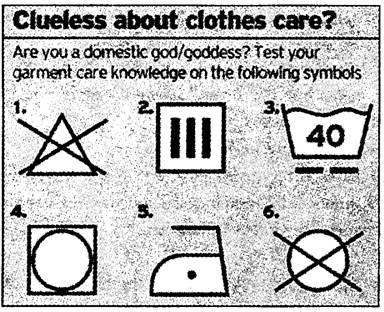
They have appeared on clothes labels for four decades, each one chosen by international experts for its simplicity and clarity. Yet for most people, washing instructions might as well be written in Martian.
According to a new poll, 9 in 10 people are unable to understand common symbols used on clothes labels. Even those who have mastered the difference between a wool and a synthetics (合成纤维织物) wash admit being puzzled by the boxes, circles and crosses used to give advice about drying and bleaching (漂白).
The findings come from a poll of 2,000 people carried out by YouGov for Morphy Richards. A third of the people surveyed said that they recognized none of the six symbols shown, while the only symbol recognized by more than half of the people was the iron with a single dot. Around 70 per cent knew it meant “iron on a low heat”. Just 10 per cent knew the sign for “do not dry clean”, while only 12 per cent were familiar with “drip dry only”.
Despite the sexual revolution, women are stir more knowledgeable than men. Awareness was highest among 18- to 29-year-old women, for whom taking care of clothes is clearly important.
Chris Lever, from Morphy Richards, said, “Clothes Care symbols are a unique language, clearly a language that few people in the
“Learning the basics such as which icon represents tumble dry (滚动热干) and which represents normal wash would go a long way to getting the best out of clothes.”
The Home Laundering Consultative Council, which promotes symbols, said it was not surprised to learn that people were unfamiliar with them. “It’s disappointing that there is a lack of recognition, but it’s a story that’s repeated time and time again,” said a spokesman, Adam Mansell. “We are a small organization and we don’t have a big budget.”
60.Why are these six washing symbols chosen by international experts?
A.Because people in the
B.Because they are simple and clear.
C.Because it’s a long way to getting the best out of clothes.
D.Because they are a unique language.
61.Which of the following statements is NOT true according to the text?
A.Clothes care symbols have appeared on clothes labels for forty years.
B.Few people in the
C.A third of the people surveyed said that they recognized the six symbols shown.
D.Women have a better knowledge of the common symbols used on clothes labels than men.
62.Which symbol did most of people recognize according to the survey?

63.By the underlined part in the first paragraph “for most people, washing instructions might as well be written in Martian”, the author means __________.
A.the washing instructions are written in Martian
B.most people can understand the washing instructions
C.most people can understand the instructions if they are written in Martian
D.most people think it impossible to understand the washing instructions
(福建省厦门双十中学09届高三热身考试B篇)
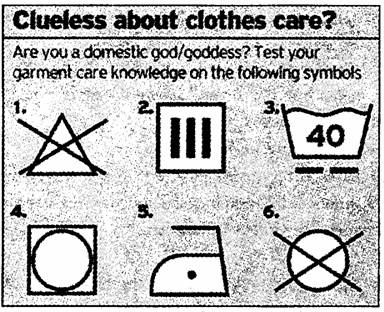
They have appeared on clothes labels for four decades, each one chosen by international experts for its simplicity and clarity. Yet for most people, washing instructions might as well be written in Martian.
According to a new poll, 9 in 10 people are unable to understand common symbols used on clothes labels. Even those who have mastered the difference between a wool and a synthetics (合成纤维织物) wash admit being puzzled by the boxes, circles and crosses used to give advice about drying and bleaching (漂白).
The findings come from a poll of 2,000 people carried out by YouGov for Morphy Richards. A third of the people surveyed said that they recognized none of the six symbols shown, while the only symbol recognized by more than half of the people was the iron with a single dot. Around 70 per cent knew it meant “iron on a low heat”. Just 10 per cent knew the sign for “do not dry clean”, while only 12 per cent were familiar with “drip dry only”.
Despite the sexual revolution, women are stir more knowledgeable than men. Awareness was highest among 18- to 29-year-old women, for whom taking care of clothes is clearly important.
Chris Lever, from Morphy Richards, said, “Clothes Care symbols are a unique language, clearly a language that few people in the UK have taken the time to learn.”
“Learning the basics such as which icon represents tumble dry (滚动热干) and which represents normal wash would go a long way to getting the best out of clothes.”
The Home Laundering Consultative Council, which promotes symbols, said it was not surprised to learn that people were unfamiliar with them. “It’s disappointing that there is a lack of recognition, but it’s a story that’s repeated time and time again,” said a spokesman, Adam Mansell. “We are a small organization and we don’t have a big budget.”
60.Why are these six washing symbols chosen by international experts?
A.Because people in the UK are interested in them.
B.Because they are simple and clear.
C.Because it’s a long way to getting the best out of clothes.
D.Because they are a unique language.
61.Which of the following statements is NOT true according to the text?
A.Clothes care symbols have appeared on clothes labels for forty years.
B.Few people in the UK have taken the time to learn about clothes care symbols.
C.A third of the people surveyed said that they recognized the six symbols shown.
D.Women have a better knowledge of the common symbols used on clothes labels than men.
62.Which symbol did most of people recognize according to the survey?

63.By the underlined part in the first paragraph “for most people, washing instructions might as well be written in Martian”, the author means __________.
A.the washing instructions are written in Martian
B.most people can understand the washing instructions
C.most people can understand the instructions if they are written in Martian
D.most people think it impossible to understand the washing instructions
完形填空(共20小题;每小题1.5分,满分30分)
In the north of Scotland there is a lake called Loch Ness. It is the biggest 36 in Britain. It is over thirty kilometers 37 and in some places nearly 300 meters deep . It is cold and dark and not many people went there until after 1930. Then a road was made 38 the lake.
Holiday makers began to use the road, and this was when the 39 began. Someone said that he had seen a monster(怪兽) in the lake. He said it was twelve meters long. It had a long 40 and a small head. Then someone else said he had seen 41 . Others said the same thing and in 1933 a London doctor took a 42 . It 43 like a monster with a long neck and a thick body but the photo was not too 44 . The newspapers printed the picture and 45 it the Loch Ness monster, or "Nessie".
Then the argument(争论) began. 46 people, however, were certain there was something living in the lake. Others said there was 47 there.
In 1961, a lot of people joined together to make a real 48 to see and photograph the monster to find 49 there was one! Several times people thought they saw something but after ten years there was 50 no real proof (证据).
Later underwater television cameras were used, but 51 found any real proof. However, they 52 find something interesting: a huge underwater cave. It was big enough to be 53 of a monster, but of course, this was not a proof.
In 1975, however, some American scientists 54 a search group. They used an underwater camera. It took pictures every seventy seconds. Some of the pictures seemed to show a red-brown creature. Its body was about four meters long 55 had a very ugly head on the end of a four -meter neck. Many people then began to believe in the monster. But even today we can't be certain.
A. river B. ocean C. sea D. lake
A. wide B. tall C. long D. high
A. in B. over C. around D. above
A. accidents B. meetings C. sayings D. stories
A. eye B. ear C. nose D. neck
A. it B. one C. some D. all
A. photo B. map C. gun D. chance
A. sounded B. looked C. feel D. would
A. clean B. clear C. taken D. shown
A. called B. believed C. thought D. regarded
A. Some B. More C. All D. No
A. nothing B. anything C. monsters D. everything
A. effort B. thing C. interest D. trip
A. so B. but C. as D. if
A. even B. still C. also D. yet
A. someone B. no one C. anyone D. we
A. did B. really C. were D. actually
A. room B. house C. home D. ground
A. found B. formed(组成) C. invited D. get
A. but B. or C. and D. however
完形填空(共20小题;每小题1.5分,满分30分)
In the north of Scotland there is a lake called Loch Ness. It is the biggest 36 in Britain. It is over thirty kilometers 37 and in some places nearly 300 meters deep . It is cold and dark and not many people went there until after 1930. Then a road was made 38 the lake.
Holiday makers began to use the road, and this was when the 39 began. Someone said that he had seen a monster(怪兽) in the lake. He said it was twelve meters long. It had a long 40 and a small head. Then someone else said he had seen 41 . Others said the same thing and in 1933 a London doctor took a 42 . It 43 like a monster with a long neck and a thick body but the photo was not too 44 . The newspapers printed the picture and 45 it the Loch Ness monster, or "Nessie".
Then the argument(争论) began. 46 people, however, were certain there was something living in the lake. Others said there was 47 there.
In 1961, a lot of people joined together to make a real 48 to see and photograph the monster to find 49 there was one! Several times people thought they saw something but after ten years there was 50 no real proof (证据).
Later underwater television cameras were used, but 51 found any real proof. However, they 52 find something interesting: a huge underwater cave. It was big enough to be 53 of a monster, but of course, this was not a proof.
In 1975, however, some American scientists 54 a search group. They used an underwater camera. It took pictures every seventy seconds. Some of the pictures seemed to show a red-brown creature. Its body was about four meters long 55 had a very ugly head on the end of a four -meter neck. Many people then began to believe in the monster. But even today we can't be certain.
1. A. river B. ocean C. sea D. lake
2. A. wide B. tall C. long D. high
3. A. in B. over C. around D. above
4. A. accidents B. meetings C. sayings D. stories
5. A. eye B. ear C. nose D. neck
6. A. it B. one C. some D. all
7.A. photo B. map C. gun D. chance
8.A. sounded B. looked C. feel D. would
9. A. clean B. clear C. taken D. shown
10. A. called B. believed C. thought D. regarded
11.A. Some B. More C. All D. No
12. A. nothing B. anything C. monsters D. everything
13. A. effort B. thing C. interest D. trip
14. A. so B. but C. as D. if
15. A. even B. still C. also D. yet
16. A. someone B. no one C. anyone D. we
17. A. did B. really C. were D. actually
18. A. room B. house C. home D. ground
19. A. found B. formed(组成) C. invited D. get
20. A. but B. or C. and D. however
My partner and I were staying in Beruwela on the Southwest coast of Sri Lanka when the tsunami(海啸) hit. We 1 from the first floor of our hotel. At that time, a wall of water swept in and tore the ground floor apart underneath us. 2 to be moved out to Colombo was very frightening because everyone was afraid that another and possibly bigger 3 would come. At one stage we heard that another wave was coming and there was 4 . Surprisingly, a fleet of small vehicles driven by local people arrived outside the hotel and we just 5 a minibus.
We were taken up a hill to a place of 6 where we were welcomed by a family who told us that we could stay as 7 as we needed to. Among all this death and 8 , these people were trying to help us! We were shown to the local Mosque where hundreds of locals were cooking, collecting and distributing food and supplies for those less 9 . In the three days we were waiting to leave, we saw many examples of ordinary Sri Lankans, many of whom had lost friends, 10 and livelihoods(生计,谋生方式), trying to help others who were worse off. It was a very moving experience.
We have since been 11 the family who took us in and they are saying that what their country needs most urgently is practical help, doctors, nurses and medicines, helping to 12 roads and rebuilding electricity and water supplies. These people would have done anything to help us, it is time for the British Government to do more to help them.
1. A.heard B.watched C.learnt D.moved
2. A.Telling B.Forcing C.Waiting D.Ordering
3. A.wave B.flood C.hurricane D.water
4. A.panic B.peace C.silence D.violence
5. A.looked into B.turned to C.jumped into D.broke into
6. A.safety B.warmth C.goodness D.dreams
7. A.well B.far C.soon D.long
8. A.kindness B.happiness C.love D.destruction
9. A.careful B.fortunate C.dependent D.energetic
10. A.children B.experts C.family D.relatives
11. A.in honor of B.by way of C.in contact with D.on behalf of
12. A.make B.clear C.clean D.build
湖北省互联网违法和不良信息举报平台 | 网上有害信息举报专区 | 电信诈骗举报专区 | 涉历史虚无主义有害信息举报专区 | 涉企侵权举报专区
违法和不良信息举报电话:027-86699610 举报邮箱:58377363@163.com