
题目列表(包括答案和解析)
Basic Math introduces students to the basic things of mathematics, as well as some easy methods of learning it. These 30 fantastic courses are designed to provide students with understanding of arithmetic and to prepare them for Algebra (代数) and beyond.
The lessons in Basic Math cover every basic field of arithmetic. They also look into exponents (指数), the order of operations, and square roots. In addition to that, students also discover how a particular mathematical topic relates to other branches , and how they can be used practically.
Basic Math starts from easier concepts and gradually moves on to the more troublesome ones. The lectures offer students the chance to understand of mathematical knowledge that may have seemed so frightening. They also help students prepare for college mathematics and develop confidence in this amazing field of study.
With the help of these lectures, they will be able to clear away the mystery (神秘性) of mathematics and face their studies with more confidence than they ever imagined. Besides, they will strengthen their ability to accept new and exciting mathematical challenges.
Professor H. Siegel, honored by Kentucky Educational Television as "the best math teacher in America, " is a devoted teacher and has a gift for explaining mathematical concepts in clear and interesting ways. From the basic ideas to the more difficult problems, he is a master in making math lectures learner-friendlier and less frightening
With a PhD in Mathematics Education form Georgia State University, Dr. Siegel now teaches mathematics at Central Arizona College.
If the course fails to provide complete satisfaction to you, you can easily exchange it for any other course that we offer. Or you can get your money back.
【小题1】What does the course Basic Math mainly cover?
| A.Algebra | B.College Mathematics |
| C.Arithmetic | D.Mathematics Education |
| A.Stronger imagination ability. |
| B.Additional presentation skills. |
| C.More mathematical confidence. |
| D.Greater chances of becoming teachers. |
| A.He is a lecturer at Kentucky Educational Television. |
| B.He is delivering 30 lectures in Basic Math. |
| C.He works in Georgia State University. |
| D.He specializes in training teachers. |
| A.news report | B.A book review |
| C.A lesson plan | D.An advertisement |
| |||||||||||||||||||||||||||||||||||||||||||||||||||||||||||
Basic Math introduces students to the basic things of mathematics, as well as some easy methods of learning it. These 30 fantastic courses are designed to provide students with understanding of arithmetic and to prepare them for Algebra (代数) and beyond.
The lessons in Basic Math cover every basic field of arithmetic. They also look into exponents (指数), the order of operations, and square roots. In addition to that, students also discover how a particular mathematical topic relates to other branches , and how they can be used practically.
Basic Math starts from easier concepts and gradually moves on to the more troublesome ones. The lectures offer students the chance to understand of mathematical knowledge that may have seemed so frightening. They also help students prepare for college mathematics and develop confidence in this amazing field of study.
With the help of these lectures, they will be able to clear away the mystery (神秘性) of mathematics and face their studies with more confidence than they ever imagined. Besides, they will strengthen their ability to accept new and exciting mathematical challenges.
Professor H. Siegel, honored by Kentucky Educational Television as "the best math teacher in America, " is a devoted teacher and has a gift for explaining mathematical concepts in clear and interesting ways. From the basic ideas to the more difficult problems, he is a master in making math lectures learner-friendlier and less frightening
With a PhD in Mathematics Education form Georgia State University, Dr. Siegel now teaches mathematics at Central Arizona College.
If the course fails to provide complete satisfaction to you, you can easily exchange it for any other course that we offer. Or you can get your money back.
1.What does the course Basic Math mainly cover?
|
A.Algebra |
B.College Mathematics |
|
C.Arithmetic |
D.Mathematics Education |
2. What good things can students expect from Basic Math?
|
A.Stronger imagination ability. |
|
B.Additional presentation skills. |
|
C.More mathematical confidence. |
|
D.Greater chances of becoming teachers. |
3.What can we learn about Professor H. Siegel?
|
A.He is a lecturer at Kentucky Educational Television. |
|
B.He is delivering 30 lectures in Basic Math. |
|
C.He works in Georgia State University. |
|
D.He specializes in training teachers. |
4.Where is the passage most likely to have been taken from?
|
A.news report |
B.A book review |
|
C.A lesson plan |
D.An advertisement |
Taxis
Taxis are in the streets 24 hours a day.Simply raise your hand, and a taxi will appear in no time.They are usually red, and they display the price per kilometre on the window.You should check whether the cab has a business permit, and make sure you ask for a receipt.
Buses and trolleybuses
Public transport provides a cheap way to get around in Beijing.There are 20,000 buses and trolleybuses in Beijing, but they can get very crowded.It’s a good idea to avoid public transport during the rush hour(6∶30 a.m.~8∶00 a.m.and 5∶00 p.m.~6∶30 p.m.).Fares are cheap, starting at 1 yuan.Air-conditioned buses cost more.Buses numbered 1 to 100 are limited to travel within the city centre.Higher numbers have destinations in the suburbs.Tourists shouldn’t miss the 103 bus which offers one of the most impressive routes, past the Forbidden City and the White Pagoda in Beihai Park.If you get on a double-decker bus, make sure you sit upstairs.You’ll have a good view of the rapidly changing city.
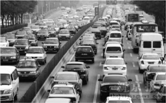
Most buses run from about 5∶00 a.m.to midnight.However, there is also a night bus service, provided by buses with a number in the 200s.
Minibuses
Minibuses with seats for 12 passengers offer an alternative to expensive taxis and crowded public transport in some areas.They run regular services and follow the same routes as large public buses.And in a minibus you always get a seat even in rush hours.
Underground
There are four underground lines in Beijing, and several lines are under construction.Trains are fast and convenient, but rush hours can be terrible.A oneway trip costs 3 yuan.Station names are marked in pinyin.The underground is open from 5∶00 a.m.to 11∶00 p.m..
Pedicabs
Tourists like these human-pedalled“tricycle taxis”, but they can be expensive.You should talk to the driver, and make sure you know the price before you begin the journey.For example, if it is per person, single or return.Tricycles are worth using if you want to explore the narrow alleys(hutong)of old Beijing.
Questions:
1.What’s the problem with buses?
2.What are the advantages of the underground?
3.What can you visit in a pedicab?
| |||||||||||||||||||||||||||||||||||||||||||||||||||||||||||||||||||||||||
湖北省互联网违法和不良信息举报平台 | 网上有害信息举报专区 | 电信诈骗举报专区 | 涉历史虚无主义有害信息举报专区 | 涉企侵权举报专区
违法和不良信息举报电话:027-86699610 举报邮箱:58377363@163.com