
题目列表(包括答案和解析)
You are walking along a lane and never know what you will find. It might be a shop selling oil paintings, or a place where you can buy Dutch cheese. One thing is for sure, you will end up by a canal.
Welcome to Amsterdam, the capital of the Netherlands.
The year 2013 will be a good time to explore Amsterdam as the city has a lot to celebrate: the famous canal ring will turn 400 years old. Amsterdam will also celebrate the 160th birthday of Dutch painter of the Van Gogh museum, home to the biggest collection of the artist’s colorful works.
The famous canal ring is a trademark of the city. With more than 100 kilometers of canals, it is no wonder that Amsterdam is called the ‘Venice of the north’. But unlike the Italian town, where boats were originally used for transport, the canals in Amsterdam were mainly used for defense in the 17th century. Today ferries on canals offer a different way to explore the city.
But to truly experience Amsterdam, you can’t miss the city’s historic museums and monuments, among which Van Gogh museum is the most famous one. It holds 200 paintings, 700 letters and 500 drawings by the artist. Another famous museum is Anne Frank’s house. Anne Frank became famous around the world because of a diary she left explaining her and her family’s experience as a Jewish girl during World War II, hiding out in a house hoping that she would not be captured by German Nazis.
Amsterdam is small enough to walk or cycle almost anywhere, but it is rarely dull. Best of all it combines its glittering past with a rebellious edginess.
1.Which of the following is TRUE of the canals in Amsterdam?
A.They had to be rebuilt after years of use.
B.They protected the city in ancient times.
C.They were built to provide transport for the city.
D.They are the main theme of Van Gogh’s paintings.
2.In the passage, Amsterdam is described as a city _____.
A.that can be explored by foot
B.that is completely built on water
C.that has two historic museums in all
D.that is famous for its modernization
3.What can we infer from the passage?
A.People get lost easily in Amsterdam.
B.Van Gogh spent his life time in Amsterdam.
C.Many Jews in Amsterdam were caught by Nazis.
D.Taking a ferry ride is the most popular activity in Amsterdam.
用下列单词或短语的适当形式填空(每小题1分,满分10分)。
|
sympathetic temperament intense prolific channel go too far blunt delete specific intricately |
1.If you make a mistake, use the __________ button to erase backwards.
2.I think you guys _______ by saying he is selfish before other guys.
3.These early works evidence van Gogh's _________ desire to express the misery and poverty of humanity as he saw it among the miners in Belgium.
4.This report offered the most_______ and accurate description of the problems.
5.The__________ writer wrote a large number of novels.
6.Water is________ through a series of irrigation canals.
7.Under the care of a __________ doctor, whose portrait he painted (Dr Gachet,1890), van Gogh spent three months at Auvers.
8.A whole lot of_______ carved sculptures are displayed in the British Museum.
9.Julian's_______ words hurt me.
10.Born in 1853, van Gogh was the son of a Dutch Protestant minister. Early in life he displayed a moody _______ that was to thwart his every pursuit.
Vincent van Gogh’s paintings were at last _____ as works of genius.
A. practiced B. recognized C. realized D. promised
Starry Night
Have you ever seen a real night sky that looks like Van Gogh’s Starry Night? I hope not! So, why would an artist paint the sky this way? Perhaps I can answer that with another question. When you’re happy, why do you sing instead of speaking? Or when you’re in love, why do you speak of roses and honey? When we do these things, we, too are artists. We’re using something that goes beyond a mere scientific description in order to communicate our feelings more powerfully than straightforward words can. So consider for a moment that Van Gogh might not have been hallucinating (产生幻觉的) on the night he painted this. Maybe he felt something so powerful that he had to go beyond the familiar to express it.
I hope I’m reminding you of something you already know as I describe the experience of being outside at night under a crystal clear sky that makes everything seem clean and refreshing. So you look up. And suddenly you see the sky that you’ve seldom seen before. It’s not just the same old dark night sky tonight. Instead, the blackness is a deep, rich blue that is more bottomless than any ocean. The stars are not spots of light but brilliant, magical diamonds that dance like tiny angels. In just this special moment, the sky is somehow alive, and it seems to speak to you silently about the meaning of infinity (无限).
Now look at the painting again. Can you see something of what makes this such a famous and well-loved image? But there’s more here than that. Van Gogh painted this while he was quite struck down by a mental disease. It is natural to imagine that he frequently battled the fear that he would never escape his prison to true freedom. It is natural for us to imagine this because each of us has faced our own personal prison, whether it be disease, the loss of a loved one, serious financial problems … In such moments it is tempting to give up to despair (绝望) and collapse in hopelessness.
Looking at this painting, I imagine Van Gogh in just such a moment of despair, when he is struck by the memory of one of those amazing night skies. He recalls the sense that he is not alone, that there is a living, infinite world with rich colorful creatures and scenes all around.
And so th e sky flows across the canvas (画布) full of vitality (活力) and power. The stars don’t just sparkle; they explode. Looking closer, we notice that the earth itself seems to respond to the movement in the sky, forming its own living waves in the mountain and rolling trees. In the sleepy village, the windows of the houses glow (发光) with the same light that brightens the universe. The giant trees at the left seem to capture the joy by stretching upwards toward the sky.
What a tremendous message of hope there is in this masterpiece! Even if our troubles persist, the world around us assures us that life is worth living. That’s what the angels sing about. Doesn’t it make you want to sing, too?
【小题1】Looking at the painting Starry Night, we can see all the following except________.
| A.The singing angels | B.the giant trees |
| C.the sleepy village | D.the sparkling stars |
| A.happiness | B.vitality | C.power | D.despair |
| A.trouble in one’s life | B.mental illness |
| C.control from the authority | D.a place where criminals are kept |
| A.To explain how Van Gogh painted the Starry Night. |
| B.To tell us how to appreciate the Starry Night. |
| C.To prove Van Gogh was in a hallucinating state of mind while painting the picture. |
| D.To show us the beauty of the sky on a starry night. |
He lived his whole life as a poor man He suffered from a mental illness that led him to cut off part of his left ear in 1888 and to shoot himself two years later. But after his death, he achieved the world fame.
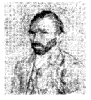
* And the Van Gogh Museum in Amsterdam, home to the biggest collection of his masterpieces, is marking the anniversary with exhibitions throughout the year.
“He is a big fame like Einstein and Beethoven. He is such a great figure. We are always amazed by how popular he is and his popularity seems to be growing.” said Andreas Bluehm, the museum's head of exhibitions.
Van Gogh was the son of a pastor. He left school when he was just 15. By the age of 27, he had already tried many jobs including an art gallery salesman and a French teacher. Finally in 1880, he decided to begin his studies in art.
“Instead of trying to reproduce exactly what I have before my eyes. I use colour more freely, in order to express myself more forcibly,” he wrote in a letter to his brother, Theo, in 1888.
Van Gogh sold only one painting during his short life. But now his works are sold for millions of dollars. His “Portrait of Dr. Gachet” was sold for US  89.5 million in 1990. It is the highest price ever paid for a painting.
1.The second paragraph mainly tells us that ________.
[ ]
A.the Van Gogh Museum is located in Amsterdam
B.the Van Gogh Museum has the biggest collection of Van Gogh'smasterpieces
C.exhibitions will be held in honor of Van Gogh
D.the Van Gogh Museum will hold exhibitions the whole year through for Van Gogh
2.The underlined word “figure” in the third paragraph means “________”.
[ ]
3.The writer cited a part of a letter written by Van Gogh to show Van Gogh's ________.
[ ]
4.Choose the right order of the given events.
a.He worked as a French teacher.
b.He achieved the world fame.
c.He left school. d. He cut off his left ear.
e.He shot himself. f. He began studies in art.
[ ]
湖北省互联网违法和不良信息举报平台 | 网上有害信息举报专区 | 电信诈骗举报专区 | 涉历史虚无主义有害信息举报专区 | 涉企侵权举报专区
违法和不良信息举报电话:027-86699610 举报邮箱:58377363@163.com