an amusement park 一个娱乐园 查看更多


题目列表(包括答案和解析)

完形填空

  When I was a teenager I volunteered to work at the water station at a 10,000m race.My job was to   1   water to the runners.I remember being so   2   to see all the different kinds of people who passed by and grabbed a cup of water.Some ran past, some walked past and a few wheeled past.I saw so many types of people doing it.I thought maybe I could do it too!So the next year I   3   up for the race.

  That first 10,000m race was quite an   4  .I jogged, I walked, I jogged and I walked.  5  , I didn’t know if I could finish Them came a defining(决定性)   6  

  At one point near the end, a 70-year-old man ran past me, very, very fast, and I felt   7   because I was 50 years younger than he but I couldn’t even keep up with him.I felt   8   for a second.

  But then I   9   something.He was running his race and I was running mine.He had   10   abilities, experience, training and goals for himself.I had mine.Remember my   11   was only to finish.

  After a minute, it   12   me that this was a lesson I could draw from.I learned something about myself in that moment.Iturned my embarrassment into   13  

  I   14   that I would not give up on running races.In fact, I would run even more races and I would learn how to train and prepare   15   and one day I would be one of those 70-year-old persons who were still running.As I crossed the finish line, I was proud of my   16  

  In life we all have those moments where we   17   ourselves to others.It’s only   18  .Don’t allow those moments to   19   you.Turn them into motivation and let them inspire you.With the proper preparation and training, you can improve your result to   20   any thing you want in life.

(1)

[  ]

A.

bring out

B.

pass out

C.

take out

D.

pick out

(2)

[  ]

A.

excited

B.

worried

C.

concerned

D.

anxious

(3)

[  ]

A.

gave

B.

made

C.

signed

D.

dressed

(4)

[  ]

A.

achievement

B.

encouragement

C.

instruction

D.

experience

(5)

[  ]

A.

At times

B.

In time

C.

In all

D.

After all

(6)

[  ]

A.

victory

B.

decision

C.

moment

D.

conclusion

(7)

[  ]

A.

embarrassed

B.

annoyed

C.

moved

D.

thrilled

(8)

[  ]

A.

relaxed

B.

defeated

C.

puzzled

D.

inspired

(9)

[  ]

A.

realized

B.

lost

C.

noticed

D.

remembered

(10)

[  ]

A.

special

B.

evident

C.

common

D.

different

(11)

[  ]

A.

motto

B.

plan

C.

goal

D.

direction

(12)

[  ]

A.

worried

B.

hit

C.

reached

D.

hurt

(13)

[  ]

A.

attraction

B.

devotion

C.

inspiration

D.

expectation

(14)

[  ]

A.

hoped

B.

promised

C.

decided

D.

suggested

(15)

[  ]

A.

slightly

B.

hardly

C.

clearly

D.

properly

(16)

[  ]

A.

excitement

B.

accomplishment

C.

movement

D.

judgemen

(17)

[  ]

A.

introduce

B.

relate

C.

present

D.

compare

(18)

[  ]

A.

important

B.

natural

C.

strange

D.

ridiculous

(19)

[  ]

A.

weaken

B.

wound

C.

amuse

D.

cheer

(20)

[  ]

A.

reserve

B.

delive

C.

achieve

D.

abandon

查看答案和解析>>

听下面5段对话。每段对话后有一个小题,从题中所给的A、B、C三个选项中选出最佳选项,并标在试卷的相应位置。听完每段对话后,你将有10秒的时间来回答有关小题和阅读下一小题。每段对话仅读一遍。

1.What is the man doing?

[  ]

A.Asking for help.

B.Making suggestion.

C.Asking for permission.

2.What do we know about the speakers?

[  ]

A.They want to have a cup of coffee.

B.They agree to have a cup of coffee the next day.

C.They woman couldn't accept the man's suggestion.

3.Where does the conversation take place?

[  ]

A.At home.  B.In a shop.  C.In a museum.

4.What are the two speakers talking about?

[  ]

A.A railway station.  B.A cinema.  C.A film.

5.When will Mr. Brown have to be at the airport?

[  ]

A.By 8:30.  B.By 9:30.  C.By 10:30.

听下面5段对话或独白。每段对话或独白后有几个小题,从题中所给的A、B、C三个选项中选出最佳选项,并标在试卷的相应位置。听每段对话或独白前,你将有时间阅读各个小题,每小题5秒钟;听完后,各小题将给出5秒钟的作答时间,每段对话或独白读两遍。

听第6段材料,回答第6至8题。

6.Why does the man think he was lucky to get the job?

[  ]

A.He likes the job.

B.He likes the factory.

C.He is able to live in the little village.

7.How did the man sleep last night?

[  ]

A.He woke for several times.

B.Very well.

C.He couldn't go to sleep.

8.Why couldn't the woman sleep well?

[  ]

A.She was not used to the silence.

B.She was afraid of the bird.

C.She was too tired.

听第7段材料,回答第9至11题。

9.What is the man's plan for the winter vacation?

[  ]

A.Go deer hunting.

B.Go travelling.

C.Go to visit three big cities.

10.Why does the man decide to do this?

[  ]

A.To see his friends.

B.To collect money.

C.To amuse himself.

11.Whom will the man go with?

[  ]

A.The woman.  B.His family.  C.His friends.

听第8段材料,回答第12、13题。

12.Where does the conversation take place?

[  ]

A.In a drug store.  B.In a pet shop.  C.In a zoo.

13.What is the man complaining about?

[  ]

A.They sold him a dead cat.

B.The cat always sleeps.

C.The cat is too tired to move.

听第9段材料,回答第14至16题。

14.What is the man looking for?

[  ]

A.A bookstore.  B.A town guide.  C.A shoe repair shop.

15.What do we know about the man?

[  ]

A.He was shown the wrong way.

B.He remembered the way wrongly at first.

C.He didn't understand what the woman said.

16.How does the woman seem to be?

[  ]

A.In a hurry to leave.

B.Curious about the man.

C.Pleased to help the man.

听第10段材料,回答第17至20题。

17.What is the couple's nationality?

[  ]

A.British.  B.French.  C.Chinese.

18.What happened to the couple's pet dog?

[  ]

A.It was well fed in the kitchen.

B.It was killed in the kitchen.

C.It had a meal with the old couple.

19.How long did the couple have to wait before their food was ready?

[  ]

A.About an hour.  B.Half an hour.  C.An hour and a half.

20.How does the woman feel about what the man said?

[  ]

A.It is true.

B.It is wrong to do so.

C.It is unbelievable.

查看答案和解析>>

阅读理解:

  A scientist turns out to be able to see the future by offering each of four-year-olds a piece of candy and watching how he or she deals with it.Some children reach eagerly for the treat they see.Some last a few minutes before they give in.But others are determined to wait until the last moment.

  By the time the children reach high school, something remarkable has happened.A survey found that those who as four-year-olds had enough self-control to hold out generally grew up to be more popular, adventurous, confident and dependable.The children who gave in to temptation(诱惑)early were more likely to be lonely, easily frustrated and inflexible(固守己见的).

  Actually, the ability to delay reward is a sign of emotional intelligence which doesn't show up on an IQ test.

  The hardware of the brain and the software of the mind have long been scientists' concerns.But brain theory can't explain what we wonder about most, like the question why some people remain upbeat in the face of troubles that would sink a less resistant soul.

  Here comes the theory of Daniel Goleman, writer of Emotional Intelligence:when it comes to predicting people's success, brain ability as measured by IQ may actually matter less than the qualities of mind once thought of as “character”.

  EQ is not the opposite of IQ.What researchers have been trying to understand is how they work together; how one's ability to handle stress, for instance, affects the ability to concentrate and put intelligence to use.Among the ingredients(要素)for success, researchers now generally agree that IQ counts for about 20%; the rest depends on everything from social class to luck.

  While many researchers in this relatively new field are glad to see emotional issues finally taken seriously, some few fear EQ invites misuse.

(1)

The experiment with the four-year-olds makes it clear that ________

[  ]

A.

the age of 4 is a proper time for scientific experiment

B.

emotional intelligence won't show up until adolescence

C.

the ability of self-control plays a role in personal success

D.

candy can be used to measure a person's emotional intelligence

(2)

Which of the following is TRUE of EQ and IQ according to the text?

[  ]

A.

There is no link between EQ and IQ.

B.

The higher a person's IQ is, the higher his or her EQ is.

C.

Some people can be blessed with lots of both, but some with little of either.

D.

Scientists are trying to discover the way in which EQ and IQ work together.

(3)

The underlined word “upbeat” in Paragraph 4 probably means ________

[  ]

A.

kind

B.

floating

C.

excited

D.

optimistic

(4)

Why does the author mention the experiment at the beginning of the text?

[  ]

A.

To amuse both the children and readers.

B.

To prove the scientist's wisdom.

C.

To introduce the topic of the text.

D.

To show us how to do an IQ test.

(5)

What is most likely to be written in the paragraph that follows?

[  ]

A.

Information about famous people with high EQ.

B.

Examples showing the opposite voice about EQ.

C.

Some reasons why EQ is a relatively new field.

D.

Strong demand for basic emotional education.

查看答案和解析>>

阅读理解

  A scientist turns out to be able to see the future by offering each of some four-year-olds a piece of candy and watching how he or she deals with it.Some children reach eagerly for the treat they see.Some last a few minutes before they give in.But others are determined to wait until the last moment.

  By the time the children reach high school, something remarkable(不寻常)has happened.A survey found that those who as four-year-olds had enough self-control to hold out(坚持)generally grew up to be more popular, adventurous(大胆的), confident and dependable.The children who gave in to temptation(诱惑)early on were more likely to be lonely, easily frustrated(沮丧)and inflexible(固守己见的).

  Actually, the ability to delay reward is a sign of emotional intelligence(情商)which doesn't show up on an IQ test.

  The hardware of the brain and the software of the mind have long been scientists' concerns.But brain theory can't explain what we wonder about(左思右想)most, like the question why some people remain upbeat in the face of troubles that would sink(使…消沉)a less resistant soul(意志不坚定者).

  Here comes the theory of Daniel Goleman, writer of Emotional Intelligence:when it comes to predicting(预测)people's success, brain ability which is measured by IQ may actually matter less than(作用不及)the qualities of mind once thought of as "character".

  EQ(情商)is not the opposite of IQ.What researchers have been trying to understand is how they work together; how one's ability to handle stress, for instance, affects the ability to concentrate and put intelligence to use.Among the ingredients(要素)for success, researchers now generally agree that IQ counts for about 20%; the rest depends on everything from social class to luck.

  While many researchers in this relatively(相对地)new field are glad to see emotional issues finally taken seriously, some few fear EQ invites(招致)misuse.

(1)

The experiment with the four-year-olds makes it clear that _________.

[  ]

A.

the age of 4 is a proper time for scientific experiment

B.

emotional intelligence won't show up until adolescence(青春期)

C.

the ability of self-control plays a role in personal success

D.

candy can be used to measure a person's emotional intelligence

(2)

Which of the following is TRUE of EQ and IQ according to the text?

[  ]

A.

The higher a person's EQ is, the higher his or her IQ is.

B.

The higher a person's IQ is, the higher his or her EQ is.

C.

Some people can be blessed with(收获)lots of both, but some with little of either.

D.

Scientists have already discovered the way in which EQ and IQ work together.

(3)

The underlined word "upbeat" in Paragraph 4 probably means _________.

[  ]

A.

kind

B.

floating

C.

excited

D.

optimistic

(4)

Why does the author mention the experiment at the beginning of the text?

[  ]

A.

To amuse(逗乐)both the children and readers.

B.

To prove the scientist's wisdom.

C.

To introduce the topic of the text.

D.

To show us how to do an IQ test.

查看答案和解析>>

根据短文内容,从下框的A-F选项中选出能概括每一段主题的最佳选项。

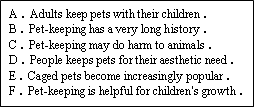
    1  

  Pet-keeping is a time-honored tradition.One of the reasons for people to raise dogs or cows was usefulness.While people in the past hunted animals and kept them in their backyards, the civilsed man today is less cruel towards them and is less exploitative(利用的).

    2  

  We keep animals as pets because they are attractive.We all have the urge to possess something that has aesthetic(审美的)value, and this is why we treasure paintings or fine furniture.Keeping pets is one form of this urge.A Siamese cat in the house can be a decorative object.Pets are playful animals and they amuse us.A little rabbit amuses us by its playful and lively runs.

    3  

  Many parents find it helpful to have pets in the house for their children.Habing pets is an excellent way of developing in children the love of animals and reponsibility.Children get the opportunity to take on full responsibitity for another creature's life.It will be an educational expreience for a child to watch the natural life cycle of an animal.There are psychological benefits for children.Pets are welcome friends for children who are lonely.Pets are excellent companions.Keeping pets means giving love and being loved.We find comfort in giving care and receiving care in return.We get pleasure from their appearance and their behavior.

    4  

  As more people move into apartments, there are limitations on keeping of animals like dogs and monkeys.Therefore, caged animals have increased in popularity.Birds fall into this group.We keep them for their beautiful songs and feathers.Fish-keeping is a widespread hobby and the keeper can observe their behavior in the glass tank and study its entire life cycle.The cat is a fine house pet and it fits neatly into human habitation(居住地)without requiring its own cage.They are wonderful hunters, if there are rats around.

    5  

  Pets satisfy man's desire to care for a bit of nature.The pet owner has the responsibility for supplying those needs that nature provides.Pets are amusing and entertaining, but we are in a way doing animals harm by making them live in a human environment.Are we not enslaving(奴役)them?

查看答案和解析>>


同步练习册答案