
题目列表(包括答案和解析)
认真阅读下列短文,并根据所读内容在文章后表格中的空格里填入一个最恰当的单词。注意:每个空格只填1个单词。
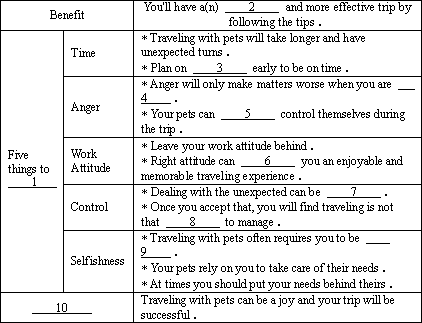
You probably have lists of remember and steps to follow in order to have the best pet-friendly trip.There are, however, a few things that are best left at home.Here are a few things to forget when you’re traveling with pets.Forgetting them will make your trip run more smoothly and more effectively.
Time
Traveling with pets will take longer and will have unexpected turns.In reality, forgetting about time means leaving impatience behind.Don't be in a rush.Your pets will require more extra stops than you will, and they'll often surprise you with unpredictable delays.Plan on leaving early and arriving later and you'll be right on time.
Anger
Getting angry at the delay will only make matters worse.Your feelings can add unnecessary stresses to you and your pets’ travel experience.If you feel yourself becoming out of control, stop and take a deep breath.Your pets have little control over their emotions, bowel movements, or motion sickness when traveling.Remember to be kind and understanding at all times, especially when under pressure.
Work Attitude
This may seem like a no-brainer, but when you are traveling, leave your work attitude behind.Traveling is not a task to be accomplished; it can be an enjoyable and memorable experience for both you and your pets as long as you have the right attitude.
Control
Part of the joy of traveling with pets is dealing with the unexpected.You can't control everything and trying to do so will only end in frustration and anger.Knowing that things will happen beyond your control will bring great relief to you and your pets.Messes happen; accidents happen.Once you accept that, traveling with your pets will be far easier to manage.
Selfishness
Traveling with pets often requires an extreme amount of selflessness.Your pets rely on you to take care of their needs, and sometimes you will need to put their needs before your own.Leave your selfish ambitions behind when traveling with your pets.They need your attention and care more than anything else because of the stresses and strains of traveling.
Traveling with pets can and will be a joy if you remember to leave these five items behind.It can be difficult at times to handle, but the traveling will go well if you can manage to do so.
Traveling with pets
She took up skating at age 85, made her first movie appearance at age 114, and held a concert in the neighborhood on her 121st birthday.
When it comes to long life, Jeanne Calment is the world’s recordholder. She lived to the ripe old age of 122. So is 122 the upper limit to the human life span(寿命)? If scientists come up with some sort of pill or diet that would slow aging, could we possibly make it to 150-or beyond?
Researchers don’t entirely agree on the answers. “Calment lived to 122, so it wouldn’t surprise me if someone alive today reaches 130 or 135, ”says Jerry Shay at the University of Texas.
Steve Austad at the University of Texas agrees. “People can live much longer than we think, ”he says. “Experts used to say that humans couldn’t live past 110. When Calment blew past that age, they raised the number to 120. So why can’t we go higher? ”
The trouble with guessing how old people can live to be is that it’s all just guessing. “Anyone can make up a number, ”says Rich Miller at the University of Michigan. “Usually the scientist who picks the highest number gets his name in Time magazine. ”
Won’t new anti-aging techniques keep us alive for centuries? Any cure, says Miller, for aging would probably keep most of us kicking until about 120. Researchers are working on treatments that lengthen the life span of mice by 50 percent at most. So, if the average human life span is about 80 years, says Miller, “adding another 50 percent would get you to 120. ”
So what can we conclude from this little disagreement among the researchers? That life span is flexible(有弹性的), but there is a limit, says George Martin of the University of Washington. “We can get flies to live 50 percent longer, ”he says. “But a fly’s never going to live 150 years. ”Of course, if you became a new species (物种), one that ages at a slower speed, that would be a different story, he adds.
Does Martin really believe that humans could evolve (进化)their way to longer life? “It’s pretty cool to think about, ”he says with a smile.
【小题1】 What does the story of Jeanne Calment prove to us?
| A.People can live to 122. |
| B.Old people are creative. |
| C.Women are sporty at 85. |
| D.Women live longer than men. |
| A.the average human life span could be 110 |
| B.scientists cannot find ways to slow aging |
| C.few people can expect to live to over 150 |
| D.researchers are not sure how long people can live |
| A.Jerry Shay. | B.Steve Austad |
| C.Rich Miller | D.George Martin |
| A.Most of us could be good at sports even at 120. |
| B.The average human life span cannot be doubled |
| C.Scientists believe mice are aging at a slower speed than before. |
| D.New techniques could be used to change flies into a new species |
完形填空
A Brother Like ThatA friend of mine named Paul received an auto-mobile from his brother as a Christmas present. 1 Christmas Eve when Paul came out of his office, a boy was walking around the shiny new car, 2 it. “Is this your car, Mister?” he asked.
Paul nodded. “My brother gave it to me for Christmas.” The boy was 3 . “You mean your brother gave it to you and it didn't cost you 4 . Boy I wish…” He hesitated.
Of course Paul knew what he was going to wish for. He was going to 5 he had a brother like that. But what the boy said moved Paul a lot.
“A wish,” the boy went 6 , “That I could be a brother like that.”
Paul looked at the boy in astonishment, then he added, “Would you like to take a 7 in my automobile?”
“Oh yes, I'd love that.”
After a short ride, the boy turned and with his eyes shining, said, “Mister, would you mind 8 in front of my house”
Paul 9 a little. He thought he knew what the boy wanted. He wanted to show his neighbors that he could ride home 10 a big automobile. But Paul was wrong 11 . “Will you stop where those two steps are?” the boy asked.
He ran up the steps. Then in a little 12 Paul heard him coming back, but he was not coming fast. He was carrying his little crippled(残废的) 13 . He sat him down on the bottom step and pointed to the car.
There she is, Buddy, just like I told you 14 . His brother 15 it to him for Christmas and it didn't cost him a cent. And 16 day I'm going to give you 17 just like it… then you can see for yourself all the pretty things in the Christmas windows that I've been trying to tell you 18 .
Paul got 19 and lifted the boy to the front seat of his car. The 20 older brother climbed in beside him and the three of them began a memorable holiday ride. That Christmas Eve, Paul learned what Jesus meant when he had said:“It is more blessed to give…”
1.
[ ]
2.
[ ]
3.
[ ]
4.
[ ]
5.
[ ]
6.
[ ]
7.
[ ]
8.
[ ]
9.
[ ]
10.
[ ]
11.
[ ]
12.
[ ]
13.
[ ]
14.
[ ]
15.
[ ]
16.
[ ]
17.
[ ]
18.
[ ]
19.
[ ]
20.
[ ]
完型填空(共20小题:每小题1.5分,满分30分)
The last day of the final examination arrived. In a large eastern university, on the steps of one building, a group of students were talking about the exam that was going to begin in a few 26. On their faces was confidence. This was their 27 exam—then on to graduation and jobs.
Some talked of jobs they already had, others talked of jobs they 28 get. With the certainty of four years of college, they felt 29 and able to take control of the world.
The coming exam, they knew, would be a(n) 30 task, as the professor had said they could bring 31books or notes they wanted, requesting only that they did not 32 each other during the test.
33 they entered the classroom. The professor handed out the papers. And smiles 34 on the students’ faces as they found there were only five questions.
Three hours had passed 35 the professor began to collect papers. The students no longer looked confident. On their faces was a frightened expression. Papers in hand, no one spoke as the professor faced the class.
He looked at the 36 faces before him, and then asked, “How many completed all five questions?” 37 a hand was raised.
“How many answered four?” Still no hand.
“Three? Two?” The students moved restlessly in their seats.
“One, then? Certainly somebody finished 38 .”But the class remained silent.
The professor put down the papers. “That is exactly what I 39 ,” he said. “I just want you to know that, although you have completed four years of study, there are 40 many things about the 41 you don’t know. These questions you could not answer are relatively common in 42 practice.” Then, smiling, he added, “You will all 43 this course, but remember—even though you are now college graduates, your education had just 44 .”
The years have weakened the name of the professor, but not the 45 he taught.
1. A.seconds B.minutes C.hours D.days
2. A.only B.first C.very D.last
3. A.would B.must C.had to D.used to
4. A.glad B.ready C.sorry D.nice
5. A.interesting B.necessary C.easy D.unusual
6. A.no B.either C.any D.some
7. A.listen to B.look at C.care for D.talk to
8. A.Hardly B.Happily C.Quickly D.Carefully
9. A.appeared B.changed C.failed D.stopped
10. A.then B.as C.before D.after
11. A.pleased B.worried C.surprised D.moved
12. A.Not B.Once C.Only D.Even
13. A.all B.none C.one D.it
14. A.wondered B.enjoyed C.hated D.expected
15. A.even B.already C.so D.still
16. A.exam B.subject C.question D.college
17. A.every day B.yearly C.everyday D.monthly
18. A.pass B.fail C.take D.start
19. A.begun B.completed C.failed D.succeeded
20. A.subject B.things C.words D.lessons
Anne Whitney, a sophomore (大学二年级学生) at Colorado State University, first had a problem taking tests when she began college. "I was always well prepared for my tests. Sometimes I studied for weeks before a test. Yet I would go in to take the test, only to find I could not answer the questions correctly. I would blank out because of nervousness and fear. I couldn't think of the answer. My low grades on the tests did not show what I knew to the teacher. “Another student in biology had similar experiences. He said, "My first chemistry test was very difficult. Then, on the second test, I sat down to take it, and I was so nervous that I was shaking. My hands were moving up and down so quickly that it was hard to hold my pencil. I knew the material and I knew the answers. Yet I couldn't even write them down!"
These two young students were experiencing something called test anxiety. Because a student worries and is uneasy about a test, his or her mind does not work as well as it usually does. The student cannot write or think clearly because of the extreme tension and nervousness. Contrary to people’s common belief that poor grades are often a result of poor study habits, sometimes test anxiety plays a role in students’ achieving low grades. Recently, test anxiety has been recognized as a real problem, not just an excuse or a false explanation of lazy students.
Special university advising courses try to help students. In these courses, advisors try to help students by teaching them how to manage test anxiety. At some universities, students take tests to measure their anxiety. If the tests show their anxiety is high, the students can take short courses to help them deal with their tensions. These courses teach students how to relax their bodies. Students are trained to become calm in very tense situations. By controlling their nervousness, they can let their minds work at ease. Learned information then comes out without difficulty on a test.
An expert at the University of California explains, " With almost all students, relaxation and less stress are felt after taking our program. Most of them experience better control during their tests. Almost all have some improvement. With some, the improvement is very great. "
1.To "blank out" is probably______.
A.to be like a blanket B.to be sure of an answer
C.to be unable to think clearly D.to show knowledge to the teacher
2.Poor grades are usually believed to be the result of______.
A.poor sleeping habit B.laziness
C.test anxiety D.inability to form good study habits
3.Test anxiety has been recognized as______.
A.an excuse for laziness B.the result of poor study habits
C.a real problem D.something that cannot be changed
4.A University of California advisor said______.
A.all students could overcome the anxiety after taking a special test anxiety program
B.almost all students felt less stress after taking a University of California advising course
C.students found it difficult to improve even though they had taken a special test anxiety course
D.students found it easy to relax as soon as they entered a University of California advising course
湖北省互联网违法和不良信息举报平台 | 网上有害信息举报专区 | 电信诈骗举报专区 | 涉历史虚无主义有害信息举报专区 | 涉企侵权举报专区
违法和不良信息举报电话:027-86699610 举报邮箱:58377363@163.com