
题目列表(包括答案和解析)
阅读理解
How can we get rid of garbage? Do we have enough energy sources to meet our future energy needs? These are two important questions that many people are asking today. Some people think that men might be able to solve both problems at the same time. They suggest using garbage as an energy source.
For a long time, people buried garbage or dumped it on empty land. Now, empty land is scarce. But more and more garbage can be a good fuel to use. The things in garbage are not like coal, petroleum(石油), or natural gas, but they are chemically similar to the fossil fuels. As we use up our fossil fuel supplies, we might be able to use garbage as an energy source.
Burning garbage is not a new idea. Some cities in Europe and the U. S. have been burning garbage for years. The heat that is produced by burning garbage is used to boil water. The steam that is produced is used to make electricity of heating nearby buildings. In Paris, France, some power plants bum almost 2 million metric tons of the city garbage each year. The amount of energy produced is about the same as would be produced by burning almost a half million barrels of oil.
But there are problems in using garbage as a fuel. Garbage that burn easily, such as food scraps(碎屑) and paper, must be separated from metals, glass and other materials that do not burn easily. This separation process is normally costly. Another problem is that burning garbage can pollute the air.
Our fossil fuel supplies are limited. Burning garbage might be one kind of energy source that we can use to help meet our energy needs. This method could also reduce the amount of garbage piling up on the earth.
1.The subject of the passage might be ________.
[ ]
A.how to get rid of garbage
B.burning garbage is a good way to get rid of garbage
C.there are many problems in using garbage
D.garbage can be burned into energy source
2.Which of the following is Not true according to the passage?
[ ]
A.Glass must be separated from metals before burning.
B.Burning garbage can pollute the air.
C.The separation process of garbage is expensive.
D.Burning garbage can help us meet our energy needs.
3.Why do people make use. of garbage?
[ ]
A.Empty land is becoming less and less.
B.Garbage is chemically similar to coal and petroleum.
C.Some power plants burn almost 2 million tons of garbage.
D.Both A and B.
4.What kind of method does the writer use to organize the passage?
[ ]
A.States the main idea and gives details to prove it.
B.Asks questions and provides methods to solve them.
C.Asks questions and gives examples to explain them.
D.Separately describes some facts and makes conclusions.
| |||||||||||||||||||||||||||||||||||||||||||||||||||||||||||||||||||||||||||||||||||||||
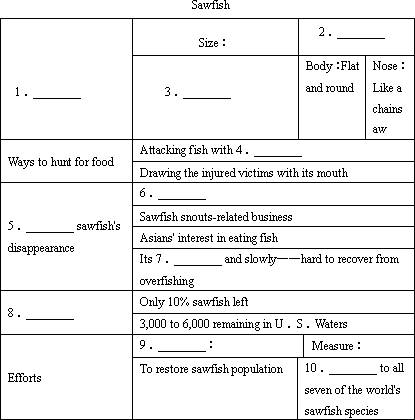
阅读短文,根据所读内容在文后1-10的空格里填土适当的单词或短语。注意:每空不超过3个单词。
It' easy to see how the sawfish got its name.These frightful creatures can grow to be more than 6 meters long.Their bodies are flat and winged, like ;underwater airplanes.And their noses are shaped like chainsaws.
Sawfish are food hunters of the sea.When a sawfish is hungry, it waves its sharp-toothed snout(口鼻部)through a group of fish.Then, it lifts its nose and uses its mouth to draw the injured victims.
Hardy(艰难的)populations of sawfish thrived in warm waters along coastlines around the world for thousands of years.Over the past 200 years, however, human actions have severely endangered sawfish.Threats include fishing nets that trap the huge animals, often by mistake.
Some people collect sawfish snouts as prizes:One snout recently sold for nearly$1,600 online.In some Asian cultures, the toothy snouts are used in ceremonies to drive evils and disease away.And sawfish are also delicious.A growing demand in Asia for the animal's fins for a pricey soup has contributed to the fish's disappearance.Compared with other fish, sawfish give birth late in life and at slow rates, which makes it hard for them to recover from overfishing.
New efforts now aim to restore sawfish populations.Beginning next month, an international agreement will provide protection for all seven of the world's sawfish species.Scientists are hoping that it's not too late to save the sawfish.
Until 1998,“this fish had never been formally studied in the United States,”says Tonya Wiley of the Mote Marine Laboratory in Sarasota, Fla.“We didn't know such basic things as where they live, what habitat they use, how often they breed, how many young they have-even what age sawfish are when they begin breeding.”
Through historical studies and field research, scientists have become aware of how much the fish's numbers have decreased.Today, there may be 90 percent fewer sawfish than there used to be.Wiley estimates that only 3,000 to 6,000 sawfish remain in U S waters.
The National School Lunch Program
The majority of America’s schools participate in the National School Lunch Program (NSLP), which provides low-cost or free lunches to more than 30 million kids a day. Signed into law in 1946 by President Harry S. Truman, the government originally started the program to absorb remaining farm products, while providing meals to school age children.
Any school district or independent nonprofit school participating in the NSLP receives cash and food from the U.S. Department of Agriculture (USDA). In turn, the school’s meals must meet national nutrition requirements which are as follows:
No more than 30 percent of the meal’s calories may come from fat. Meals must provide one-third of the recommended protein, Vitamin A, Vitamin C, iron and calorie intakes.
It is worth noting that many experts feel these national nutrition guidelines are out of date and that some fast food provided by the NSLP isn't much healthier than some fast food. President Obama’s White House chef , for example, states the NSLP meals are high in fat. Parents and nutrition experts alike are calling for a complete review of the program.
Budget Challenges
Providing healthy school lunches within a limited budget is a challenge. Most schools today don’t even have full kitchens due to school lunch budget drops. Food is instead prepared outside or simply heated up and served at the school.
School Lunch Alternatives
Some school districts may find the NSLP unsatisfactory and instead provide other options. For example, the Farm-to-School Program aims to connect schools with local farms. Students can learn about the journey of their food “from farm to fork”, and local products appear in school meals. School gardens also provide opportunities for nutrition education, as well as produce food that can be offered at the school cafeteria. Of course, these programs require money and resources, and it is up to the school district to figure out how to get them.
60. According to the text, the NSLP _________.
A. provides completely free food to children
B. applies to all of America’s schools
C. did not come into force legally until 1946
D. mainly provided school meals when it first started
61. What can we infer from the fourth paragraph?
A. Obama’s chef likes NSLP food very much.
B. Food from the NSLP is healthier than fast food.
C. Many parents are worried about the program.
D. The national nutrition guidelines are still good.
62. Sometimes schools prepare food for their students outside because _______.
A. parents asked the schools to do so
B. the government allows the school to do so
C. it is cleaner and healthier than food produced on campus
D. the school lunch budget is limited
63. What can we learn about the Farm-to-School Program?
A. Students can learn a lot from it. B. It is based on a free-of-charge rule.
C. It has replace the NSLP in most places. D. The school cannot buy local products.
As we know, the earth's climate has changed over time. The present rate of climate change depends, in large part on human activities. Today, people all over the world are making everyday Choices that help the environment. Small actions matter. In other words, climate change is your business.
A woman in Nicaragua buys fluorescent light bulbs(灯泡) that are 80 percent more energy-saving than traditional ones. Many governments are now allocating money to encourage people to turn to energy-saving lights. Consumers are discovering that the new-generation bulbs help them save money in the long run.
Agriculture accounts for about 14 percent of global greenhouse gas emissions (排放) ,and transporting the food around adds to the environmental cost. There is a team of young vegetable growers in the United Kingdom who want to encourage kids to start planting their own fruit and vegetables.
A young lawyer wearing business clothes rides her bicycle to work in a large U.S. city. She’s been biking to work every day for the past two years and says it’s a lot easier than many people think. A recent study shows that more Americans bike or walk to work today than before.
A university student from southeastern China carries a reusable shopping bag to cut back on disposable (一次性) plastics. Some large shopkeepers have removed paper and plastic bags, and consumers are responding positively.
In Canberra, Australia, summers are hot and winters cold. To save electricity, Adam Wilson in Canberra uses an energy-saving heating system, and he keeps the temperature lower than he did in years past. He still makes it through the summer without air conditioning.
57. The passage mainly tells us that .
A. climate change is concerned with everyone
B. the global warming is getting worse
C. saving energy is of great necessity
D. humans are destroying the environment
58. Why do the governments expect consumers to use the new-generation bulbs?
A. Because they are less expensive to buy.
B. Because they will be used for a very long time.
C. Because they can save a lot more energy.
D. Because they can help consumers save money at once.
59. What is consumers' attitude towards removing plastic bags from some big shops?
A. Opposed. B. Doubtful. C. Surprised. D. Supportive.
60. We can learn from the last paragraph that .
A. the climate in Canberra is mild all the year round
B. an energy-saving heating system will come into use
C. Adam Wilson has a good habit of saving energy
D. Adam Wilson is skilled in inventing the energy-saving equipment
湖北省互联网违法和不良信息举报平台 | 网上有害信息举报专区 | 电信诈骗举报专区 | 涉历史虚无主义有害信息举报专区 | 涉企侵权举报专区
违法和不良信息举报电话:027-86699610 举报邮箱:58377363@163.com