
题目列表(包括答案和解析)
Once upon a time, there was a group of forest deer. In this group was a wise and respected 36 , smart in the ways of deer. He taught the tricks of 37 to the fawn-the young deer.
One day, his younger sister 38 her son to him, to be taught 39 is so important for deer. The teacher said to the fawn, “Very well, you can come at this time tomorrow for your first 40 .”
At first, the young deer came to the lessons 41 he was supposed to. But soon, he became more interested in 42 with the other young bucks(雄鹿). He didn’t realize how 43 it could be for a deer who learned 44 but deer games. So he started
45 . Soon he was escaping school all the time.
46 , one day the fawn who played hooky 47 a snare(陷阱)and was trapped. Since he was 48 , his mother got worried. She went to her brother the teacher, and
49 him if her son had learned something. The teacher 50 ,”My dear sister, your son was disobedient and 51 . Out of respect for you, I 52 to teach him. But he did not want to learn the 53 of deer. He played hooky! How could I possibly teach him?”
Later they heard the sad news. The 54 fawn had been trapped and killed by a hunter. He skinned him and took the meat home to his family.
The moral is: Nothing can be learned from a teacher by one who 55 the class.
A. student B. mother C. teacher D. magician
A. perform B. survival C. hunting D. hiding
A. brought B. caught C. arranged D. referred
A. that B. which C. how D. what
A. arrival B. punishment C. prize D. lesson
A. as B. because C. whether D. where
A. learning B. playing C. talking D. fighting
A. interesting B. boring C. dangerous D. useful
A. nothing B. something C. all D. none
A. working hard B. cutting classes C. playing games D. teaching others
A. Luckily B. Unexpectedly C. Definitely D. Unfortunately
A. found out B. set up C. stepped in D. got over
A. dying B. missing C. unhappy D. improving
A. told B. scolded C. asked D. suspected
A. replied B. analyzed C. advised D. questioned
A. unbelievable B. unreachable C. inflexible D. unimportant
A. made up my mind B. tried my best C. gave up D. would like
A. stories B. structures C. games D. tricks
A. proud B. sick C. stubborn D. shy
A. misses B. loves C. forms D. attends
Soccer is played by millions of people all over the world, but there have only been few players who were truly great. How did these players get that way---was it through training and practice, or are great players “born, not made”? First, these players came from places that have had famous stars in the past---players that a young boy can look up to and try to imitate(模仿). In the history of soccer, only seven countries have ever won the World Cup---three from South America and four from western Europe. There has never been a great national team---or a really great player---from North America or from Asia. Second, these players have all had years of practice in the game. Alfredo Di Stefano was the son of a soccer player, as was Pele. Most players begin playing the game at the age of three or four.
Finally, many great players come from the same kind of neighbourhood---a poor, crowded area where a boy’s dream is not to be a doctor, lawyer, or businessman, but to become a rich, famous athlete or entertainer(艺人). For example, Liverpool, which produced the Beatles, had one of the best English soccer teams in recent years. Pele practiced in the street with a “ball” made of rags(破布). And George Best learned the tricks that made him famous by bouncing the ball off a wall(对着墙壁踢球) in the slums(贫民窟) of Belfast.
All great players have a lot in common, but that doesn’t explain why they are great. Hundreds of boys played in those Brazilian streets, but only one became Pele. The greatest players are born with some unique quality that sets them apart from all the others.
46. According to the writer, which of the following statements is true?
A. Soccer is popular all over the world, but truly great players are few.
B. Millions of people all over the world are playing soccer, but only seven countries have ever had famous stars.
C. Soccer is played by millions of people all over the world, but only seven countries from South America and western Europe have ever had great national teams.
D. Soccer is one of the most popular games all over the world, but it seems the least popular in North America and Asia.
47. The world “tricks” at the end of Paragraph 2 is closest in meaning to ______.
A. experience B. cheating C. skills D. training
48. The Brazilian streets are mentioned to illustrate that ______.
A. famous soccer players live in slum areas
B. people in poor areas are born with some unique quality
C. children in poor areas start playing football at the age of three or four
D. a great soccer player may be born in a slum area
49. In the last paragraph the statement “…but only one became Pele” indicates that ______.
A. Pele is the greatest soccer player
B. the greatest players are born with some unique quality
C. Pele’s birthplace sets him apart from all the others
D. the success of a soccer player has everything to do with the family background
50. The writer mentions all the factors that may affect a soccer player’s success except ______.
A. his family background B. his neighbourhood
C. his practice D. his character
Once upon a time, there was a group of forest deer.In this group was a wise and respected 36 , smart in the ways of deer.He taught the tricks of 37 to the fawn-the young deer.
One day, his younger sister 38 her son to him, to be taught 39 is so important for deer.The teacher said to the fawn, “Very well, you can come at this time tomorrow for your first 40 .”
At first, the young deer came to the lessons as he was 41 to.But soon, he became more interested in 42 with the other young bucks(雄鹿).He didn’t realize how 43 it could be for a deer who learned 44 but deer games.So he started 45 .Soon he was escaping school all the time.
46 , one day the fawn who stayed away from school 47 a snare(陷阱)and was trapped.Since he was 48 , his mother got worried.She went to her brother the teacher, and 49 him if her son had learned something.The teacher 50 ,“My dear sister, your son was disobedient and 51 .Out of respect for you, I 52 to teach him.But he did not want to learn the 53 of deer.He escaped school! How could I possibly teach him?”
Later they heard the sad news.The 54 fawn had been trapped and killed by a hunter.He skinned him and took the meat home to his family.
The moral is: Nothing can be learned from a teacher by one who 55 the class.
1. A.student B.mother C.teacher D.magician
2. A.perform B.survival C.hunting D.hiding
3. A.brought B.caught C.arranged D.referred
4. A.that B.which C.how D.what
5. A.arrival B.punishment C.prize D.lesson
6. A.preserved B.thought C.supposed D.suspected
7. A.learning B.playing C.talking D.fighting
8. A.interesting B.boring C.dangerous D.useful
9. A.nothing B.something C.all D.none
10. A.working hard B.cutting classes C.playing games D.teaching others
11. A.Luckily B.Unexpectedly C.Definitely D.Unfortunately
12. A.found out B.set up C.stepped in D.got over
13. A.dying B.missing C.unhappy D.improving
14. A.told B.scolded C.asked D.suspected
15. A.replied B.analyzed C.advised D.questioned
16. A.unbelievable B.unteachable C.unflexible D.unimportant
17. A.made up my mind B.tried my best C.gave up D.would like
18. A.stories B.structures C.games D.tricks
19. A.proud B.sick C.stubborn D.shy
20. A.misses B.loves C.forms D.attends
ERATH WEEK---A DIARY OF THE PLANET
Enduring Storms
Several more rounds of severe storms, tornadoes and flash flooding struck many parts of the American Midwest and Northeast as bad weather continued across the US for a second month. 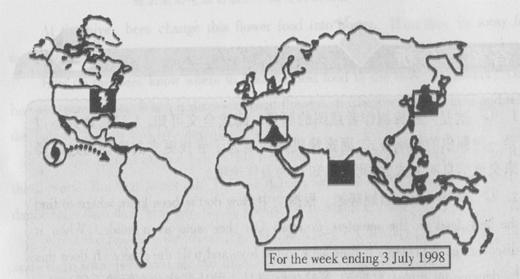
Monsoon Storms
A south-west monsoon has caused havoc in parts of Sri Lanka. Government meteorologists said that unexpected monsoonal winds blew directly across the country from the Southern Hemisphere at about 100km/h, p roducing several rounds of stormy weather. Nearly 250 houses in the capital Colombo were damaged.
Mt. Etna Erupts
Sicily’s Mount Etna volcano erupted shortly after midnight on July 1, shooting “bombs” of lava nearly 1.5 meters in diameter on the eastern side of the mountain. The 30-minute eruption could be seen for several miles, but did not threaten any nearby villages.
Hurricane
Hurricane Blas lost strength as it moved over cooler waters in the Pacific Ocean to the west of Mexico. Blas formed off southwest Mexico during the previous week, but squalls on the outer fringes of the storm lashed western Michoacan State, killing four people when their wood and cardboard home collapsed.
Monkey Repellent
After years of unsuccessful attempts to keep crop-eating monkeys out of Japanese fields, a Tokyo research team believes that it may have finally found a way to prevent the damage caused by the monkeys. Animal raids on crops were successfully prevented by shooting chilli powder into the air, irritating the eyes and noses of monkeys that passed in front of carefully-placed warning sensors. “We’ve tried al kinds of preventive measures, but the monkeys are smart enough t o outwit the tricks, “said Toshiaki Wada, Director of the Tokyo Forestry Experiment Station in western Tokyo.
【小题1】.
. According to the information, which of the following statements is TURE?
A. The eruption of Mt. Etna lasted thirty days.
B. Hurricane Blas was formed off the coast of Italy.
C. The American Midwest had fine weather throughout July 1998.
The eruption of Mt. Etna did not destroy local villages.
【小题2】.
. According to the information, the monkeys in the Japanese fields ________.
| A.destroy crops | B.kill unsuspecting humans |
| C.spread eye diseases to humans | D.stop farmers from working |
| A.predicts future weather patterns |
| B.gives advice on dealing with monsoons |
| C.shows that weather can be unpredictable |
| D.shows the effects that storms have on animals |
It's certain:for twins,life really does imitate art.My twin brother,Kirk,and I grew up being constantly mistaken for each (处理这个问题) other.Classmates,friends,teachers,even relatives couldn't tell us apart. As a result,we were often unfairly punished or rewarded.
Eventually,we learned how to use the Mistaken Identity Syndrome (MIS) to our advantage.For example,we would play tricks on our friends and classmates,pretending to be the other twin.Nor were teachers immune(不受某事物影响) to our tricks.On at least one occasion,when Kirk was sick,I covered for (替代) him by taking his tests.We also tried our little game out on Mom,but she always knew who was who.Once we grew up,we even covered for each other at work.We didn't mean any harm;we simply started this as an experiment to see whether our bosses and co-workers could tell the difference.
As a bank manager, I meet with dozens of clients(顾客) on a daily basis, while my brother manages a staffing service for local employers. As a result, Kirk is constantly approached by people who want to discuss their various money accounts, while I'm frequently thanked on the street as a department store customer service representative.
However, the MIS took a truly embarrassing turn when Kirk and I found ourselves unable to tell each other apart. Once, my brother and I were traveling in a car with several friends. My brother's hair must always be in place. Kirk was driving when he noticed in the rearview mirror (后视镜) that his hair was a bit messy.
He lifted his right hand to brush his hair back into place and was disturbed when his hand didn't appear in the mirror. Several times he repeated this action. Finally, he started laughing.
【小题1】According to the first paragraph, we know that .
| A.few people can tell the author from Kirk |
| B.the author was punished more than Kirk |
| C.the author was always rewarded though he was wrong |
| D.being twins is really a good thing for both twins |
| A.a kind of disease difficult to cure |
| B.the situation of mistaking identities |
| C.the tricks that children like to play |
| D.the way to separate two similar things |
| A.he is often successful |
| B.he means to harm his boss |
| C.his brother is seriously ill |
| D.he often behaves strangely |
| A.He felt embarrassed about his hair. |
| B.His brother's hair was really messy. |
| C.His brother was doing the same thing. |
| D.He became the victim of the MIS. |
湖北省互联网违法和不良信息举报平台 | 网上有害信息举报专区 | 电信诈骗举报专区 | 涉历史虚无主义有害信息举报专区 | 涉企侵权举报专区
违法和不良信息举报电话:027-86699610 举报邮箱:58377363@163.com