China the Great Wall. 查看更多


题目列表(包括答案和解析)

The Great Wall of China is one of Beijing’s biggest

draws for tourists; despite its fame and ubiquity in

postcards across the world, it rarely fails to attract tourists at

the first proper sight.

Yet the authorities open only certain sections of the wall

as fit for viewing, and few get to visit the unauthorized sections.

查看答案和解析>>

The Great Wall of China, one of the greatest wonders of the world, was enlisted in the World Heritage by the UNESCO in 1987. Just like a gigantic dragon, the Great Wall winds up and down across deserts, grasslands and mountains, stretching about 6,700 kilometers from east to west of China. With a history of more than 2,000 years, some parts of the Great Wall are now in ruins or even entirely disappeared. However, it is still one of the most appealing attractions around the world.

No one can tell for sure when the building of the Great Wall was started, but it is popularly believed that it originated as a military fortification(要塞) against intrusion by tribes on the borders during the earlier Zhou Dynasty. Late in the Spring and Autumn Period, some states extended the defence work to prevent the attacks from other states.

It was not until the Qin Dynasty that the separate walls were connected to form a defensive system by Emperor Qin Shi Huang. After the emperor unified the country in 214 BC, he ordered the construction of the wall. It took about ten years to finish and the wall stretched from Gansu Province to Jilin Province. The wall not only served as a defence in the north but also symbolized the power of the emperor.

Further construction also experienced several dynasties. The present Great Wall in Beijing is mainly remains from the Ming Dynasty. Today, the Great Wall has become a must-see for every visitor to China. Few can help saying “Wow” when they stand on top of a beacon tower and look at this giant dragon. It has become a national pride of Chinese people.

The underlined word “appealing” probably means “______”.

A. huge   B. attractive   C. ordinary    D. moving

In the Qin Dynasty, ______.

A. the construction of the Great Wall was finished in 204 BC

B. the emperor wanted to invade other minor states

C. the defensive system of the Great Wall was separated

D. the Great Wall began its way from Jilin Province

According to the passage, the Great Wall _______.

A. is from the west to the east

B. is as long as 6,700 miles

C. was built in several dynasties

D. was begun in the Qin Dynasties

The best title for the passage probably is _______.

A. History of the Great Wall

B. Culture of the Great Wall

C. Construction of the Great Wall

D. Projection of the Great Wall

查看答案和解析>>

The Great Wall of China, one of the greatest wonders of the world, was enlisted in the World Heritage by the UNESCO in 1987. Just like a gigantic dragon, the Great Wall winds up and down across deserts, grasslands and mountains, stretching about 6,700 kilometers from east to west of China. With a history of more than 2,000 years, some parts of the Great Wall are now in ruins or even entirely disappeared. However, it is still one of the most appealing attractions around the world.

No one can tell for sure when the building of the Great Wall was started, but it is popularly believed that it originated as a military fortification(要塞) against intrusion by tribes on the borders during the earlier Zhou Dynasty. Late in the Spring and Autumn Period, some states extended the defence work to prevent the attacks from other states.

It was not until the Qin Dynasty that the separate walls were connected to form a defensive system by Emperor Qin Shi Huang. After the emperor unified the country in 214 BC, he ordered the construction of the wall. It took about ten years to finish and the wall stretched from Gansu Province to Jilin Province. The wall not only served as a defence in the north but also symbolized the power of the emperor.

Further construction also experienced several dynasties. The present Great Wall in Beijing is mainly remains from the Ming Dynasty. Today, the Great Wall has become a must-see for every visitor to China. Few can help saying “Wow” when they stand on top of a beacon tower and look at this giant dragon. It has become a national pride of Chinese people.

The underlined word “appealing” probably means “______”.

A. huge   B. attractive   C. ordinary    D. moving

In the Qin Dynasty, ______.

A. the construction of the Great Wall was finished in 204 BC

B. the emperor wanted to invade other minor states

C. the defensive system of the Great Wall was separated

D. the Great Wall began its way from Jilin Province

According to the passage, the Great Wall _______.

A. is from the west to the east

B. is as long as 6,700 miles

C. was built in several dynasties

D. was begun in the Qin Dynasties

The best title for the passage probably is _______.

A. History of the Great Wall

B. Culture of the Great Wall

C. Construction of the Great Wall

D. Projection of the Great Wall
查看答案和解析>>


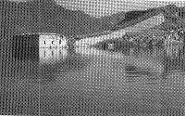
The Great Wall of China is one of Beijing’s biggest draws for tourists; despite its fame and ubiquity in postcards across the world, it rarely fails to attract tourists at the first proper sight.Yet the authorities open only certain sections of the wall as fit for viewing, and few get to visit the unauthorized sections. Fewer still are aware of the existence of at least one part of the Wall that remains in almost original condition, nearly 1,500 years after construction of legendary fortification began. But there’s a good reason for this – it’s underwater.
American journalist Steven Schwankert has been diving since age 10. It was though his setting – up of a diving school that Schwankert came to explore some of lesser – known areas of China’s lakes – and discovered the underwater Wall under a reservoir. “The most fascinating piece of diving I ever did in China must be the Great Wall. I managed to find out about it via the Internet. It wasn’t difficult to get to Pan Jiakou in Hebei Province, near the East Qing Tomb about 4 hour’s drive from Beijing. Why do I want to dive the Great Wall? Why do people want to walk on the Great Wall? It’s the same answer.”
There are, however, advantages of visiting the Great Wall in a diving suit over being on foot. The water acts as a preservative by preventing the kind of mass tourism that has brought trouble on other parts of the Wall. “Unlike the people who walk in the Wall, we as divers never need to actually touch it. I’ve dived twice there, the last time in July. I found that the water then was much deeper than it was before – 13 meters deep.” When he first dived, parts of the Wall were visible above the surface. Now even the guard tower is completely submerged. “It’s better that the Wall is deep under water, as there are lots of boats coming in and out around that area. Their wave action could potentially damage the brickwork. So, the deeper, the better.”
1.Steven Schwankert is most interested in           .
A.collecting photos of the Wall  B.walking along on the Wall
C.diving the underwater Wall     D.visiting some famous lakes
2.What does the underlined word “submerged” in Paragraph 5 most probably mean?
A.Damaged by water.  B.Washed by water.
C.Preserved by water. D.Covered by water.
3.What is the topic discussed in the last paragraph?
A.Advantages of walking on the Great Wall.
B.Advantages of visiting the underwater Wall.
C.The reasons why the Wall is deep under water.
D.The reasons why the underwater Wall is protected.
4.What can we infer from the text?
A.The underwater Wall will sink deeper year by year.
B.Diving the Wall is popular with divers all over the world.
C.Diving is a good way to visit the Wall without causing much damage.
D.More and more tourists will come to visit the underwater Wall in China.

查看答案和解析>>


The Great Wall of China is one of Beijing’s biggest draws for tourists; despite its fame and ubiquity in postcards across the world, it rarely fails to attract tourists at the first proper sight.Yet the authorities open only certain sections of the wall as fit for viewing, and few get to visit the unauthorized sections. Fewer still are aware of the existence of at least one part of the Wall that remains in almost original condition, nearly 1,500 years after construction of legendary fortification began. But there’s a good reason for this – it’s underwater.

American journalist Steven Schwankert has been diving since age 10. It was though his setting – up of a diving school that Schwankert came to explore some of lesser – known areas of China’s lakes – and discovered the underwater Wall under a reservoir.  “The most fascinating piece of diving I ever did in China must be the Great Wall. I managed to find out about it via the Internet. It wasn’t difficult to get to Pan Jiakou in Hebei Province, near the East Qing Tomb about 4 hour’s drive from Beijing. Why do I want to dive the Great Wall? Why do people want to walk on the Great Wall? It’s the same answer.”

There are, however, advantages of visiting the Great Wall in a diving suit over being on foot. The water acts as a preservative by preventing the kind of mass tourism that has brought trouble on other parts of the Wall. “Unlike the people who walk in the Wall, we as divers never need to actually touch it. I’ve dived twice there, the last time in July. I found that the water then was much deeper than it was before – 13 meters deep.” When he first dived, parts of the Wall were visible above the surface. Now even the guard tower is completely submerged. “It’s better that the Wall is deep under water, as there are lots of boats coming in and out around that area. Their wave action could potentially damage the brickwork. So, the deeper, the better.”

1.Steven Schwankert is most interested in           .

         A.collecting photos of the Wall     B.walking along on the Wall

         C.diving the underwater Wall       D.visiting some famous lakes

2.What does the underlined word “submerged” in Paragraph 5 most probably mean?

         A.Damaged by water.  B.Washed by water.

         C.Preserved by water.  D.Covered by water.

3.What is the topic discussed in the last paragraph?

         A.Advantages of walking on the Great Wall.

         B.Advantages of visiting the underwater Wall.

         C.The reasons why the Wall is deep under water.

         D.The reasons why the underwater Wall is protected.

4.What can we infer from the text?

        A.The underwater Wall will sink deeper year by year.

         B.Diving the Wall is popular with divers all over the world.

         C.Diving is a good way to visit the Wall without causing much damage.

         D.More and more tourists will come to visit the underwater Wall in China.


查看答案和解析>>