
题目列表(包括答案和解析)
Rain to come to
 Xinmin Evening Post reports that a much anticipated live concert of
The concert has been planned since two years ago, but has met with various problems. Earlier this year, a Chinese performing company even filed a law suit(诉讼)against the star’s agency companies for failing to lay on the concert last March, citing Rain’s “tight schedule”. The stars South Korean agency then promised to set a clear date for a later
Before the concert, Rain is expected to hold a meeting with his fans in
Transformers to be shown in China
BEIJING, May 12―Paramount’s latest work Transformers will be able to meet its Chinese fans on July 11th, just one week after its premiere in the USA.
The domestic portal, sina. com, reported on Friday that the movie has passed that scrutiny(审查)of the state film bureau, citing a sourse from the Huaxia Film Group, the importer of the movie.
16 bands to tout capital audiences
May 12―16 jazz bands from Beijing, Shanghai and other countries like the United States, Russia and Austria will bring a jazz banquet to Beijing audiences starting from May 25.
The second Beijing Ninegates Jazz Week, which was named after the nine city gates of old
Big names like violinist Didier Lockwood from France, drummer Rony Holan from
51. Why did Rain’s South Korean agency promise to set a clear date for the
A. Because Rain wants to make more money.
B. Because Rain’s schedule is very tight.
C. Because he once failed to lay on a concert as planned.
D. Because he has come across a variety of trouble in his personal life.
52. What does the underlined word “premiere” mean?
A. First being made B. Being planned
C. Being shot D. First being shown
53. What can Li Lei do to celebrate his birthday on May 31st ?
A. Attend Rain’s
B. Enjoy jazz music brought by the 16 bands.
C. Make an interaction with Rain on his meeting with fans in
D. See the movie Transformers in a cinema.
54. Which section of a newspaper would this article probably be from?
A. Economy. B. Politics. C. Entertainment. D. Culture.
阅读理解
Every December millions of Christmas cards go through the post. There are pictures of stars and snow or Christrmas trees. In these days it is hard to think of a Christmas without Christmas cards. Yet little over a hundred and fifty years ago there were none at all. Here is just one story of the way in which they started.
Some boys of those days who were at boarding schools had to write a special piece of English at Christmas time. This was sent to their parents so that they could see how the boy's work had improved during the year.
Young people like to make little drawings on the paper when they write letters or poems. These boys were the same. They used to draw little pictures all round the writing. Sometimes they coloured them, and after a time the pictures became more important than the writing. These were the first Christmas cards.
Then, grown-up people copied the idea. The early Christmas cards, of course, were all made by hand, and there has always been some doubt about who was actually the first person to send one. But some people believe that one of the first artists who designed a Christmas card was John C. Horsley. In 1843, he was asked to design a Christmas card. These cards were printed in black and white and colored by hand. It is said that about 1000 of them were sold in London that year. At about the same time, another English artist, William Egley, designed a card and had it printed. He had one hundred of them sent to his friends with the now familiar greeting “A Merry Christmas and a Happy New Year.”
Soon printing machines began to improve. The new ones were much better than the old ones, and could print much more quickly. Printing became much cheaper, and the printers began to sell Christmas cards. Then the idea of sending Christmas cards suddenly spread.
At first the cards were small and flat. Then folded cards appeared with greetings printed inside. The cards became more and more beautiful. Some were covered with little spots that looks like real snow. Some had stars that shone in the night. Some were printed in gold or silver. Some were made of silk. Hundreds of people started sending cards to each other.
Year by year the idea spread. Year by year more people sent cards to their friends both at home and abroad. The number of cards grew into thousands and then into millions. In Great Britain, for example, the Post Office employs over 150,000 extra workers in December to sort out about 655 million Christmas cards.
Today many countries have accepted the idea. Every year, billions of greeting cards are sent all over the world. Whatever language the greetings are written in, the message is the same--a wish for peace and goodwill among all people.
(1)Christmas cards first appeared about ________.
[ ]
A. centuries ago
B. one and a half centuries ago
C. one hundred and fifteen years ago
D. none of the above
(2)Some boarding school boys ________.
[ ]
A. used to write a special letter to their parents at Christmas
B. enjoyed drawing on the letters to their parents
C. would report their progress in studies to their parents at the end of a year
D. all the above
(3)Which of the following can be inferred from the passage?
[ ]
A. The Christmas cards designed by John C. Horsley became very popular among people in Britain.
B. William Egley was much better than John C. Horsley in designing Christmas Cards.
C. It was not until printing became much cheaper and quicker that many British people began to send Christmas cards.
D. “A Merry Christmas and a Happy New Year”is no longer used today.
(4)The original Christmas cards were invented by ________.
[ ]
A. boarding school students
B. John C. Horsley
C. William Egley
D. unknown
(5)Why do millions of people all around the world send Christmas cards?
[ ]
A. Christmas cards are beautifully designed.
B. Christmas cards are cheap.
C. People want to show goodwill to their friends.
D. Sending Christmas cards had become a fashion.
阅读理解
Every December millions of Christmas cards go through the post. There are pictures of stars and snow or Christrmas trees. In these days it is hard to think of a Christmas without Christmas cards. Yet little over a hundred and fifty years ago there were none at all. Here is just one story of the way in which they started.
Some boys of those days who were at boarding schools had to write a special piece of English at Christmas time. This was sent to their parents so that they could see how the boy's work had improved during the year.
Young people like to make little drawings on the paper when they write letters or poems. These boys were the same. They used to draw little pictures all round the writing. Sometimes they coloured them, and after a time the pictures became more important than the writing. These were the first Christmas cards.
Then, grown-up people copied the idea. The early Christmas cards, of course, were all made by hand, and there has always been some doubt about who was actually the first person to send one. But some people believe that one of the first artists who designed a Christmas card was John C. Horsley. In 1843, he was asked to design a Christmas card. These cards were printed in black and white and colored by hand. It is said that about 1000 of them were sold in London that year. At about the same time, another English artist, William Egley, designed a card and had it printed. He had one hundred of them sent to his friends with the now familiar greeting “A Merry Christmas and a Happy New Year.”
Soon printing machines began to improve. The new ones were much better than the old ones, and could print much more quickly. Printing became much cheaper, and the printers began to sell Christmas cards. Then the idea of sending Christmas cards suddenly spread.
At first the cards were small and flat. Then folded cards appeared with greetings printed inside. The cards became more and more beautiful. Some were covered with little spots that looks like real snow. Some had stars that shone in the night. Some were printed in gold or silver. Some were made of silk. Hundreds of people started sending cards to each other.
Year by year the idea spread. Year by year more people sent cards to their friends both at home and abroad. The number of cards grew into thousands and then into millions. In Great Britain, for example, the Post Office employs over 150,000 extra workers in December to sort out about 655 million Christmas cards.
Today many countries have accepted the idea. Every year, billions of greeting cards are sent all over the world. Whatever language the greetings are written in, the message is the same--a wish for peace and goodwill among all people.
(1)Christmas cards first appeared about ________.
[ ]
A. centuries ago
B. one and a half centuries ago
C. one hundred and fifteen years ago
D. none of the above
(2)Some boarding school boys ________.
[ ]
A. used to write a special letter to their parents at Christmas
B. enjoyed drawing on the letters to their parents
C. would report their progress in studies to their parents at the end of a year
D. all the above
(3)Which of the following can be inferred from the passage?
[ ]
A. The Christmas cards designed by John C. Horsley became very popular among people in Britain.
B. William Egley was much better than John C. Horsley in designing Christmas Cards.
C. It was not until printing became much cheaper and quicker that many British people began to send Christmas cards.
D. “A Merry Christmas and a Happy New Year”is no longer used today.
(4)The original Christmas cards were invented by ________.
[ ]
A. boarding school students
B. John C. Horsley
C. William Egley
D. unknown
(5)Why do millions of people all around the world send Christmas cards?
[ ]
A. Christmas cards are beautifully designed.
B. Christmas cards are cheap.
C. People want to show goodwill to their friends.
D. Sending Christmas cards had become a fashion.
听力
第一节(共5小题;每小题1.5分,满分7.5分)
听下面5段对话。每段对话后有一个小题,从题中所给的A、B、C三个选项中选出最佳选项。听完每段对话后,你都有10秒钟的时间来回答有关小题和阅读下一小题。每段对话仅读一遍。
1.What does the man want to do?
A.To go out with Sally.
B.To see Sally.
C.To talk to Sally.
2.When will the man be free?
A.On Wednesday afternoon.
B.On Tuesday afternoon.
C.On Wednesday morning.
3.Why is the man so eager to post the letters?
A.He has already delayed posting them.
B.He is asked to post them next morning.
C.He will have no time to do them next morning.
4.What can we learn from the conversation?
A.The fire broke out suddenly.
B.Everything was burnt down in the fire.
C.No one died in the fire.
5.Why are they in such a hurry?
A.They are late for school.
B.They want to catch the train.
C.They don’t want to be late for the party.
第二节(共15小题;每小题1.5分,满分22.5分)?
听下面5段对话或独白。每段对话或独白后有几个小题,从题中所给的A、B、C三个选项中选出最佳选项。听每段对话或独白前,你将有时间阅读各个小题,每小题5秒钟;听完后,各小题将给出5秒钟的作答时间。每段对话或独白读两遍。
听第6段材料,回答第6~8题。
6.How long did the woman work in the travel agency?
A.Two weeks.
B.A few months.
C.A year.
7.Why did Joe go to Canada?
A.To find a job.
B.To spend his holidays.
C.To visit his relatives.
8.What can we learn from the conversation?
A.The man is leaving for Canada too.
B.The man has been in touch with Joe ever since Joe left for Canada.
C.Neither of them has seen Joe for a long time.
听第7材料,回答第9~11题。
9.Where was Colin Boyle born?
A.In Dublin.
B.In London.
C.In Paris.
10.Why wasn’t the woman able to get the tickets for the concert?
A.All tickets were sold out.
B.She is too poor to buy a concert ticket.
C.She couldn’t afford the expensive tickets.
11.How will the woman get the tickets?
A.The singer will give the woman the tickets.
B.The woman will get some tickets at the cheaper price.
C.The concert hall manager will let them in free of charge.
听第8段材料,回答第12~14题。
12.How does the man seem to feel after this interview?
A.Nervous.
B.Hopeful.
C.Sad.
13.How many people were NOT chosen for the second interview?
A.4.
B.8.
C.12.
14.What does the man’s girlfriend want?
A.She hopes to find a job near the man.
B.She hopes the man finds a job near her.
C.She hopes the man gets a job far away from her home.
听第9段材料,回答第15~16题。
15.Who will come to the airport to meet the woman?
A.Her daughter.
B.The managing director.
C.The manager.
16.What is the most probable relationship between the two speakers?
A.Boss and secretary.
B.Workmates.
C.Husband and wife.
听第10段材料,回答第17~20题。
17.Why are Martha’s eyes red?
A.She is sick in her eyes.
B.She is sorry to leave her children.
C.She’s been weeping.
18.What do you know about the children?
A.They still love their father.
B.They know nothing about their parents’ problems.
C.They don’t like to talk to their parents any more.
19.How often can Tony and George see their father in future?
A.Every summer.
B.Twice a month.
C.Every day.
20.What are the parents doing now?
A.They’re quarreling before the children.
B.They’re complaining to the children of their problems.
C.They’re telling the sons their future arrangement.
选做题:听取信息(共5小题;每小题1分,满分5分)?
听下面1段对话或独白。请根据题目要求,从所听到的内容中获取必要的信息,填入标号为*21~*25的空格中。录音读两遍。你有80秒钟的作答时间。
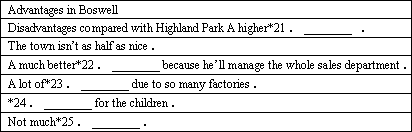
第一部分:听力(共两节,满分30分)
第一节(共5小题;每小题1.5分,满分7.5分)
听下面5段对话。每段对话后有一个小题,从题中所给的A、B、C三个选项中选出最佳选项。听完每段对话后,你都有10秒钟的时间来回答有关小题和阅读下一小题。每段对话仅读一遍。
1.What does the man want to do?
A.To go out with Sally.
B.To see Sally.
C.To talk to Sally.
2.When will the man be free?
A.On Wednesday afternoon.
B.On Tuesday afternoon.
C.On Wednesday morning.
3.Why is the man so eager to post the letters?
A.He has already delayed posting them.
B.He is asked to post them next morning.
C.He will have no time to do them next morning.
4.What can we learn from the conversation?
A.The fire broke out suddenly.
B.Everything was burnt down in the fire.
C.No one died in the fire.
5.Why are they in such a hurry?
A.They are late for school.
B.They want to catch the train.
C.They don't want to be late for the party.
第二节(共15小题;每题1.5分,满分22.5分)
听下面5段对话或独白。每段对话或独白后有几个小题,从题中所给的A,B,C三个选项中选出最佳选项。听每段对话或独白前,你将有时间听下面一段对话,回答第6至8三个小题。阅读各个小题,每小题5秒钟;听完后,每小题将给出5秒钟的作答时间。每段对话或独白读两遍。
听下面一段对话,回答第6至8三个小题。
6.How long did the woman work in the travel agency?
A.Two weeks.
B.A few months.
C.A year.
7.Why did Joe go to Canada?
A.To find a job.
B.To spend his holidays.
C.To visit his relatives.
8.What can we learn from the conversation?
A.The man is leaving for Canada too.
B.The man has been in touch with Joe ever since Joe left for Canada.
C.Neither of them has seen Joe for a long time.
听下面一段对话,回答第9至11三个小题。
9.Where was Colin Boyle born?
A.In Dublin.
B.In London.
C.In Paris.
10.Why wasn't the woman able to get the tickets for the concert?
A.All tickets were sold out.
B.She is too poor to buy a concert ticket.
C.She couldn't afford the expensive tickets.
11.How will the woman get the tickets?
A.The singer will give the woman the tickets.
B.The woman will get some tickets at the cheaper price.
C.The concert hall manager will let them in free of charge.
听下面一段对话,回答第12至14三个小题。
12.How does the man seem to feel after this interview?
A.Nervous.
B.Hopeful.
C.Sad.
13.How many people were NOT chosen for the second interview?
A.4.
B.8.
C.12.
14.What does the man's girlfriend want?
A.She hopes to find a job near the man.
B.She hopes the man finds a job near her.
C.She hopes the man gets a job far away from her home.
听下面一段对话,回答第15至16两个小题。
15.Who will come to the airport to meet the woman?
A.Her daughter.
B.The managing director.
C.The manager.
16.What is the most probable relationship between the two speakers?
A.Boss and secretary.
B.Workmates.
C.Husband and wife.
听下面一段对话,回答第17至20四个小题。
17.Why are Martha's eyes red?
A.She is sick in her eyes.
B.She is sorry to leave her children.
C.She's been weeping.
18.What do you know about the children?
A.They still love their father.
B.They know nothing about their parents'problems.
C.They don't like to talk to their parents any more.
19.How often can Tony and George see their father in future?
A.Every summer.
B.Twice a month.
C.Every day.
20.What are the parents doing now?
A.They're quarreling before the children.
B.They're complaining to the children of their problems.
C.They're telling the sons their future arrangement.
湖北省互联网违法和不良信息举报平台 | 网上有害信息举报专区 | 电信诈骗举报专区 | 涉历史虚无主义有害信息举报专区 | 涉企侵权举报专区
违法和不良信息举报电话:027-86699610 举报邮箱:58377363@163.com