
题目列表(包括答案和解析)
Why People Get Tattoos
Jack lay, quiet and unmoving for thirty minutes while a stranger repeatedly stabbed (刺) him with sharp needles, causing blood to pour steadily out of his leg. Jack was getting a tattoo. His friend Tony had recently gotten a tattoo, and Jack was so impressed by it that he decided to get one too. Peer pressure, media influence, and personal expression are some of the common reasons for wearing tattoos today.
The desire to be accepted by one’s friends or peers can have a great influence on what a person does. Sometimes, wearing a tattoo can be a sign that you belong to a certain group. Gangs often use special clothes and tattoos to identify their particular group. Some of these groups wear only brand – name clothes. Others wear tattoos. When a person’s friends are all doing something, that person is more likely to do the same thing.
The media is another big influence behind the popularity of tattoos in North America. A wide variety of media images(人物,图像) show tattoos-people appearing in commercials selling expensive cars, famous sports heroes with tattoos in magazines, fashion models wearing designer clothes that show their bodies tattooed with detailed and colourful patterns. These media images link tattoos to ideas of wealth, success, and status. As a result, many people decide to get a tattoo for its fashion and status value.
Many people decide to wear tattoos in order to express their artistic nature, their beliefs, or their feelings-in other words, to show their individuality(个性). A musician in a rock band may get a tattoo of a guitar on the arm. Some environmentalists may tattoo pictures of endangered animals on their shoulders. A tattoo can be a public sign to show what is important in a person's life.
As you can see, there are many reasons why young North Americans get tattoos. A tattoo can be part of a group's uniform, a sign of fashion or an expression of individuality. The decision to get a tattoo is most often a result of the influence of friends or media or the desire to express oneself. For Jack, it was a mixture of all three.
72. Jack has got tattoos in order to .
A. show his great bravery B. gain a special experience
C. make himself more healthy D. be different from others
73. According to the passage, media images are linked to .
A. traditional lifestyle B. social position
C. cultural background D. public interest
74. We can infer from the passage that .
A. some people get tattoos out of pressure
B. tattoo is related to religious belief
C. getting tattoos costs a lot of money
D. most people with tattoos are artists
75. Which of the following shows the structure of the passage?
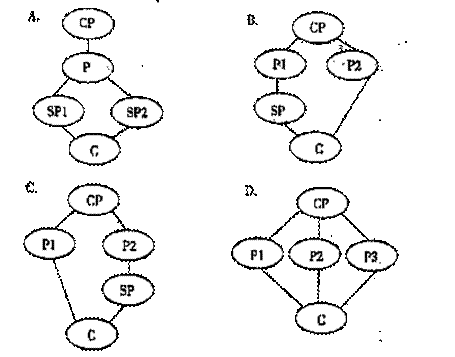
CP: Central Point P: Point Sp: Sub – point (次要点) C: Conclusion
Wilderness
“In wilderness(荒野) is the preservation of the world.” This is a famous saying from a writer regarded as one of the fathers of environmentalism. The frequency with which it is borrowed mirrors a heated debate on environmental protection: whether to place wilderness at the heart of what is to be preserved.
As John Sauven of Greenpeace UK points out, there is a strong appeal in images of the wild, the untouched; more than anything else, they speak of the nature that many people value most dearly. The urge to leave the subject of such images untouched is strong, and the danger exploitation(开发) brings to such landscapes(景观) is real. Some of these wildernesses also perform functions that humans need—the rainforests, for example, store carbon in vast quantities. To Mr.Sauven, these ”ecosystem services” far outweigh the gains from exploitation.
Lee Lane, a visiting fellow at the Hudson Institute, takes the opposing view. He acknowledges that wildernesses do provide useful services, such as water conservation. But that is not, he argues, a reason to avoid all human presence, or indeed commercial and industrial exploitation. There are ever more people on the Earth, and they reasonably and rightfully want to have better lives, rather than merely struggle for survival. While the ways of using resources have improved, there is still a growing need for raw materials, and some wildernesses contain them in abundance. If they can be tapped without reducing the services those wildernesses provide, the argument goes, there is no further reason not to do so. Being untouched is not, in itself, a characteristic worth valuing above all others.
I look forwards to seeing these views taken further, and to their being challenged by the other participants. One challenge that suggests itself to me is that both cases need to take on the question of spiritual value a little more directly. And there is a practical question as to whether wildernesses can be exploited without harm.
This is a topic that calls for not only free expression of feelings, but also the guidance of reason. What position wilderness should enjoy in the preservation of the world obviously deserves much more serious thinking.
【小题1】John Sauven holds that_____.
| A.many people value nature too much |
| B.exploitation of wildernesses is harmful |
| C.wildernesses provide humans with necessities |
| D.the urge to develop the ecosystem services is strong |
| A.The exploitation is necessary for the poor people. |
| B.Wildernesses cannot guarantee better use of raw materials. |
| C.Useful services of wildernesses are not the reason for no exploitation. |
| D.All the characteristics concerning the exploitation should be treated equally. |
| A.Objective. | B.Disapproving. |
| C.Sceptical. | D.Optimistic. |
A. | B. |
C. | D. |
Wilderness
“In wilderness(荒野) is the preservation of the world.” This is a famous saying from a writer regarded as one of the fathers of environmentalism. The frequency with which it is borrowed mirrors a heated debate on environmental protection: whether to place wilderness at the heart of what is to be preserved.
As John Sauven of Greenpeace UK points out, there is a strong appeal in images of the wild, the untouched; more than anything else, they speak of the nature that many people value most dearly. The urge to leave the subject of such images untouched is strong, and the danger exploitation(开发) brings to such landscapes(景观) is real. Some of these wildernesses also perform functions that humans need—the rainforests, for example, store carbon in vast quantities. To Mr.Sauven, these ”ecosystem services” far outweigh the gains from exploitation.
Lee Lane, a visiting fellow at the Hudson Institute, takes the opposing view. He acknowledges that wildernesses do provide useful services, such as water conservation. But that is not, he argues, a reason to avoid all human presence, or indeed commercial and industrial exploitation. There are ever more people on the Earth, and they reasonably and rightfully want to have better lives, rather than merely struggle for survival. While the ways of using resources have improved, there is still a growing need for raw materials, and some wildernesses contain them in abundance. If they can be tapped without reducing the services those wildernesses provide, the argument goes, there is no further reason not to do so. Being untouched is not, in itself, a characteristic worth valuing above all others.
I look forwards to seeing these views taken further, and to their being challenged by the other participants. One challenge that suggests itself to me is that both cases need to take on the question of spiritual value a little more directly. And there is a practical question as to whether wildernesses can be exploited without harm.
This is a topic that calls for not only free expression of feelings, but also the guidance of reason. What position wilderness should enjoy in the preservation of the world obviously deserves much more serious thinking.
【小题1】John Sauven holds that_____.
| A.many people value nature too much |
| B.exploitation of wildernesses is harmful |
| C.wildernesses provide humans with necessities |
| D.the urge to develop the ecosystem services is strong |
| A.The exploitation is necessary for the poor people. |
| B.Wildernesses cannot guarantee better use of raw materials. |
| C.Useful services of wildernesses are not the reason for no exploitation. |
| D.All the characteristics concerning the exploitation should be treated equally. |
| A.Objective. | B.Disapproving. | C.Sceptical. | D.Optimistic. |
A. | B. | C. | D. |
Humankind has tried to improve its standard of living since the very beginning of civilization. Back then, as well as today, providing food and security was the basic task for a person. However, nowadays the range of required goods has expanded significantly. People feel the need for not only some primary things, such as a piece of bread and a roof over their heads, but also for various facilities and luxuries. Providing humanity with these things is connected to the use of natural resources, which requires energy. In turn, the common sources of energy we use today cause pollution, so economic growth is almost inevitably associated with environmental damage.
Economic growth is the increase in numbers of goods and services produced over time by an economy, and it's calculated in terms of real Gross Domestic Product (GDP). Before growth is calculated, inflation(通货膨胀) is adjusted in order to take into account its misleading effect on the price of goods and services. Economic growth can also be explained as the increase in expected output, which results from an increase in actual output, or total demand.
There are certain aspects of economic growth which affect the environment. The first of these is the fact that in order to produce more goods and products, at a faster rate, the construction of large industrial plants is required. These plants produce a lot of waste, leading to the pollution of water and the atmosphere, which may cause negative long- term health effects to nearby populations of animals, or people. They also lead to global warming.
Industrial manufacturing leads to the constantly increasing energy consumption. The traditional energy sources, which are commonly used nowadays, are considered to be the greatest polluters to the environment. There also exist so-called eco-friendly sources of energy. They are sometimes preferred but replacing the traditional sources with them also requires time, during which people have to make some sacrifices to support these undertakings.
In order to produce economically practical energy, a sometimes significant transformation of the natural site is often inevitable. This is expensive and, has harmful effects on the environment. Application of wind energy would Block airflows' natural speed, which is the reason for their decrease in strength, after crossing the windmill. Consequently, the pressure balance that is brought about by this current will be affected, and it is important to remember that the environment and weather conditions are directly affected by atmospheric pressure.
For these reasons, bringing about economic growth without resulting in any environmental damage is impossible.
【小题1】What does the passage mainly talk about?
| A.Pollution caused by plant construction |
| B.Effects of windmills on the environment |
| C.Economic growth and human civilization |
| D.Economic growth and environmental damage |
| A.economic growth should be calculated in terms of GDP |
| B.use of natural resources causes no damage to the environment |
| C.industrial manufacturing may cause damage to the environment |
| D.a windmill is a perfect way to produce economically practical energy |

Why People Get Tattoos
Jack lay, quiet and unmoving for thirty minutes while a stranger repeatedly stabbed (刺) him with sharp needles, causing blood to pour steadily out of his leg. Jack was getting a tattoo. His friend Tony had recently gotten a tattoo, and Jack was so impressed by it that he decided to get one too. Peer pressure, media influence, and personal expression are some of the common reasons for wearing tattoos today.
The desire to be accepted by one’s friends or peers can have a great influence on what a person does. Sometimes, wearing a tattoo can be a sign that you belong to a certain group. Gangs often use special clothes and tattoos to identify their particular group. Some of these groups wear only brand – name clothes. Others wear tattoos. When a person’s friends are all doing something, that person is more likely to do the same thing.
The media is another big influence behind the popularity of tattoos in North America. A wide variety of media images(人物,图像) show tattoos-people appearing in commercials selling expensive cars, famous sports heroes with tattoos in magazines, fashion models wearing designer clothes that show their bodies tattooed with detailed and colourful patterns. These media images link tattoos to ideas of wealth, success, and status. As a result, many people decide to get a tattoo for its fashion and status value.
Many people decide to wear tattoos in order to express their artistic nature, their beliefs, or their feelings-in other words, to show their individuality(个性). A musician in a rock band may get a tattoo of a guitar on the arm. Some environmentalists may tattoo pictures of endangered animals on their shoulders. A tattoo can be a public sign to show what is important in a person's life.
As you can see, there are many reasons why young North Americans get tattoos. A tattoo can be part of a group's uniform, a sign of fashion or an expression of individuality. The decision to get a tattoo is most often a result of the influence of friends or media or the desire to express oneself. For Jack, it was a mixture of all three.
72. Jack has got tattoos in order to .
A. show his great bravery B. gain a special experience
C. make himself more healthy D. be different from others
73. According to the passage, media images are linked to .
A. traditional lifestyle B. social position
C. cultural background D. public interest
74. We can infer from the passage that .
A. some people get tattoos out of pressure
B. tattoo is related to religious belief
C. getting tattoos costs a lot of money
D. most people with tattoos are artists
75. Which of the following shows the structure of the passage?

CP: Central Point P: Point Sp: Sub – point (次要点) C: Conclusion
湖北省互联网违法和不良信息举报平台 | 网上有害信息举报专区 | 电信诈骗举报专区 | 涉历史虚无主义有害信息举报专区 | 涉企侵权举报专区
违法和不良信息举报电话:027-86699610 举报邮箱:58377363@163.com