
题目列表(包括答案和解析)
Each of us must take responsibility for our own a________.
Water, which covers about 74 percent of the earth’s surface, is man’s most precious resource. Without it we cannot live. Clean water keeps us alive; polluted water means disease and death.Keeping our water pure is by no means an easy task but it is something that must be done.
Hong Kong once prided herself on being the “Fragrant Harbour”. However, these days, it is not certain if Hong Kong’s harbour could still be called “fragrant”. For, like many other places, Hong Kong has not been spared water pollution. A visit to Tolo and Victoria Harbour, or any of the beaches in Hong Kong is enough to make one aware of the ugly truth that Hong Kong waters are indeed polluted.
The great threat to our water is bacteria pollution. Another great source of water pollution is poisonous chemicals. These substances, which are found in industrial waste and agricultural pesticides, make up unseen dangers that enter biological food chains.
Pollution control is a continuing problem for the government. It is believed that the most effective form of control is legislation(立法). Most importantly, the present laws on pollution should be given more force. On the other hand, no amount of legislation can effectively control pollution unless those concerned are properly educated about the danger posed by pollution.
While a great majority of Hong Kong citizens and residents seem to be greatly concerned about ways to control water pollution, it is discouraging to note that there are, in our midst, some people who remain apathetic(无动于衷)about the problem. In a recent radio programme conducted on what people in the streets thought about the water pollution problem, one apparently unconcerned person said, “What do I care about water pollution? I don’t drink polluted water. As long as the water I drink is not polluted, I’m not bothered. Water pollution is too big a problem and let’s leave it to the government.”
If all residents in Hong Kong will take such an indifferent attitude, all the government’s attempts to control pollution, let alone the anti-pollution legislation, will prove useless. The best form of pollution control each citizen can employ is to be aware of his surroundings. We hope that someday, the problem of water pollution in Hong Kong will cease to alarm us.
【小题1】By the underlined sentences, the writer wants to show that ______.
| A.we should not use polluted water |
| B.it is our responsibility to keep our water clean and safe |
| C.clean water is vitally important to the survival of human beings |
| D.water is abundant but very expensive |
| A.Hong Kong indeed deserves the name. |
| B.Hong Kong never deserves such a name. |
| C.Hong Kong can’t avoid the damage of pollution. |
| D.Hong Kong has failed to live up to such reputation. |
| A.people’s lack of education |
| B.people’s I-don’t-care attitude |
| C.people’s wait-and-see attitude |
| D.people’s over-dependence on the government |
| A.legislation |
| B.rapid development of modern science |
| C.mass education |
| D.everybody taking care of his own surroundings |
Water, which covers about 74 percent of the earth’s surface, is man’s most precious resource. Without it we cannot live. Clean water keeps us alive; polluted water means disease and death. Keeping our water pure is by no means an easy task but it is something that must be done.
Hong Kong once prided herself on being the “Fragrant Harbour”. However, these days, it is not certain if Hong Kong’s harbour could still be called “fragrant”. For, like many other places, Hong Kong has not been spared water pollution. A visit to Tolo and Victoria Harbour, or any of the beaches in Hong Kong is enough to make one aware of the ugly truth that Hong Kong waters are indeed polluted.
The great threat to our water is bacteria pollution. Another great source of water pollution is poisonous chemicals. These substances, which are found in industrial waste and agricultural pesticides, make up unseen dangers that enter biological food chains.
Pollution control is a continuing problem for the government. It is believed that the most effective form of control is legislation(立法). Most importantly, the present laws on pollution should be given more force. On the other hand, no amount of legislation can effectively control pollution unless those concerned are properly educated about the danger posed by pollution.
While a great majority of Hong Kong citizens and residents seem to be greatly concerned about ways to control water pollution, it is discouraging to note that there are, in our midst, some people who remain apathetic(无动于衷)about the problem. In a recent radio programme conducted on what people in the streets thought about the water pollution problem, one apparently unconcerned person said, “What do I care about water pollution? I don’t drink polluted water. As long as the water I drink is not polluted, I’m not bothered. Water pollution is too big a problem and let’s leave it to the government.”
If all residents in Hong Kong will take such an indifferent attitude, all the government’s attempts to control pollution, let alone the anti-pollution legislation, will prove useless. The best form of pollution control each citizen can employ is to be aware of his surroundings. We hope that someday, the problem of water pollution in Hong Kong will cease to alarm us.
1.By the underlined sentences, the writer wants to show that ______.
A. we should not use polluted water
B. it is our responsibility to keep our water clean and safe
C. clean water is vitally important to the survival of human beings
D. water is abundant but very expensive
2.What can you infer from the second paragraph?
A. Hong Kong indeed deserves the name.
B. Hong Kong never deserves such a name.
C. Hong Kong can’t avoid the damage of pollution.
D. Hong Kong has failed to live up to such reputation.
3.The writer quotes the words in the programme to show us that a block to the solution of the problem is _________.
A. people’s lack of education
B. people’s I-don’t-care attitude
C. people’s wait-and-see attitude
D. people’s over-dependence on the government
4.In the final analysis, the best approach to the problem of water pollution is ________.
A. legislation
B. rapid development of modern science
C. mass education
D.everybody taking care of his own surroundings
Part I Listening Comprehension(30 marks)
Section A(22.5 marks)
Directions:In this section, you'll hear six conversations between two speakers.For each conversation, there are several questions, and each question is followed by three choices marked A, B and C.Listen carefully and then choose the best answer for each question.You will hear each conversation TWICE.
Conversation 1
1.How long does the woman need to work every day?
A.Three hours.
B.Four hours.
C.Five hours.
2.How much can the woman earn each day?
A.5 dollars.
B.10 dollars.
C.20 dollars.
Conversation 1
M:Do you have any work experience?
W:No, I’ve never worked in a restaurant before.
M:Do you think you can get along will with customers?
W:Yes, I think so.
M:Can you make sure to be here from four to eight in the afternoon?
W:Yes, I'm always on time.
M:Then you can start tomorrow.Monday through Friday.Five dollars an hour.
W:That's fine.
Conversation 2
3.What's the possible relationship between the speakers?
A.Boss and employee.
B.Mother and son.
C.Teacher and student.
4.When will the man come back?
A.This Monday.
B.This Wednesday.
C.This Friday.
Conversation 2
M:Mrs.Sharon, I say…, I have to …
W:What's the matter, Richard?
M:Er, I'd like to take two days off.My mother's ill.I need to stay with her.
W:I'm sorry to hear that.You mean you will be back here this Wednesday?
M:Yes, I hope I can come back earlier.
W:That's all right.By the way, don't worry about your lessons.I'll certainly help you with them.
Conversation 3
5.What can we know about Nancy and Steve?
A.They will divorce soon.
B.They have two daughters.
C.They divorced last year.
6.Who will help Nancy out in the woman's opinion?
A.Her daughter.
B.Her parents.
C.Her friends.
Conversation 3
M:Kate, Nancy and Steve are breaking up.
W:It's really a shame.I’ve heard that they quarrel, but they’ve always made up afterward.
M:Things are not working out this time.They are getting a separation soon.
W:What will happen to their daughter, Bonnie?
M:Nancy is going to take her.
W:The cost of living is so high.It will be difficult for her to take te responsibility.
M:She seems to have made up her mind.She said she would rather be a single parent than cope with an unhappy marriage.
W:Well, I hope her parents will be able to help her out.
Conversation 4
7.How often does the woman pay the tax?
A.Once a month.
B.Twice a year.
C.Once a year.
8.Why does the woman have to pay more taxes?
A.The government has raised the tax rate.
B.She didn't pay taxes last year.
C.She has got extra money.
9.What can we know about the woman?
A.She is an accountant.
B.She taught in a night school.
C.She lives upon a small income.
Conversation 4
W:Henry, our income tax is due soon.Did you call our accountant?
M:He's figuring out our taxes right now.I gave him all the records on our income and expenses last week.
W:The government has taken away taxes from our paychecks all year.I hope we get some of that money back or at least that we won't have to pay more.
M:Remember the money your aunt left us when she died, and the money you made when you taught in a night school?
W:Yes.
M:Well, that's all taxable income.That money has put us in a higher tax bracket.
W:What does that mean?
M:It means we have to pay more taxes.
W:Well, it looks like we'll have to make more money this year just to pay last year's taxes.
Conversation 5
10.What can we know about the kid from Haiti?
A.He doesn't get on well at school.
B.He is often late for school.
C.He doesn't speak much English.
11.How many countries are mentioned in the conversation?
A.Six.
B.Five.
C.Four.
12.How does the woman help the immigrant kids?
A.She has spent much time with them after class.
B.She gives them more lessons than other kids.
C.She pays more attention to them at class.
Conversation 5
M:Kate, how's the new student in your class doing?
W:The kid from Haiti? He's having a rough time communicating since he doesn't speak much English.However, the other kids seem to involve him pretty well.
M:Our students are used to new kids who don't speak much English since we have had so many new immigrant families moving into our school district.
W:Don't I know it! This year I have had a Vietnamese, an Ethiopian, a Cuban and the kid from Haiti in my class.I spend a lot of time with them after class so that they can catch up.
M:It must have been hard for you since you have to give them special attention in order to help them.
W:It has been.Nevertheless, it's really rewarding to see them progress and make friends.
Conversation 6
13.When will the speakers have the exams?
A.In one week.
B.In two weeks.
C.In three weeks.
14.What will the woman do this summer?
A.Teach English.
B.Find a job.
C.Study Chinese.
15.How did the man learn Chinese?
A.By speaking.
B.By reading.
C.By listening.
Conversation 6
M:Well, Jenny.The school year is almost over.We just have two weeks before exams.What are you going to do this summer?
W:I'm going to teach English to some immigrants in the university's community service program.
M:That sounds interesting.Don't you need to speak a foreign language for the job?
W:No.You just have to present the language simply and give the students a chance to practice speaking.
M:But that's the way I was taught to speak Chinese.But speaking Chinese didn't help me learn to read and write Chinese.
W:My students don't want to read and write English.They are more interested in speaking.
M:You sound very knowledgeable about all this.How do you know so much?
W:I took teaching English as a second language course last year when you were in China.I’ve also talked with the program administrators quite a lot.I think I would like to be an ESL teacher when I graduate.
SECTION B
Directions:In this section, you'll hear a mini-talk.Listen carefully and then fill in numbered blanks with the information you’ve got.Fill each blank with NO MORE THAN 3 WORDS.
You'll hear the mini-talk TWICE.
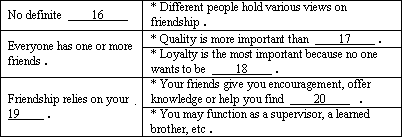
About friendship
Section B
We often say, “A friend in need is a friend indeed.” But what is the exact meaning of friendship? No one can really offer a definite concept, because different people hold various views on friendship.
Everyone has his own friendship and some have a lot of friends.But in fact, quantity is not so important as quality.Loyalty is the most important for friendship.No one wants to make friends with those who will betray them.
No matter whether you are married or not, no matter where you live and work, your friends are your friends.It is not based on bloodline.It relies on your intention.To you, some friends are fun-loving, some give encouragement, some offer knowledge, and others help you to find your own identity.Before your friends, you may act as a supervisor, a learned brother, a lovely child, a gentleman or a playmate.In a word, friendship helps you to be a full person.So friendship can benefit.
Keys:
湖北省互联网违法和不良信息举报平台 | 网上有害信息举报专区 | 电信诈骗举报专区 | 涉历史虚无主义有害信息举报专区 | 涉企侵权举报专区
违法和不良信息举报电话:027-86699610 举报邮箱:58377363@163.com