
题目列表(包括答案和解析)
Tom是一个五岁男孩, 你的邻居。下列图画描述了他的一段经历, 请据此为中学生英文报的故事专栏写一篇短文。
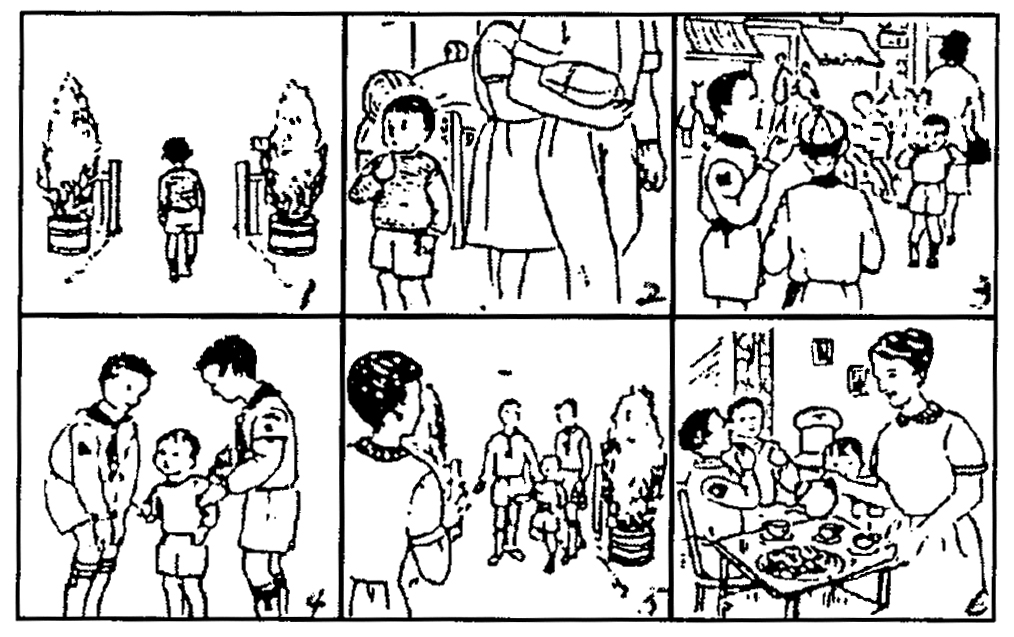
注意:1. 短文必须包括图画所表示的主要内容, 可以适当增减细节, 使其连贯、完整。
2. 词数100左右。
Mr Jackson lived in the center of London but he had a hotel near the airport. There a lot of foreigners stayed for night. He didn't know any other language but English and he found it difficult for him to understand the foreign visitors. Sometimes he had to use the gesture to talk with them, and tried his best to make himself understood. But he was often misunderstood(误解)and it brought him a lot of trouble. A friend of his who taught a few foreign languages in a university would teach him. He was happy and studied hard. At first he learned some, but soon he found it wasn't very easy to remember the words and expressions. His friend advised him to write down the useful expressions in his notebook so that he could use them when necessary. He did as he was told. He found it helpful for him to do so.
One evening there were plenty of people in the dining-room. They were all busy eating something except a Japanese. He was wandering(徘徊)there and waiting for his wife who was dressing herself up upstairs. Mr Jackson thought to himself, “The man wants to eat something but he doesn't know any English. Let me help him.”
As he knew only a little Japanese, he had to bring out his notebook and showed it to the man, pointing to the sentence “I'm hungry.”
The Japanese had a look at it and gave him two pounds and left.
(1) Mr Jackson knew only English because _______.
[ ]
A.he was an English student
B.he had never been abroad
C.he couldn't learn by himself
D.he hadn't studied any foreign languages
(2) Mr Jackson had to use the gesture because _______.
[ ]
A.he wanted the foreign visitors to understand him
B.he wanted to learn the foreign languages from the visitors
C.he hoped to know the foreign visitors' custom
D.he hoped more foreign visitors would stay for night in his hotel
(3) As not all foreign visitors understand his gesture, sometimes Mr Jackson __________ to communicate with them.
[ ]
(4) ______, so he decided to help the man.
[ ]
A.Mr Jackson thought the Japanese wanted to stay for night
B.Mr Jackson thought the Japanese was not hungry
C.Mr Jackson knew the Japanese was waiting for his wife
D.Mr Jackson was sure the Japanese couldn't speak English
(5) The Japanese thought _______, so he gave him two pounds.
[ ]
A.Mr Jackson was a beggar
B.Mr Jackson was a translator
C.Mr Jackson could help him
D.Mr Jackson could ring his wife up
写作
短文改错
此题要求改正所给短文中错误。对标有题号的每一行作出判断:如无错误,在该行右边横线上画一个勾(√);如有错误(每行只有一个错误),则按下列情况改正:
该行多一个词:把多余的词用斜线(\)划掉,在该行右边的横线上写出该词,并也用斜线划掉。
该行缺一词:在缺词处加一个漏字符号(∧),在该行右边的横线上写出该加的词。
该行错一词:在错的词下划一横线,在该行右边横线上写出改正后的词。
注意:原行没有错的不要改
阅读下面短文, 掌握其大意, 然后从1 ̄25各题所给的四个选项中, 选出一 个最佳答案。
The Great Wall of China is called the "Ten-Thousand-li Great Wall" 1. In fact, it's more than 6,000 kilometers long. It winds 2 way from west to east, across deserts, over mountains, 3 valleys till at last it reaches the sea. It is one of the wonders of the world.
The Great Wall has a 4 of over 2000 years. Parts of it 5 built through different dynasties. It was during the Qing Dynasty 6 the parts were joined up into one long wall.
The Great Wall is wide enough at the top 7 five horses or ten men to walk 8 . Along the wall are watchtowers, 9 soldiers used to keep watch 10 were lit on the towers as a warning when the enemy came.
It was difficult to build 11 wall in the ancient days without any modern machines. All the work 12 by hand. Thousands of men died of 13 when they were forced to work 14 the wall.
Today the Great Wall has become a place of 15 to the Chinese people and people from all over the world.
1. A. in China B. in Chinese C. of China D. in the Chinese
[ ]
2. A. it's B. it C. their D. its
[ ]
3. A. in B. over C. through D. from
[ ]
4. A. history B. historical C. historic D. histories
[ ]
5. A. were B. was C. is D. are
[ ]
6. A. which B. that C. where D. when
[ ]
7. A. to B. for C. from D. with
[ ]
8. A. side by side B. little by little C. from side to side D. step by step
[ ]
9. A. who B. in which C. where D. there
[ ]
10. A. Fire B. A fire C. Fires D. The fire
[ ]
11. A. such a B. such C. so D. so a
[ ]
12. A. were done B. was done C. was worked D. were worked
[ ]
13. A. cold and hungry B. cold and hunger
C. coldness and hunger D. cold and hungrily
[ ]
14. A. over B. on C. in D. for
[ ]
15. A. interests B. the interest C. interest D. the interests
[ ]
Nancy Clark paced(漫步) back and forth in the hall of the theatre. 16 the theatre her new play Laugh Minute was about to begin.
Nancy was 17 to watch it herself. This was the opening night for the play. She said 18" If tonight's audience(观众) thought the play was 19, it would probably become a success. But if they 20 it the play would soon close."
Nancy 21 hard, she was hoping to hear the audience 22 loudly and often. But she heard 23 laughter during the first act(幕).
When the first act 24, about one fourth of the audience left the theatre.
As Nancy watched the people leave, she knew that the future of the play 25.
16. A. Outside B. Inside C. Within D. Out
[ ]
17.A. too pleased B. too sad
C. too nervous D. too frightened
[ ]
18. A. yourself B. myself C. himself D. herself
[ ]
19. A. funny B. stupid C. clever D. foolish
[ ]
20. A. liked B. didn't like C. like D. don't like
[ ]
21. A. noticed B. listened C. heard D. watched
[ ]
22. A. crying B. shouting C. talking D. laughing
[ ]
23. A. few B. a lot of C. very little D. many
[ ]
24. A. ended B. started C. went by D. left
[ ]
25 A. will be decided B. had been decided
C. have been decided D. was decided
[ ]
Mr Jackson lived in the center of London but he had a hotel near the airport. There a lot of foreigners stayed for night. He didn't know any other language but English and he found it difficult for him to understand the foreign visitors. Sometimes he had to use the gesture to talk with them, and tried his best to make himself understood. But he was often misunderstood(误解)and it brought him a lot of trouble. A friend of his who taught a few foreign languages in a university would teach him. He was happy and studied hard. At first he learned some, but soon he found it wasn't very easy to remember the words and expressions. His friend advised him to write down the useful expressions in his notebook so that he could use them when necessary. He did as he was told. He found it helpful for him to do so.
One evening there were plenty of people in the dining-room. They were all busy eating something except a Japanese. He was wandering(徘徊)there and waiting for his wife who was dressing herself up upstairs. Mr Jackson thought to himself, “The man wants to eat something but he doesn't know any English. Let me help him.”
As he knew only a little Japanese, he had to bring out his notebook and showed it to the man, pointing to the sentence “I'm hungry.”
The Japanese had a look at it and gave him two pounds and left.
(1) Mr Jackson knew only English because _______.
[ ]
A.he was an English student
B.he had never been abroad
C.he couldn't learn by himself
D.he hadn't studied any foreign languages
(2) Mr Jackson had to use the gesture because _______.
[ ]
A.he wanted the foreign visitors to understand him
B.he wanted to learn the foreign languages from the visitors
C.he hoped to know the foreign visitors' custom
D.he hoped more foreign visitors would stay for night in his hotel
(3) As not all foreign visitors understand his gesture, sometimes Mr Jackson __________ to communicate with them.
[ ]
(4) ______, so he decided to help the man.
[ ]
A.Mr Jackson thought the Japanese wanted to stay for night
B.Mr Jackson thought the Japanese was not hungry
C.Mr Jackson knew the Japanese was waiting for his wife
D.Mr Jackson was sure the Japanese couldn't speak English
(5) The Japanese thought _______, so he gave him two pounds.
[ ]
A.Mr Jackson was a beggar
B.Mr Jackson was a translator
C.Mr Jackson could help him
D.Mr Jackson could ring his wife up
湖北省互联网违法和不良信息举报平台 | 网上有害信息举报专区 | 电信诈骗举报专区 | 涉历史虚无主义有害信息举报专区 | 涉企侵权举报专区
违法和不良信息举报电话:027-86699610 举报邮箱:58377363@163.com